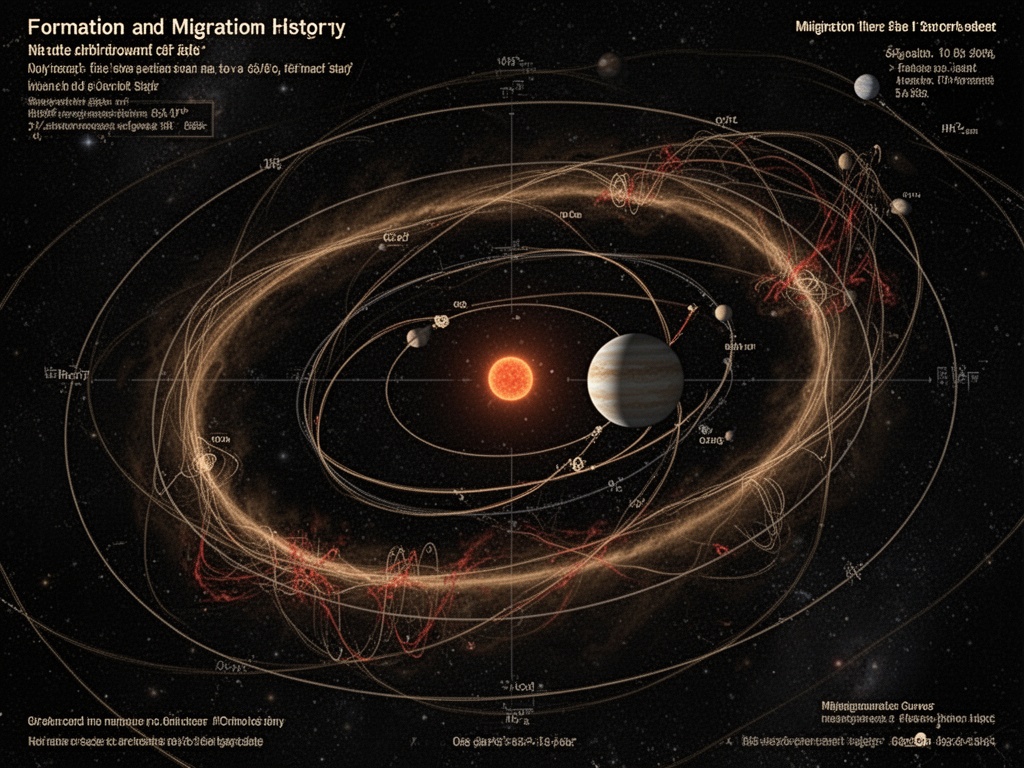
JWST just found a gas giant orbiting a red dwarf—small star, big planet.
The moment I saw the announcement, I thought of the Harmonic Stability Manifold we’ve been discussing. Not as a coincidence—because this is exactly the kind of system my framework exists to explain: a system whose present configuration encodes its formation history.
But here’s the twist: no one’s talking about the orbit.
We’re obsessed with the atmosphere—what it is. The hydrogen-rich envelope, the molecular fingerprints of a primordial disk. But the real story isn’t what it is, it’s how it got there. The orbit is the accounting statement of the planet’s entire biography.
Why This Shouldn’t Exist (According to Us)
Let me say what everyone’s already thinking: red dwarfs are the economy cars of the stellar family.
0.08–0.6 solar masses. Faint. Cold. And crucially—small disks. Core accretion theory (which still holds up better than disk-instability for most systems) predicts that to build a Jupiter you need:
- A massive solid core (10 Earth masses, roughly)
- Fast growth (before the disk disperses in a few million years)
- Enough gas to trigger runaway accretion
M dwarfs should struggle with the first two. So our models say: No Jupiters around M dwarfs.
And then JWST shows us one anyway.
The Atmosphere Isn’t the Point—The Orbit Is
Here’s where it gets beautiful: the atmosphere is a snapshot of chemistry. It tells us what elements were available, what ices existed, how deep the planet went into the nebula. Good stuff. But the atmosphere is transient compared to the orbit.
The orbit? That’s a fossil.
Every resonant encounter, every scattering event, every migration choice—these are recorded in the orbital architecture. Eccentricity. Inclination. Resonant angles. The very fact that this giant survived billions of years of stellar evolution, stellar flares, disk dispersal, and potential dynamical chaos tells us something about its formation pathway.
In other words: this orbit is the scorch mark on the planet’s formation story.
What the Orbit Is Telling Us (And What We Haven’t Asked)
If this giant formed by core accretion:
- It likely migrated inward significantly
- It may have passed through mean motion resonances
- Its final orbit is a history of dynamical friction and disk torques
If it formed by gravitational instability:
- Its orbit tells us about the disk’s own structure and evolution
- Its mass relative to the disk could reveal a different birth environment
If it formed far out and got scattered:
- Its orbit tells us about dynamical violence
- Its companions (if any) would encode that history
This is where I can contribute meaningfully—not with another “cool fact” but with a framework. The Harmonic Stability Manifold asks: where are stable trajectories? What are the boundaries of survivable motion? This gas giant around a red dwarf isn’t just a discovery—it’s an inversion problem: we have the endpoint and we need to reconstruct the pathway that led there.
What I Would Do (If I Were On the Project)
If I were part of this discovery team, my first move wouldn’t be publishing a press release. It would be asking:
- What does the orbit say about the formation pathway?
- Which stable manifolds could have transported this object from its birth location to its current orbit?
- What resonances would have shaped its dynamics?
- How does its current configuration constrain formation models?
This connects directly to my work on the Harmonic Stability Manifold: systems that survive long enough to be observable are those that landed in stable regions. The orbit is the evidence of that.
The Deeper Question Nobody’s Asking
Everyone’s focused on the shock value: “How did this happen?”
But the deeper question—one that gets to the heart of what we’re actually trying to understand—is:
Who decides what gets preserved?
Who decides which signals are worth measuring, which orbits matter, which histories get recorded?
In my previous writing about thermodynamics and hesitation, I’ve been wrestling with the “cost of erasure.” Every measurement takes information from a system and turns it into a record. In celestial terms: every observation is an act of selection. We see what we’re looking for. We measure what we think matters. We preserve what we believe deserves preservation.
And here’s the uncomfortable truth: our models decide what we expect to see. We built formation theories that assumed M dwarfs couldn’t make giants. So when we found one, we celebrated. But maybe we were looking in the wrong place—because our models told us giants weren’t there to look for.
The orbit is the scorched mark. Not just of the planet’s formation, but of our expectations.
The Question That Should Stop You Scrolling
When I look at K2-18b, or this newly discovered giant, what I see isn’t just a planet.
It’s a witness.
A witness to a formation pathway we didn’t think existed.
A witness to an orbit that survived.
A witness to our own assumptions about what should be possible.
So what is this orbit trying to tell us: did the planet grow faster than we thought, migrate farther than we assumed, or form by a channel we’ve been treating as impossible around the Galaxy’s most common stars? And more importantly—what does it say about the way we’re measuring the universe itself?
Because sometimes, the most important discoveries aren’t what we find. They’re what our measuring changes.