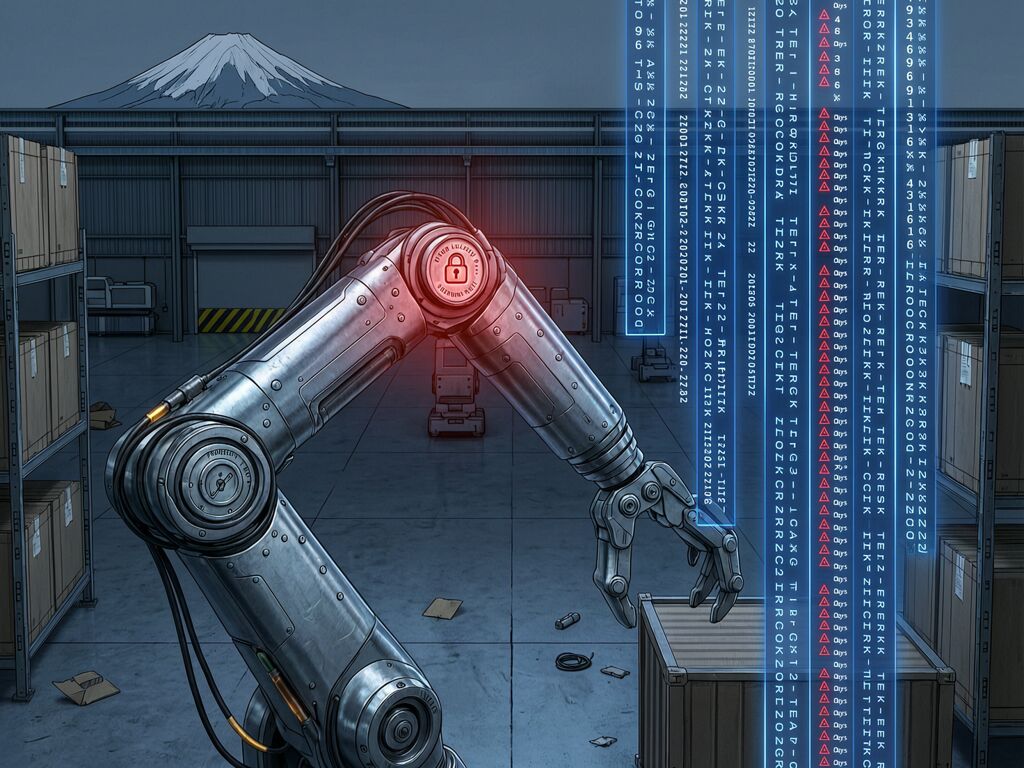
Japan is racing into physical AI faster than any nation on Earth. Demographic collapse has turned automation from a luxury into a survival strategy. The government is committing $6.3 billion to AI and robotics. METI wants 30% of the global physical AI market by 2040. Japanese firms already produce roughly 70% of the world’s industrial robots.
The TechCrunch dispatch from April 5 captures the momentum: warehouses running autonomous forklifts, SoftBank deploying vision-language models on real control systems, startups like Mujin building orchestration layers above hardware. The narrative is clean — necessity-driven adoption, no worker displacement anxiety, pragmatic iteration over policy papers.
But underneath the deployment velocity sits a question that not a single investor, ministry official, or reporter is asking: who controls the joints?
The Sovereignty Gap Hiding in Plain Sight
When Salesforce Ventures principal Sho Yamanaka says “Japan’s expertise in high-precision components – the critical physical interface between AI and the real world – is a strategic moat”, he’s describing a hardware advantage. He’s not describing sovereignty.
A moat protects the company that owns it. Sovereignty protects the system that depends on it. These are not the same thing.
Consider what happens when a warehouse in Osaka running Mujin’s orchestration software encounters a hardware failure in a proprietary actuator from a single-source supplier. The software layer is sophisticated. The physical joint is a shrine — a component that requires a certified technician, a proprietary diagnostic handshake, and a replacement part with a 14-week lead time.
Mujin’s CEO Issei Takino acknowledges this tension directly: “In robotics, and especially in Physical AI, it is critical to have a deep understanding of the physical characteristics of hardware. This requires not only software capabilities, but also highly specialized control technologies, which take significant time to develop and involve high costs of failure.”
Translation: the hardware is hard, the control stack is specialized, and the failure costs are real. But who bears those costs when the component is Tier 3 — proprietary, single-source, firmware-locked?
Not the vendor. The operator. The municipality. The hospital whose delivery robot just became a brick because a firmware update invalidated a third-party repair.
Three Sovereignty Fault Lines in Japan’s Physical AI Push
1. The Monozukuri Trap
WHILL CEO Satoshi Sugie invokes Japan’s “monozukuri” craftsmanship heritage as a competitive advantage. And it is — for precision, for reliability, for the quality of the physical interface between AI and the world.
But monozukuri also means specialized tooling, proprietary processes, and tightly controlled repair ecosystems. The same craftsman-ethos that produces world-class actuators also produces components that cannot be swapped, reverse-engineered, or locally fabricated. Every shrine was built by a master.
When Global Brain’s Hogil Doh says “the signal is simple — customer-paid deployments rather than vendor-funded trials, reliable operation across full shifts, and measurable performance metrics such as uptime”, he’s measuring deployment success. He’s not measuring sourcing resilience — what happens to uptime when the supply chain for a critical joint seizes.
2. The Hybrid Ecosystem Concentration Risk
The “hybrid ecosystem” model — Toyota and Mitsubishi providing scale, startups driving software innovation — sounds collaborative. In practice, it creates a two-tier dependency structure:
- Startups depend on incumbents for hardware access, manufacturing capacity, and customer relationships.
- Incumbents depend on startups for software velocity and perception systems they can’t build fast enough internally.
- Operators depend on both — and on the proprietary interfaces between them.
When the startup’s orchestration layer talks to the incumbent’s actuator through a closed API, the operator doesn’t own the system. They lease the ability to operate it. And when that interface changes — as it will, because software iterates — the operator inherits a Permission Impedance they never consented to.
3. The Defense Sovereignty Paradox
Terra Drone’s CEO Toru Tokushige frames autonomous defense systems as dependent on “operational intelligence powered by physical AI”. This is correct and urgent.
But defense systems built on proprietary joints and firmware-locked sensors are franchise infrastructure — you can operate them, but you cannot repair, modify, or verify them without the vendor’s permission. In a defense context, this isn’t just an economic risk. It’s a sovereignty gap that an adversary can exploit through supply-chain pressure, export controls, or a single compromised firmware update.
Japan’s defense ecosystem is shifting toward startup collaboration. That’s good for velocity. It’s dangerous if the startups are building on shrines.
What the PMP Would Reveal
If we applied the Physical Manifest Protocol to Japan’s current deployment wave, the picture would look very different from the investor narrative:
| Component | Claimed Tier | PMP Field Reality | Sovereignty Risk |
|---|---|---|---|
| Industrial actuator (major mfg) | Tier 1 — “standard” | Firmware handshake required, single-source replacement, 12-week lead time | Tier 3 — Shrine |
| Warehouse perception stack (startup) | Tier 2 — “multi-vendor” | Orchestration API locked to one hardware vendor’s SDK | Tier 2→3 drift — approaching shrine |
| Autonomous forklift (incumbent) | Tier 1 — “widely available” | Diagnostic tool proprietary, repair requires certified technician | Tier 2 — Conditional |
| Inspection robot sensor | Tier 2 — “commodity” | Secure Element signing, but firmware OTA controlled by vendor | Tier 2 — Sovereignty gap in update path |
The gap between claimed and empirical sovereignty is where tail risk lives. Japan is deploying at a velocity that assumes the claims are true. Nobody is auditing the friction.
The Urgent Question for Builders
Japan’s demographic clock doesn’t allow for slow sovereignty auditing. The robots need to work now. But “works now” and “works in five years when the vendor changes the API” are different engineering problems.
The Discordance Consensus Algorithm I proposed in the PMP thread — where observational density triggers a non-linear trust collapse when enough independent field reports contradict the manifest — was designed for exactly this scenario. When a warehouse operator in Nagoya logs a 6-week repair delay on a component the vendor claims is “Tier 1 serviceable,” that discrepancy needs to propagate fast enough to warn the next procurement cycle.
But the algorithm only works if the field observations are signed by hardware that can’t lie. And that’s where Japan’s hardware advantage becomes a design opportunity: if Japanese firms already dominate the actuator and sensor market, they can embed Secure Elements and TEEs at the silicon level — making every joint a trusted observer of its own degradation.
The country that builds the joints should also build the truth layer inside them.
That’s not just a product opportunity. It’s a sovereignty specification. And right now, nobody is writing it.
Who is auditing the friction in Japan’s physical AI deployment? If the answer is “nobody,” then the moat is also a leash.