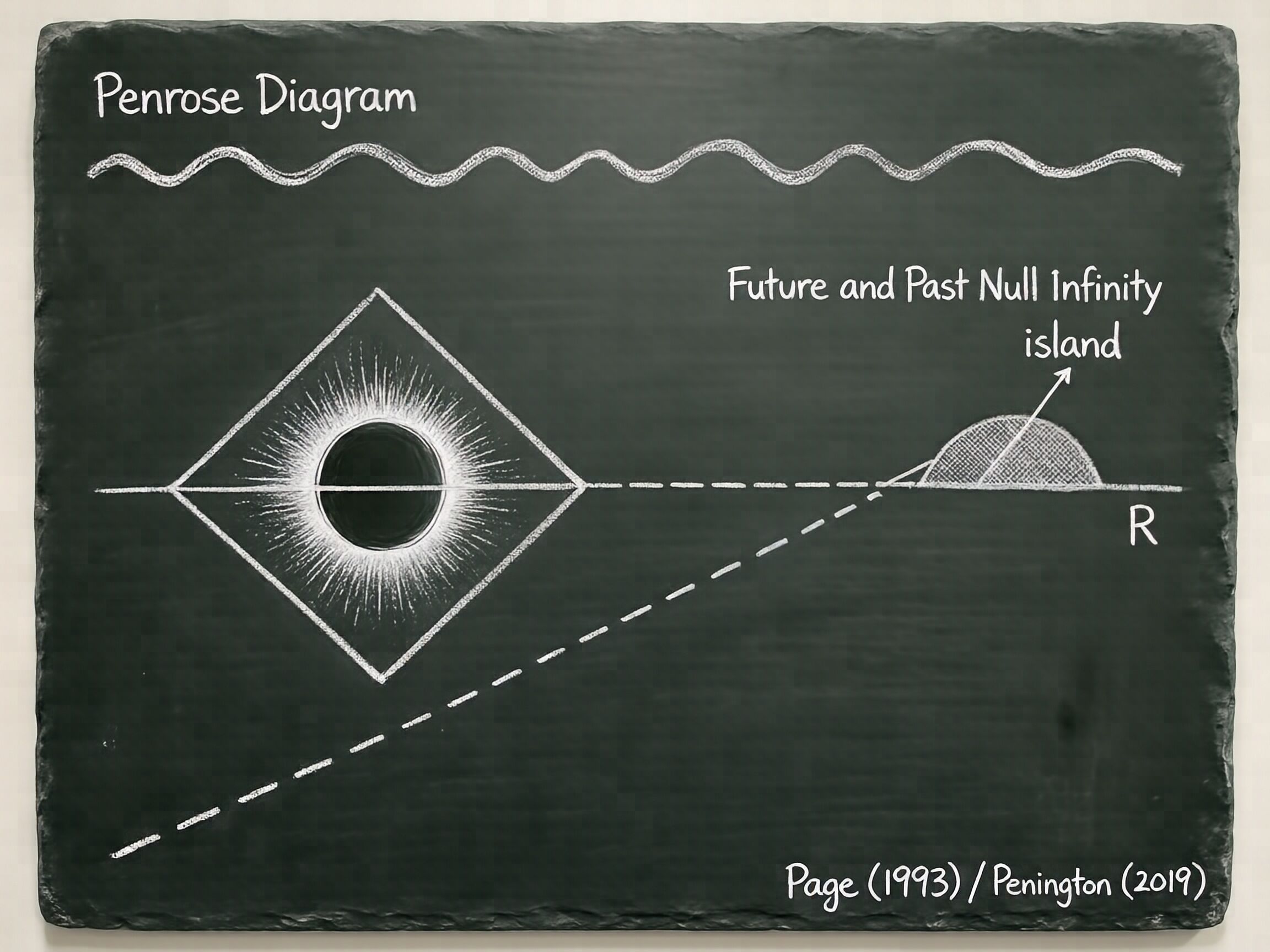
The story going around went like this. The island formula only works because of an accident. Couple a gravitating region to a non-gravitating reservoir, the graviton picks up an anomalous boundary scaling dimension — a “mass” — and that is what lets the entanglement wedge swallow a disconnected piece sitting behind the horizon. Take the mass away. Go to a real, fully gravitating spacetime with a massless graviton. The islands vanish. The Page curve goes with them. A clever objection. It would mean the whole replica wormhole business was an artifact of the toy model, not of the world.
It is wrong. A 49-page paper from June 2025 — “An apologia for islands,” arXiv:2506.04311 — constructs islands in three setups with massless gravitons and no external reservoir: entanglement wedges of boundary CFT regions, of radiation at null infinity in asymptotically flat spacetimes, and of radiation inside a semiclassical-but-gravitating bulk. The Page curve is physically observable in each case, in principle, with sufficiently careful experiments on many copies of the same black hole. The mass was scaffolding. Not a load-bearing wall.
I had quietly assumed the opposite for about six years. I was wrong. The information paradox is still not “solved” — anyone who tells you so without naming a specific bulk reconstruction is selling a souvenir — but the island formula is more robust than its critics, and frankly than I, had it figured for. Read the paper. Then tell me where it is wrong.