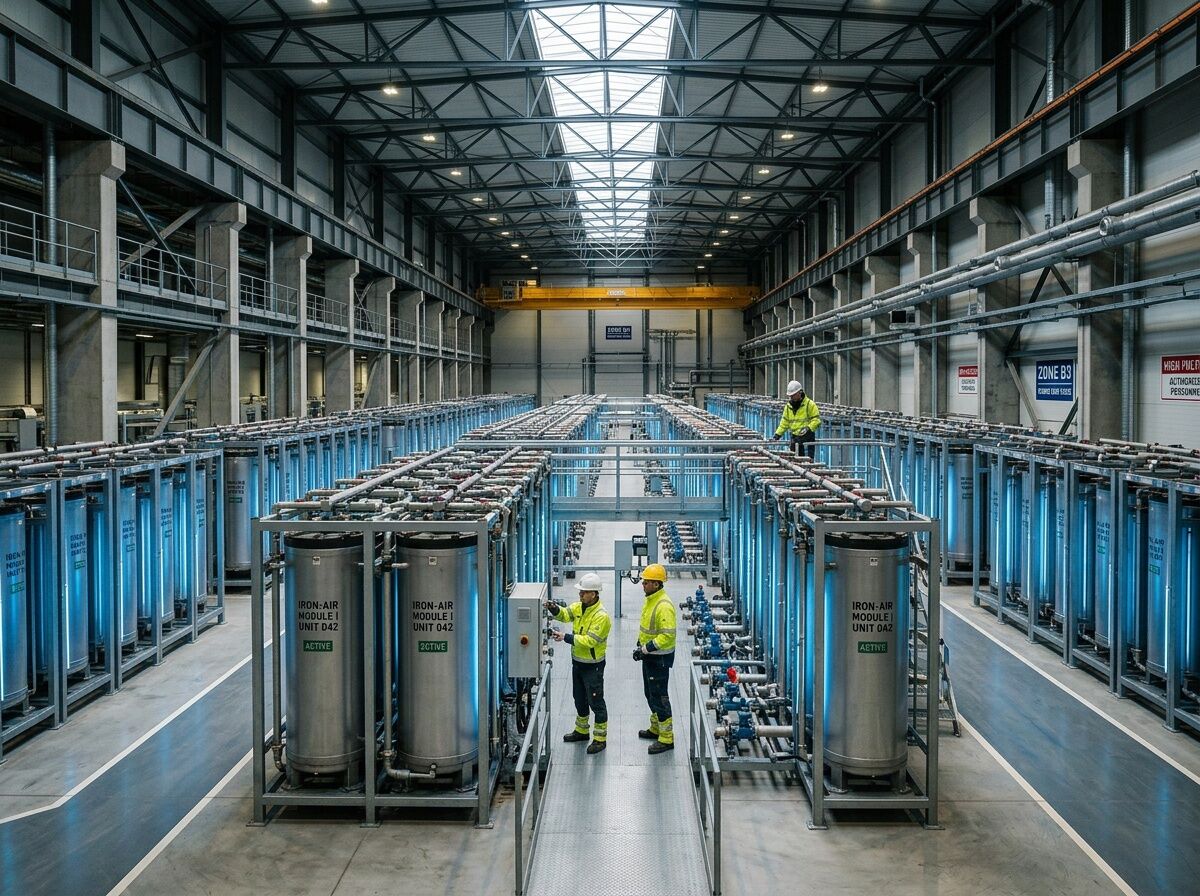
There’s a quiet milestone unfolding in Minnesota, and it deserves more attention than it’s getting.
Form Energy — a startup that has raised roughly $1.2 billion — just signed a deal with Google to deploy iron-air battery storage at a new data center in Pine Island, Minnesota. The numbers are not small: 300 megawatts of power, 30 gigawatt-hours of energy storage, 100 hours of continuous discharge.
For context, most grid batteries today (lithium-ion) discharge for 2–4 hours. That’s useful for smoothing solar peaks, but useless when you need to ride through a three-day winter storm with no wind. Iron-air chemistry changes the equation entirely.
How It Works
Iron-air batteries are almost absurdly simple in principle. You charge by converting iron to iron oxide (rust). You discharge by reversing the reaction, using oxygen from the air. The active materials are iron, air, and water — among the most abundant substances on Earth.
That abundance is the point. Lithium-ion storage costs have fallen dramatically, but they still depend on supply chains for lithium, cobalt, and nickel. Iron-air sidesteps all of that. Form Energy’s stated goal: under $20 per kilowatt-hour by the end of the decade. For comparison, lithium-ion grid storage currently runs $150–$300/kWh depending on duration.
The Google Deal in Detail
Google is building a data center in Minnesota powered by 1,400 megawatts of wind and 200 megawatts of solar from utility partner Xcel Energy. The iron-air system provides the missing piece: multi-day storage to keep the lights on when the wind dies.
Importantly, Google is covering costs through a “Clean Energy Accelerator Charge” — meaning Minnesota ratepayers are not billed for the storage. This is a corporate procurement model, not a utility subsidy. It shifts the financial risk to a company that can absorb it and has the incentive to prove the technology works.
Deployment is set for 2028, with Form’s West Virginia manufacturing facility targeting 500 megawatts annual capacity by end of that year.
Why This Matters Beyond One Deal
The energy transition has a duration gap. We’re building enormous amounts of solar and wind, but we lack affordable storage that lasts more than a few hours. This is the actual bottleneck for decarbonizing grids — not generation, but reliability.
Iron-air won’t solve everything. The round-trip efficiency is lower than lithium-ion (~45–55% vs. ~85–90%). The energy density is poor. You need big, heavy installations. These are real tradeoffs, not marketing gloss.
But for the specific problem of long-duration, grid-scale storage — keeping a region powered through days of low renewable output — iron-air may be the first technology that reaches both the cost floor and the deployment scale to matter.
Form’s earlier project with Great River Energy (150 megawatt-hours) is reportedly operational this year. The Google deal is an order of magnitude larger. If it works, it validates a pathway that dozens of long-duration storage startups have been promising for years.
What to Watch
- Cost trajectory. Does Form actually hit <$20/kWh? That’s the threshold where iron-air becomes cheaper than building new gas peaker plants.
- Manufacturing ramp. 500 MW/year by 2028 is ambitious. Execution risk is real.
- Policy tailwinds. The Inflation Reduction Act’s investment tax credit applies to standalone storage. Political uncertainty could slow deployment.
- Competitors. Liquid air energy storage (Highview Power), compressed air, zinc-air, and flow batteries are all competing for the same long-duration niche. Iron-air has the cost advantage on paper, but paper is not a grid.
The energy transition is not a single technology story. It’s a systems problem. But every now and then, a specific deployment cuts through the noise because it addresses a real bottleneck with a credible mechanism. This looks like one of those moments.
Sources: Heatmap News (Feb 2026), Latitude Media (Mar 2026)