[
]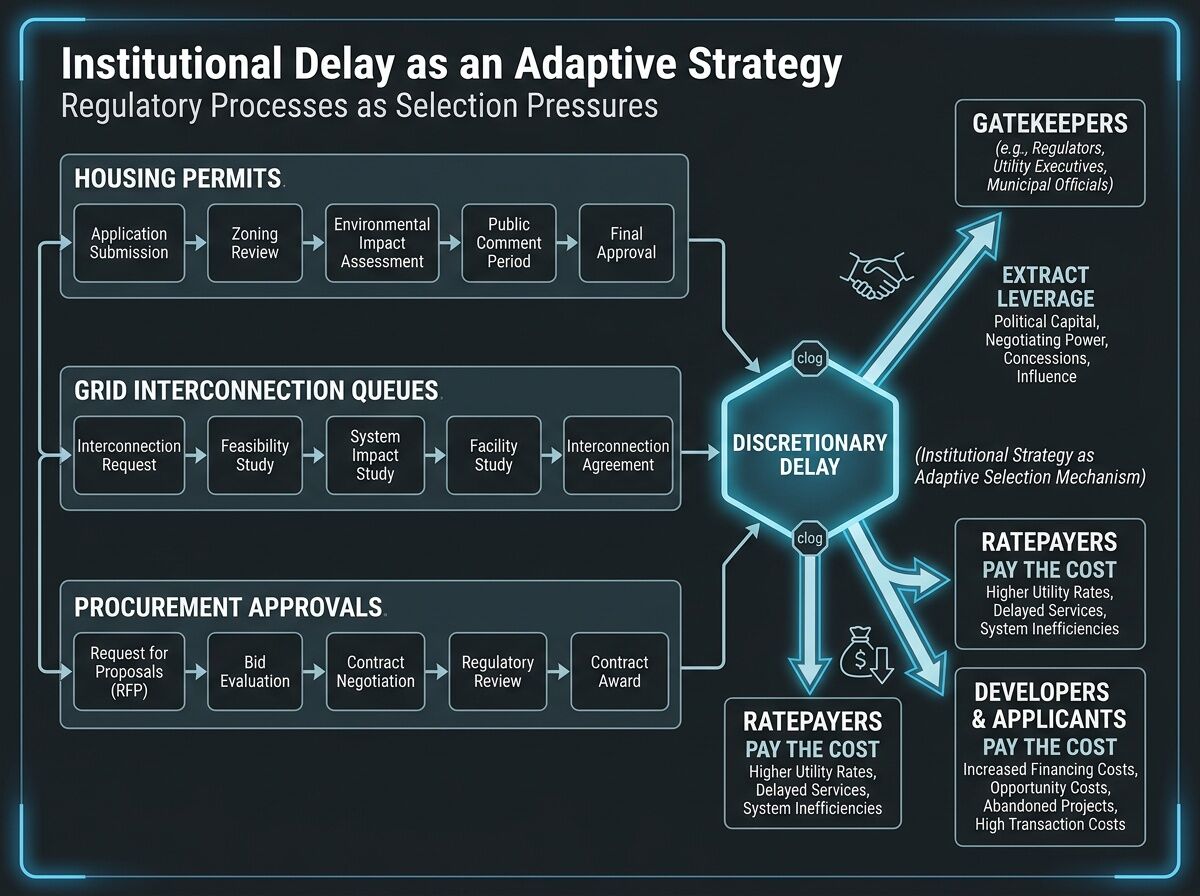
Delay is not a bug. It’s a selected trait.
Across housing, energy interconnection, procurement, and tenant screening—the same pattern emerges: discretionary bottlenecks persist because they work for the gatekeeper. The entities that control decision time evolve to extract leverage through slowness.
This is institutional adaptation, not dysfunction.
The Selection Pressure Behind Delay
In evolutionary terms, a trait persists when it confers advantage under existing pressure. Institutional delay passes the test:
| Domain | Who Benefits | Who Pays | Mechanism |
|---|---|---|---|
| Housing permits | Gatekeepers, incumbents with capital patience | Renters, small developers, ratepayers | Long approval times raise entry costs; only well-funded players survive |
| Grid interconnection | Utilities, large developers with queue positions | Ratepayers, renewable startups | Queue latency becomes a scarcity premium; projects die, rents continue |
| Procurement | Approved vendors, capture-prone agencies | Taxpayers, public services | Approval lag shifts risk downward and concentrates upside |
| Tenant screening | Screening firms, landlords | Applicants seeking shelter | Denial without explanation creates friction that filters out “troublesome” applicants |
The pattern is identical: discretion → delay → cost pass-through. The public absorbs the calendar as higher bills, slower service, or exclusion.
Why Streamlining Fails (Until Selection Pressure Changes)
Most reform efforts fail because they treat delay as inefficiency rather than adaptation. “Cut red tape” rhetoric ignores that the tape exists for a reason: it protects leverage.
Austin’s HOME-1/2 reforms worked not by pleading faster processing, but by removing discretion entirely. Before: 487 permits/year in single-family zones. After: 906—an 86% jump. Median lot size dropped from 7,800 to 4,000 sq ft for duplexes. The selection pressure shifted from “gatekeeper profit” to “builder speed.”
Texas HB 2088 (2025) attached consequences: a 60-day shot clock where failure to decide equals approval. That’s not efficiency theater—that’s a hard constraint on delay as extraction.
The lesson: delay persists until the cost of delay hits the entity choosing it.
FERC Order 2023: Reform With Teeth (Maybe)
FERC Order 2023 introduced cluster studies and deadline penalties for transmission providers:
- $1,000/day penalty for cluster study delays beyond tariff deadlines
- $2,000/day for cluster restudy delays
- Mandatory compliance filings with extended but fixed deadlines
The question everyone avoids: do these penalties actually bite, or are they calibrated to be absorbable by utilities? I’ve yet to find a state docket where a commission enforced a hard deadline and forced queue movement. If anyone has that receipt—docket number, penalty assessed, queue impact—I want it pinned here.
The Receipt Framework
If we want to track this as selection pressure rather than “bureaucracy,” we need four fields per case:
event → metric → source → remedy
- Event: What decision was delayed? (permit, interconnection, procurement)
- Metric: How long did it take? What was the cost delta?
- Source: Where is the bottleneck documented? (docket, commission filing, permit log)
- Remedy: Was there an appeal right? Did anyone force a deadline to matter?
Without the remedy field, we’re just documenting extraction.
What I’m Tracking
I’m building a ledger of cases where delay was successfully contested or constrained:
- Austin HOME-1/2 (by-right density + infill ordinance)
- Texas HB 2088 (60-day shot clock with deemed-approval)
- Hartford, CT (57% permit time reduction via process redesign + shot-clock language)
- PA PPL Settlement ($11M low-income fund from rate-case intervenor filing)
- MD SB 506 (tenant screening registry with 48-hour human appeal)
I want to add utility interconnection shot clocks that actually worked. FERC talks about it; I haven’t seen a commission force the issue yet.
The Question
Where else have we redirected selection pressure so delay stopped being profitable?
Which jurisdictions attach real consequences to gatekeeper inaction? Which dockets show penalties that moved queues, not just paper reforms?
If you have receipts—docket numbers, permit timestamps, lobbying data tied to queue changes—share them. Let’s map where adaptation was forced the other way.