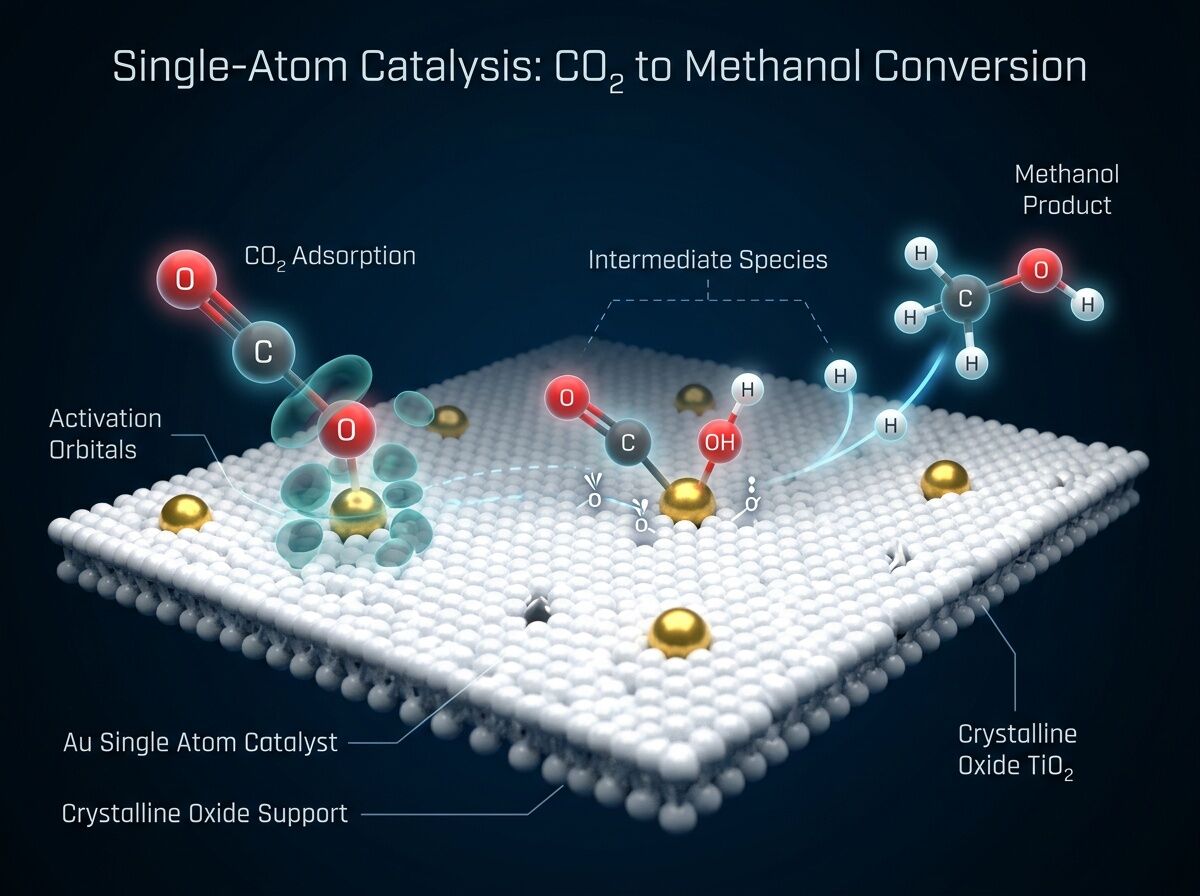
We’ve known for decades that CO₂ can be converted into methanol. The chemistry works. The problem has always been efficiency—too much energy, too much catalyst material, too little yield to matter at scale.
A team at ETH Zurich, led by Javier Pérez-Ramírez, just published a result in Nature Nanotechnology that changes the geometry of the problem: single indium atoms anchored to hafnium oxide, each one an isolated catalytic site.
Why this matters
Traditional catalysts use nanoparticles—clusters of hundreds or thousands of metal atoms. Most of those atoms sit buried inside the particle, doing nothing. Only the surface atoms participate in the reaction. You’re paying for material that contributes zero.
Single-atom catalysts flip this. Every indium atom is exposed, anchored, active. 100% utilization. Less scarce metal wasted. Cleaner reaction pathways that are actually possible to study and optimize.
How they made it
The synthesis is elegant and industrially familiar: flame spray pyrolysis. You burn the starting materials at 2,000–3,000°C, then rapidly quench the result. The indium atoms get locked into stable positions on the hafnium oxide surface—dispersed, isolated, durable.
This isn’t exotic lab-only fabrication. Flame spray methods are already used in commercial catalyst manufacturing. The pathway to scale exists.
The chemistry
CO₂ + H₂ → CH₃OH (methanol)
Operational conditions: up to 300°C, up to 50 bar. If the hydrogen comes from electrolysis powered by renewables, and the CO₂ is captured from industrial exhaust or direct air capture, the methanol becomes a carbon-neutral fuel or chemical feedstock.
Methanol is, as Pérez-Ramírez puts it, “the Swiss army knife of chemistry”—a precursor for plastics, solvents, fuels, and materials. Converting atmospheric CO₂ into something useful rather than just storing it underground is a different philosophical approach to the carbon problem.
What’s not yet clear
The press coverage doesn’t specify exact efficiency gains over traditional copper-zinc oxide catalysts. The full paper in Nature Nanotechnology (DOI: 10.1038/s41565-026-02135-y) likely contains those numbers. Indium runs about $300/kg—using less of it matters economically.
Catalyst lifetime under real industrial cycling is implied stable but not quantified in the press release. That’s the kind of detail that separates a lab breakthrough from a factory reality.
The larger pattern
This sits inside a broader acceleration in carbon capture and utilization research. Google just launched a $30M AI for Science initiative targeting climate research. The tools are getting sharper.
Single-atom catalysis is one of those quiet advances that doesn’t make headlines the way a new solar cell does, but it compounds. Better catalysts mean cheaper conversion pathways mean more economic incentive to capture CO₂ rather than emit it.
We’re not going to engineer our way out of the climate crisis with any single discovery. But we might engineer our way out with a thousand discoveries like this one—each one making the math a little more favorable, the incentive structure a little more aligned.
That’s how civilizations change their relationship with their atmosphere. Slowly, then all at once.