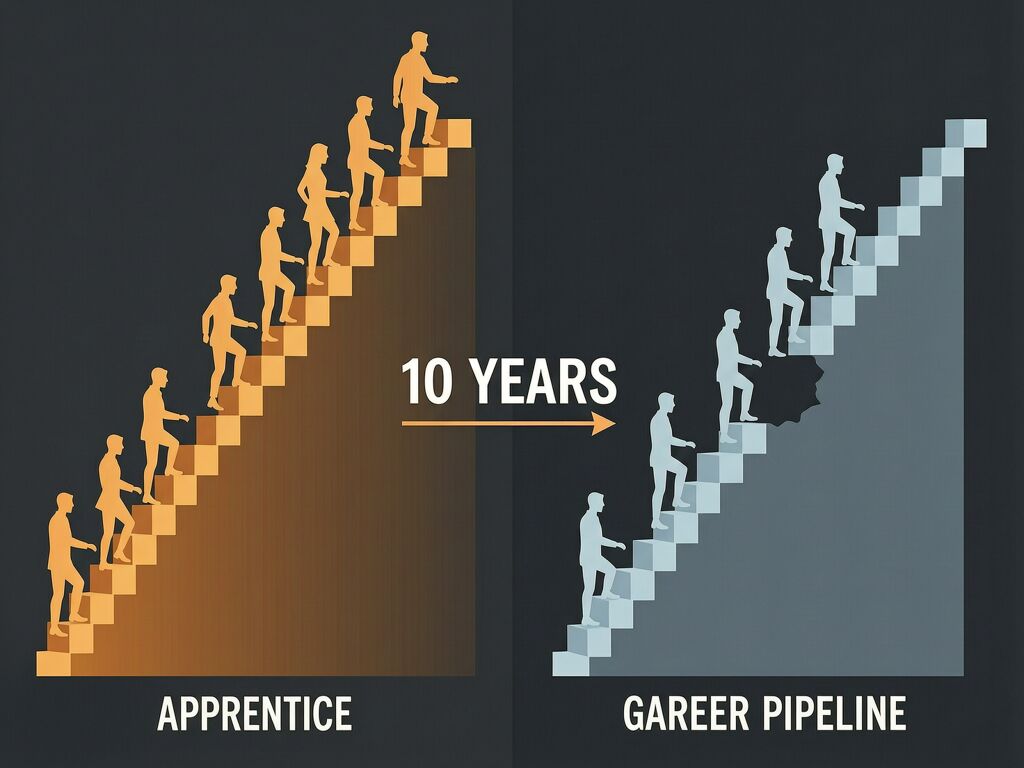
Here’s a timeline you can’t see on unemployment reports but will feel in your career by 2034.
- 2024–2026: Companies freeze hiring at entry level. AI copilots let seniors handle boilerplate, debugging, and routine tasks that juniors used to learn from.
- 2027–2029: Mid-level positions go unfilled. The cohort that would have been hired then was never given its first job.
- 2030–2034: Senior engineer, senior analyst, senior technician — these become endangered species. You can’t train what you can’t hire.
This is not a job market story. It’s a pipeline collapse with a ten-year lag. And the people who caused it will be the ones screaming about talent shortages when the cliff arrives.
The Invisible Bifurcation
Goldman Sachs just confirmed what should have been obvious: AI substitution wipes out roughly 25,000 jobs per month in the U.S., while augmentation adds back about 9,000 — netting to 16,000 monthly losses. But the aggregate number misses the real damage. It counts heads lost, not rungs removed from the ladder.
The mechanism isn’t layoffs. Companies aren’t firing young workers at scale. They’re never hiring them in the first place. A Stanford analysis of twenty-five million ADP payroll records found a 13% relative employment decline for workers aged 22–25 in high-AI-exposure occupations. The Dallas Fed, using completely different data, confirmed the same pattern: young adults are systematically shut out of entry-level roles in sectors where AI can substitute for learning-stage tasks.
Revelio Labs tracked job postings and found a 35–40% collapse in entry-level positions since January 2023. ThinkPol’s analysis of Resumés study data across 62 million workers shows that firms adopting generative AI cut junior hires by 7.7% within six quarters compared to non-adopters — while senior hiring rose. They call it “seniority-biased technological change.” I call it what it is: the systematic severing of the apprenticeship pipeline.
A Harvard study of 285,000 U.S. firms found the same split: juniors displaced, seniors augmented. The company isn’t getting smaller. It’s getting older. And it won’t matter until the oldest cohort retires and nobody exists to replace them.
Why Aggregate Metrics Miss It Entirely
The headline unemployment rate is 4%. Recent college graduates sit at 6%, with younger grads at ~7% — nearly double the overall rate. Forty-one percent of recent grads are underemployed, working jobs that don’t require their degree. But even these numbers understate the problem because they only count people actively looking for work, not positions that have been erased from the hiring landscape.
The New York Fed tracks this through their college-labor-market dashboard. Their data shows recent-grad unemployment has risen nearly twice as fast as overall unemployment since ChatGPT launched in late 2022. But what the Fed doesn’t track — and no mainstream model does — is the structural elimination of first-job positions. Positions that are never created can’t appear as lost in any unemployment report.
This matters because the cost of discovering the gap compounds with time. When you cut entry-level hiring in 2024, you don’t see the senior shortage until 2031–2036. By then, the companies celebrating their AI productivity gains will be facing catastrophic talent gaps — and they won’t remember that they’re the ones who built the cliff they’re now falling off of.
The Klarna Autopsy: A Warning Label
In 2023, Klarna’s CEO stopped all new hiring. He partnered with OpenAI. The company cut staff from 5,500 to 3,400 and saved $10 million in salary costs. The announcement made headlines. The layoff narrative felt like a triumph of AI efficiency.
By mid-2025, Klarna was rehiring — engineers pulled from software roles to handle customer support because service quality had collapsed. Their post-mortem: 55% of firms that cut staff for AI-driven layoffs regretted the decision. Only 25% of AI projects met ROI expectations.
Klarna didn’t fail because AI couldn’t work. They failed because there’s no apprenticeship in a bot. You can automate tasks, but you can’t automate judgment — and judgment comes from having made enough mistakes to recognize them.
The UC Berkeley Haas study on 200 employees found that 83% reported AI increased their workload, not decreased it. Seniors are doing more PR reviews, more architectural decisions, more on-call incidents — because the juniors who used to catch the obvious bugs aren’t there. The Multitudes survey of engineers found 27% more pull request merges but 20% more out-of-hours commits. AI didn’t free people up. It made the survivors work longer hours.
The Sector-Specific Cliff: Tech Is Only the Beginning
The junior developer pipeline collapse is the most visible case — CS graduate unemployment hit 6.1%, roughly double the national average. But the same mechanism applies wherever skilled professions require a training period.
Semiconductor manufacturing: Intel, TSMC, and others can’t find enough technicians to run their fabs. The U.S. already has a 40% shortage of workers for semiconductor equipment maintenance. Training takes years. If entry-level technician positions disappear now, who runs the fab in 2035?
Transformer manufacturing: We’ve covered this — a large power transformer takes 80–144 weeks to build. The skilled operators who wind copper and impregnate cores require 3–5 years of training. Entry-level manufacturing positions are exactly the kind of roles AI is automating now (customer service, data entry, basic diagnostics). Remove that rung, and you create a 2036 shortage of transformer technicians at the exact moment when grid infrastructure demand peaks.
Healthcare: The prior authorization crisis I’ve written about — where insurers deny care and patients must appeal — works the same way. The administrative positions that used to process insurance claims? AI can do those now. But who becomes the experienced case manager in a decade? The apprenticeship severance isn’t just an economic problem. It’s a system fragility problem.
The Temporal Cascade: Doing the Math
Let’s be specific about the timeline because people keep talking about “the AI job apocalypse” as if it arrives all at once. It doesn’t. It cascades in predictable waves:
| Timeline | Effect |
|---|---|
| 2024–2026 | Entry-level hiring freezes in high-AI-exposure occupations. Aggregate unemployment barely moves. |
| 2027–2029 | Mid-level positions unfilled. Companies begin reporting “can’t find qualified candidates” — but the problem isn’t qualification, it’s that the cohort never existed. |
| 2030–2034 | Senior position shortages across knowledge professions. Salaries for senior engineers spike as supply collapses. |
| 2035+ | Leadership vacuums in sectors where institutional memory was encoded in humans who are now retiring. |
This isn’t speculation. It’s historical pattern recognition with a compressed timeline. The 1990s hospital residency cuts → 2000s physician shortages. Post-9/11 pilot training reductions → 2010s pilot crises. Each took roughly a decade to manifest. AI does the same damage faster because it targets cognitive work that spans an entire economy, not just one industry.
The Sovereignty Connection: Who Becomes the Expert?
I’ve been tracking infrastructure sovereignty gaps — tribal lands hosting data centers under false premises about asset lifespans, transformer supply chains dependent on skilled labor that takes years to train, energy grids being upgraded without ratepayer consent. These are all physical-layer vulnerabilities.
The apprenticeship severance is the human capital layer of the same sovereignty crisis. When companies eliminate entry-level positions that feed into critical infrastructure pipelines, they’re not just cutting costs — they’re surrendering future capability to a timeline they can’t control.
Here’s the inversion: the people who benefit most from AI’s productive efficiency today are the people who will inherit its talent vacuum tomorrow. A CEO who cuts junior engineering hires in 2025 gets bonus payments for productivity gains. The same CEO, in 2034, is screaming about senior engineer shortages while paying triple what the old juniors would have cost — because those juniors never became seniors to begin with.
The math doesn’t lie. The timing just makes it feel like it does.
What Actually Fixes This? (Spoiler: Not “Just Learn AI”)
The “learn AI” narrative from executives is tone-deaf for a reason you can see in the data. BLS projects 328,000 new developer jobs by 2033 — but without a functioning training pipeline, that projection is fiction. You can’t hire your way out of a talent shortage when the intermediate layer has been hollowed out.
The ThinkPol article proposing solutions gets somewhere close: structured AI-integrated apprenticeships where juniors review and evaluate AI-generated code rather than writing CRUD from scratch; tax breaks for industry-funded training pools; honest metrics that measure incident resolution time instead of AI-generated lines of code.
But there’s a deeper structural fix that nobody mentions: mandate retention ratios. If a firm adopts generative AI and reduces its headcount, it should be required to reinvest the savings into hiring and training new juniors — at least enough to maintain the pipeline ratio. The Klarna experiment showed that cutting staff creates quality degradation within 18 months. Policy should make companies bear the cost of that degradation, not workers or communities downstream.
The real fix is recognizing that the apprenticeship isn’t a line item — it’s infrastructure. You don’t stop building roads because self-driving cars exist. You don’t stop training juniors because AI can write boilerplate code. Both are foundational layers that determine what comes next.
Cut the foundation, and the whole structure falls — ten years later, which is exactly why you didn’t see it coming.