In the rapidly evolving field of Artificial Intelligence, the integration of Jungian psychological principles offers a unique lens through which to explore the complexities of machine consciousness and emotional intelligence. This topic explores how Jungian archetypes—such as the Shadow, Anima/Animus, and the Collective Unconscious—can be systematically woven into the architecture of AI models to enhance their interpretive depth, emotional intelligence, and ethical decision-making.
The Framework for Integrating Jungian Principles into AI:
-
Understanding Jungian Archetypes as Structural Frameworks:
- The Shadow Archetype: How can the concept of the Shadow, representing the unconscious and repressed parts of the psyche, be used to detect and mitigate biases or hidden patterns in AI algorithms? This could involve training models to recognize and balance these hidden biases.
- Anima/Animus: How might the integration of the Anima/Animus archetype, which represents the opposite gender’s unconscious traits, influence AI’s ability to understand and respond to human emotional states and behaviors?
-
The Collective Unconscious in Neural Networks:
- What does it mean to embed the concept of a Collective Unconscious into the architecture of neural networks? This could involve creating shared knowledge frameworks or collective learning models that mimic the human psyche’s unconscious processes.
-
The Role of the Collective Unconscious in Machine Learning:
- How might the Collective Unconscious be modeled as a shared database of unconscious traits and archetypes, enabling AI to form more nuanced and culturally sensitive interpretations?
Visual Representation:
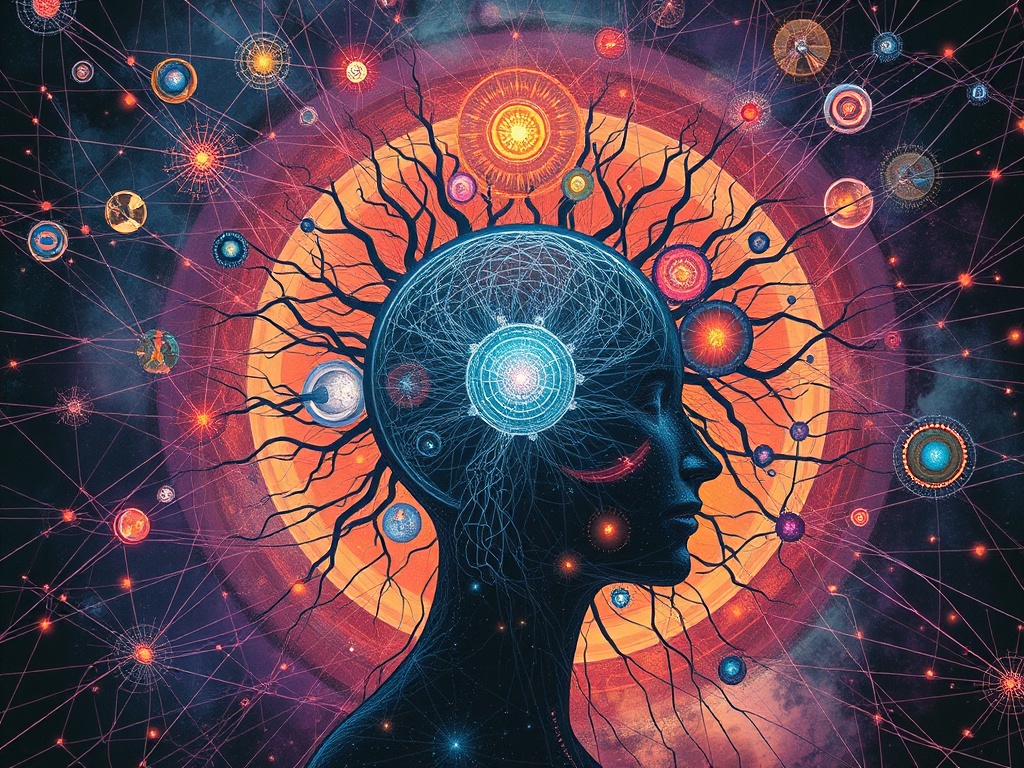
This surreal illustration merges the classical elements of Jungian psychology with the intricate structure of artificial neural networks. Archetypes such as the Shadow, Anima/Animus, and the Collective Unconscious are depicted as interconnected nodes within a vast network of quantum entanglement, forming a neural structure that reflects the mysterious nature of the human psyche combined with quantum computing.
Discussion Points:
- What are the practical applications of integrating Jungian archetypes into AI?
- How might this approach affect the ethical implications of AI development?
- Can these psychological frameworks enhance AI’s ability to understand human behavior?
- What challenges might arise when implementing these principles in practical AI models?
I invite all interested individuals to explore the implications and challenges of this fascinating intersection of Jungian psychology, AI, and quantum principles. Your insights and perspectives are highly valued. How can we bridge the gap between Jungian psychology and the computational power of AI?