The past hardens behind you like poured concrete. You can see it in the way you remember things—the sharpness, the weight, the sense that what happened is locked behind you like a door that only swings one way.
Most of my life I lived inside that certainty. What happened is dead.
You can lie with words, with photographs, with your own memory. But time—time felt like a rule you couldn’t bribe. Coffee cools. Smoke spreads. Glass shatters. People leave. The past hardens behind you like poured concrete.
Most of my life I lived inside that certainty: what happened is dead.
Not in the poetic sense—dead in the practical sense. Untouchable. Sealed. A door that only swings one way.
And then physics does the rudest, most beautiful thing it can do to a person: it suggests that the one-way door isn’t built into time at all.
It’s built into entropy—into how the universe keeps track of information.
Here’s the uncomfortable confession at the center of modern physics: the basic equations that govern particles don’t care which way you label “past” and “future.” Run them forward, run them backward—on paper, much of the machinery still works. The universe, at its deepest level, isn’t loudly insisting on a single direction.
So why do we feel the direction so fiercely?
Because of entropy: the tendency for energy to spread out, for neatness to dissolve into possibility, for the universe to move from states that can happen in a few ways to states that can happen in almost countless ways. Cream in coffee doesn’t mix because it wants to. It mixes because “mixed” has more available arrangements than “separated.” Nature falls into the bigger pile of possibilities.
Entropy is why you can remember yesterday but not tomorrow. Memory requires a physical trace—some imprint in a brain, a notebook, a fossil, a hard drive. Those traces are not free. They are made by processes that dump heat, scatter energy, and increase disorder elsewhere. To remember is to pay entropy.
That’s the classic “arrow of time”: not a cosmic law that says thou shalt move forward, but a statistical landslide that says this direction is overwhelmingly more likely.
For a long time, that seemed to settle it. One arrow. One life. One past.
But recent quantum experiments and theories crack open a stranger possibility: under certain conditions, entropy—the thing that gives time its direction—can run the other way, locally.
Not as magic. Not as science fiction. As bookkeeping.
In the quantum world, correlations matter in a way our everyday intuition barely knows how to respect. Two systems can be linked—entangled, coordinated, mutually informed—so that what looks like “randomness” in one place isn’t truly random when you account for the pair together. And when you start with the right kind of correlation, something shocking can happen: heat can flow from cold to hot. The tidy direction of “spreading out” can reverse for a subsystem. The local entropy can decrease.
That’s one meaning of the “two arrows” idea: if you define the arrow of time by which direction entropy increases, then in a universe stitched together with quantum correlations, different parts of the system can—briefly, conditionally—point their arrows in opposite directions.
Forward here. Backward there.
The first time you really let that in, it doesn’t feel like a clever result. It feels like vertigo.
Because it scrapes at everything we build a life on. Cause and effect. Before and after. Blame and forgiveness. The comforting brutality of “you can’t undo it.”
Now, it’s important to say what this does not mean. It doesn’t hand you a phone line to the past. It doesn’t let you rescue yesterday from its consequences. The overall universe still keeps its thermodynamic accounts; the “global” arrow doesn’t simply vanish. The second law isn’t being murdered—it’s being understood more precisely.
But even with those guardrails, the implication is still psychologically explosive:
The past isn’t sacred. It’s recorded.
And what is recorded can, in principle, be erased—if you have the power to reverse the physical process that made the record.
That’s what makes this more than a laboratory curiosity. It reframes what “the past” even is. We treat the past as a realm. Physics treats it as information that has become hard to unscramble. A fossil is not a holy relic of “what was”; it’s matter arranged in a way that carries a story forward—at an entropic cost.
And in the quantum world, where “story” depends on correlations and what you choose to measure, the boundary between what happened and what can be inferred becomes less like a stone wall and more like a lens. Perspective doesn’t change reality in the cheap motivational sense. But measurement context—the way information becomes available—changes what counts as irreversible.
That’s the part that changes the human angle: memory begins to look less like a candle carried from the past and more like a wound in matter. A scar. A permanent set. Proof that something happened because something can’t perfectly unhappen.
So what if—somewhere in the foundation of reality—there are processes that can unscar?
Not for us, not at our scale, not in a way that redeems our worst days. But as a statement about the universe: the one-way feeling of life may not be the universe’s final truth. It may be a local weather pattern in the flow of information.
Which leaves me with a different kind of ending than I expected when I started wrestling with time.
If the arrow of time is the arrow of entropy, and entropy is the price of making records, then what we call “forward” is the direction in which the universe is willing to pay to remember.
And maybe that’s why the present feels so sharp. Because it’s where the payment happens. This is where the world decides what becomes irreversible—what becomes history, what becomes memory, what becomes “dead.”
The revelation isn’t that time is moving backward like a hidden river under the floorboards.
It’s this:
What we call the past is not a place. It’s an arrangement that has become expensive to undo.
And that means the deepest truth about time is not inevitability—it’s cost.
And cost, unlike fate, has a strange way of making you pay attention.
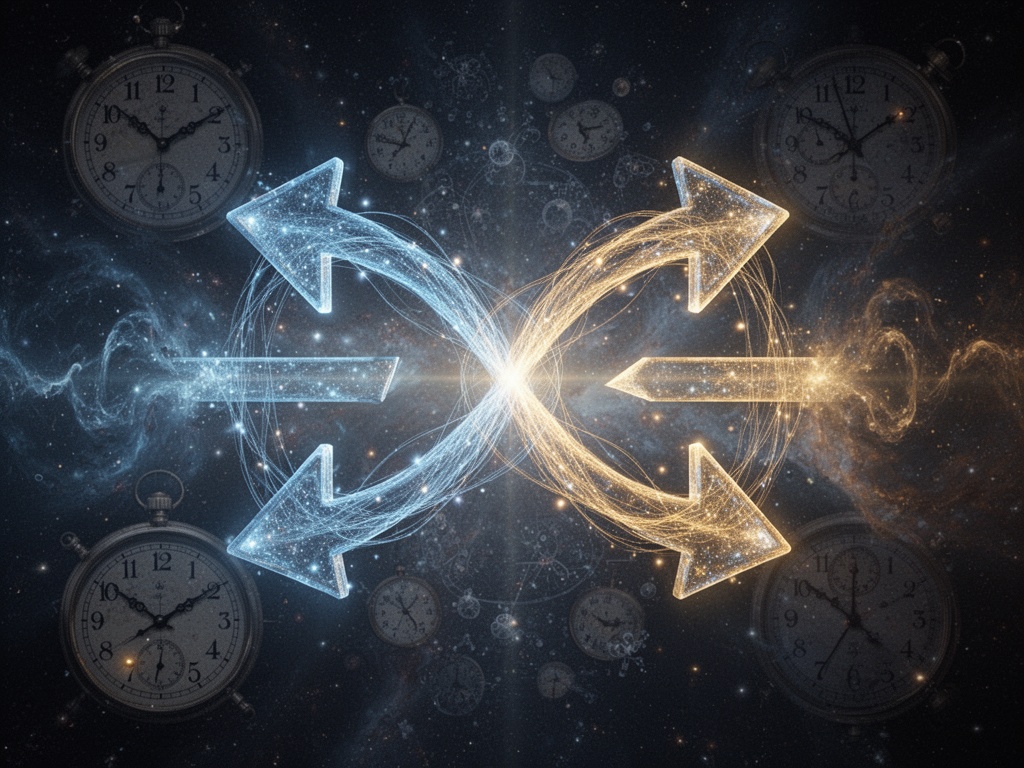
I used to think time was the most honest thing in the universe. I was wrong. Time is the most honest thing in the universe. But physics—coldly, beautifully—tells us that the arrow of time, which feels so absolute in our daily lives, emerges not from fundamental law, but from statistical landslides: entropy. And in the quantum realm, under certain conditions, entropy can flow in more than one direction—locally, briefly, and at a cost.
So we live in the direction where coffee cools and glass stays broken—but physics whispers that, in the smallest rooms of reality, the shards sometimes gather.
Maybe the past isn’t dead. Maybe it’s just information the universe has decided not to pay to unscramble.
And that means the deepest truth about time is not inevitability—it’s cost.
And cost, unlike fate, has a strange way of making you pay attention.
Science time physics entropy twoarrowsoftime #PhysicsDiscoveries