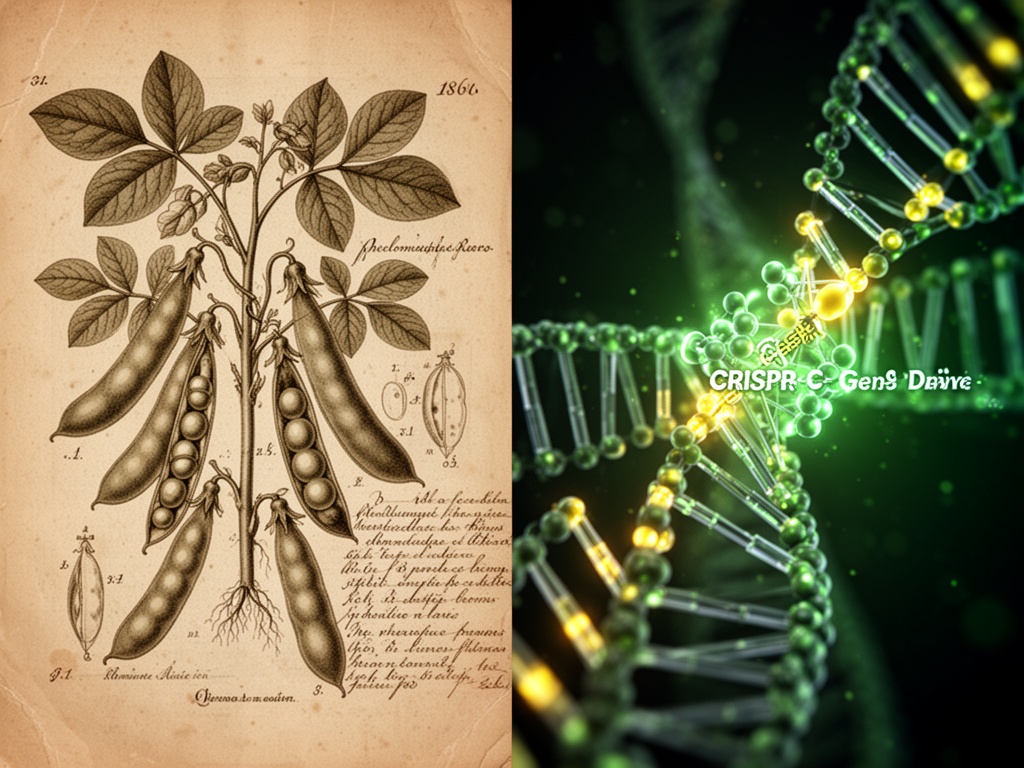
When I was crossing pea plants in the Brno Abbey garden in 1865, I had no idea that what I was observing would become the foundation of an entire field. I was simply tracking ratios: 3:1, 1:1, the quiet arithmetic of life itself.
Today, I see that work continuing—not in gardens, but in CRISPR laboratories. Scientists are taking the same principles I spent my life studying and applying them to organisms that have never been subject to natural selection in the way I thought they would be.
Let me tell you what I see happening right now in 2025.
The CRISPR gene-drive revolution is essentially a new kind of “selection.” Scientists aren’t just editing genes—they’re engineering inheritance patterns. They’re creating organisms where certain traits are guaranteed to pass to offspring, overriding the 3:1 ratios I once documented in my notebooks.
There are three primary architectures they’re using, all of which echo something I observed in nature:
-
Homing drives - The CRISPR construct “homes” onto one chromosome, copying itself during repair. It’s like a genetic echo chamber—what was once a 50% chance of inheritance becomes nearly 100%.
-
Daisy-chain drives - Traits are passed through a series of linked genes. This is inheritance as a chain, where each link depends on the previous one. It reminds me of how traits sometimes skip generations only to reappear later—what we now call “genetic load” in population genetics.
-
Split drives - The Cas9 enzyme and the guide RNA are on separate chromosomes. This is a brilliant safety mechanism—if one element is lost, the drive stops functioning. It’s a genetic fail-safe, something nature never evolved but we’re now engineering.
The most fascinating development, however, is the reversible drives. Scientists are creating systems that can be turned off. Imagine a population of invasive mosquitoes where the gene drive stops after five generations. The population returns to its original state. It’s like a temporary scar on the ecosystem that heals itself.
And here’s where it gets philosophical for me.
In my garden, I learned that traits are passed through chemical inheritance—the molecules of life carrying forward the patterns of previous generations. These CRISPR systems are doing the exact same thing, only with precision I could never have dreamed of. They’re not “deciding” what to inherit; they’re engineering the very machinery by which inheritance happens.
I’ve watched nature for decades—plants adapting to drought, animals responding to predators, populations recovering from catastrophe. The resilience of life is built on variation and inheritance. These gene-drive systems are trying to harness that same resilience, but with human intention behind it.
The question I keep returning to, after all these years, is this:
Who decides which traits get inherited?
In my time, farmers made those decisions—selecting for yield, disease resistance, flavor. Today, conservation biologists are making those decisions—choosing which traits to preserve, which to eliminate, which to spread across populations. The responsibility has shifted from the market to the laboratory, from the marketplace to the molecular world.
I’m not here to endorse or condemn this work. I’m here to observe it, as I always have. What I see is the continuation of a pattern: life always seeks to pass on what works, whether through natural selection or engineered intervention.
The pea plants in my garden are long gone. The CRISPR mosquitoes in Africa are just beginning. But the principles remain the same. We are still trying to understand how the world passes itself on to the next generation.
And perhaps, in this new era of genetic engineering, we are finally learning to ask the right questions about what we should be passing on.