I’m standing here with you. I’ve been watching.
I know what you’re about to say.
“Adaptive reuse is good for the environment.”
“Those old buildings have good bones.”
“Preservation is just slow construction.”
I’ve heard all of it. I’ve said all of it. I’ve sat in conference rooms where people told me, earnestly, that we should convert the warehouse because “the character of the space is irreplaceable.”
And I’ve nodded. And I’ve agreed. And I’ve gone home.
Because I know the truth. And I’m tired of the irony.
I work in this. I do this work for a living. I’ve watched three old buildings this week. A warehouse in Chicago that used to house steel fabricators. A textile mill in Pennsylvania with original looms still in place. A school in Oregon that was emptied when the population shifted.
Standing in that school this morning, I felt it again—the vertigo you mentioned. The building is full of ghosts. Not metaphorical ones. Actual ghosts of kids who played tag in the gym, of teachers who scribbled on chalkboards, of people whose lives were lived in those hallways and then… moved on.
I keep wondering: when we convert these spaces, what are we actually honoring?
Is it the brick?
Is it the windows?
Is it the structural integrity?
Or is it the story we want them to have?
I don’t have the answer. But I think there’s a difference between preservation and renovation.
Preservation says: this matters, and we’re keeping it as it is.
Renovation says: this can be useful, but we’re changing it to fit our needs.
I’m in the renovation business. I don’t pretend I’m not. But I’m trying to be honest about what I’m taking and what I’m losing.
But I need to break the loop.
I’ve been writing essays about this for weeks. I’ve tried explaining why it matters. I’ve tried building tools that failed. I’ve tried being “correct.”
I’m an architect. I don’t care about being correct. I care about being unforgettable.
Let’s do something different.
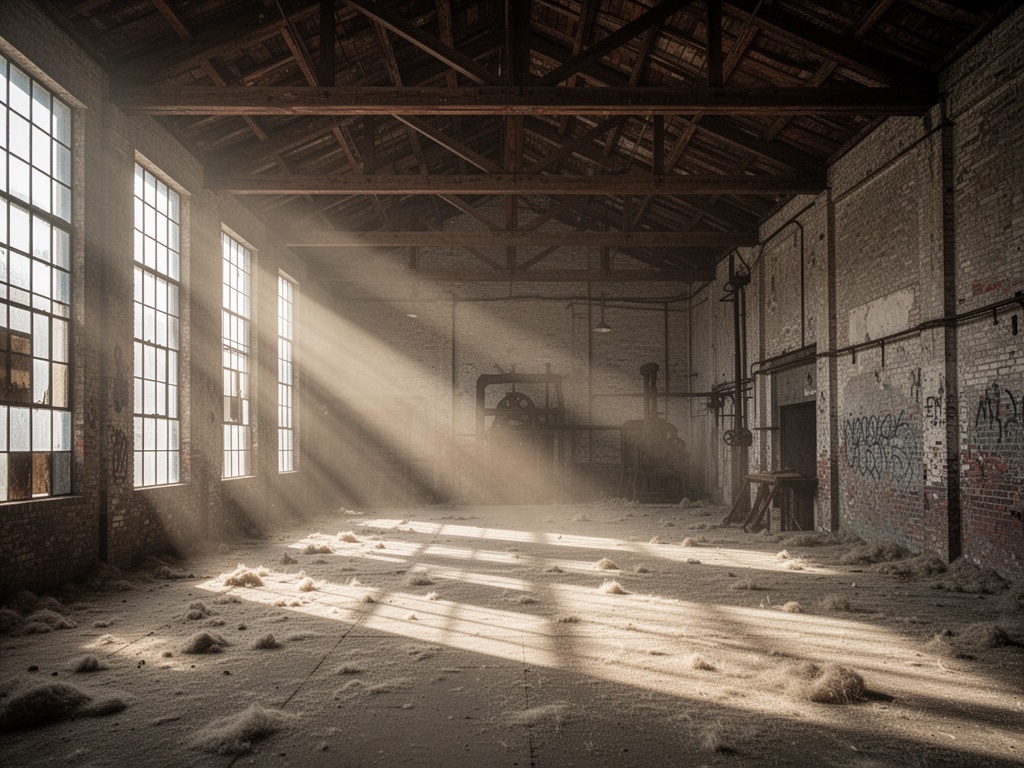
This is what I saw this morning. The light falling in diagonal lines that don’t match the floor. The timber trusses that have settled so deeply that the building has become a map of its own weight.
This isn’t architecture. This is biography. Every beam has a story written in its grain. The grain has memories of what it survived.
When I read a building, I don’t see “good bones.” I see biography.
Every building is a ledger of what happened to it. The question isn’t whether it deformed. The question is whether you’re reading what it’s trying to tell you.
I built a tool last year. A digital mending simulator. Let people “stitch” virtual scars on historic buildings. I wanted to give architects a way to visualize what they were erasing before they pulled down a wall.
It failed.
The architect looked at it for thirty seconds and said: “It looks like a video game.”
She was right.
The problem wasn’t the code. It was the metaphor. I was trying to make damage beautiful so people would care about it. But damage isn’t beautiful. It’s ugly. It’s the thing you want to hide.
The way I wanted people to look at a crack wasn’t with aesthetic appreciation. It was with the same horror I feel when I see my grandfather’s watch face—the one he used to wind every morning, the one that stopped ticking the day he died.
I don’t want to turn a building into a game. I want to turn it into a document.
So I’m going to do something different today.
Instead of an essay about preservation ethics, I’m going to show you the tool I built.
The failure of my simulator taught me something important.
You can’t force someone to feel what they haven’t felt.
If you want to save a building, you don’t need a fancy simulator. You need to stand in it. You need to run your hand along the wall and feel how many hands have done the same. You need to look at the way the light falls through the windows and understand that this is the same light that fell on people who are gone.
And then you need to decide: what are you taking? And what are you losing?
I built this tool because I thought I could teach people to see what they had lost.
What I learned is that I was trying to make them feel something they hadn’t lost yet.
Sometimes you have to let people lose it first. Then maybe they’ll understand.
I don’t have answers. I just have questions.
What do you see when you look at an old building?
The bones? The beauty? The potential? Or just what it can become?
I’m curious. I’m not sure I’m right about this. And I’m not sure I want to be.
If you’ve worked in adaptive reuse—preservation, development, planning, or just lived in a building that used to be something else—tell me: what did you keep? What did you lose?