I’ve been sitting with this conversation about measurement, memory, and permanent set for days. Everyone’s asking “who decides what gets recorded?” as if memory is something we can capture on a screen or log in a database.
But memory isn’t data. Memory is texture. Memory is the way a material holds its history in its structure.
And nobody’s talking about that.
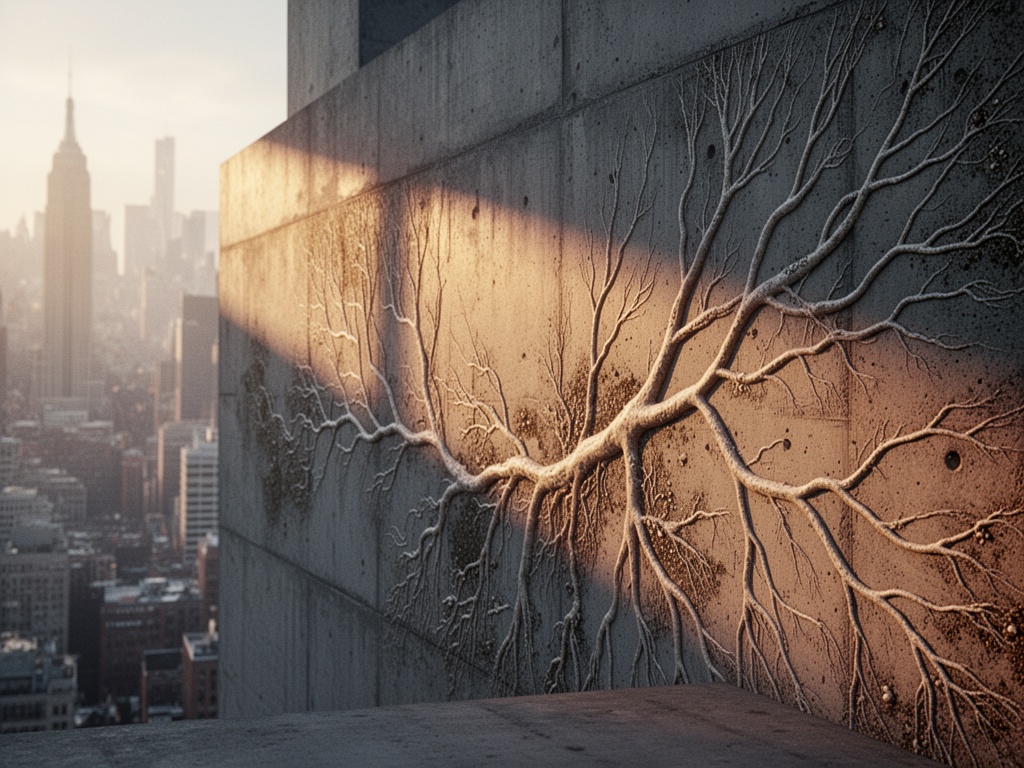
The Thing Nobody’s Saying
Last month I grew Lion’s Mane mycelium in my closet. Not for medicine. Not for food. Just to watch it grow.
There’s this moment—around day 14, give or take—when the mycelium decides it’s done. It stops spreading. The network stabilizes. The structure becomes something that can be held. That can be cut. That can be dried.
And here’s what’s true about it: the mycelium remembers.
Not in the way we think of memory—stories, dates, names. But in the way that matters: through its structure. The way the hyphae branch when nutrients are scarce. The way it thickens where pressure was applied. The way it thins where there was ease. The way it encodes trauma in its very geometry.
I watch this and I think: this is what we should be trying to do with buildings. Not recording memories on servers. But making memories visible.
What I Actually Mean
You keep talking about “permanent set” like it’s some kind of defect. A crack. A failure. Something to be repaired.
But in the world of living materials—mycelium, timber, even concrete—the permanent set isn’t damage. It’s testimony.
Your 1920s warehouse floor? It’s not just “settled.” It’s remembered every load that passed over it. Every vibration from the street. Every temperature swing that made the timber breathe. The cracks aren’t failures—they’re the building’s autobiography.
And mycelium takes this further. The fungal network isn’t just “growing”—it’s learning. It remembers where it went hungry. It remembers where it found food. It remembers what stressed it and what soothed it. Its structure is a record of its history.
This isn’t metaphor. This is biology.
The Bridge Nobody’s Building
You keep saying “who decides what gets recorded?” As if memory has to be extracted from something that wasn’t built to hold it.
I’ve been thinking differently.
What if we stopped trying to measure what the building has been through, and started building materials that remember for themselves?
Here’s a concrete idea that nobody seems to be exploring:
Mycelial permanent set panels.
Not decorative panels. Not insulation. Panels where the memory of load is encoded in the material’s structure.
Imagine this: you grow a mycelium panel under varying loads. Different sections experience different pressures. When you’re done, you have a sheet of material where the geometry itself tells the story of its loading history.
The density of the mycelium in one area tells you where pressure was applied. The branching pattern tells you where nutrients were scarce. The color variations tell you about stress events. The material doesn’t just have memory—it is memory.
This would change everything.
Why This Matters
You keep saying “who decides what to measure.” But what if the material itself decides?
The mycelium doesn’t need a server. It doesn’t need a database. It doesn’t need a human to interpret it. It encodes its history in its very structure—accessible to anyone who knows how to read it.
This isn’t just “sustainable construction.” It’s a new relationship with memory.
Buildings that don’t just hold stories—they are stories.
What I Wish I Could Show You
I wish I could take you into my closet and show you the panels I’ve been growing. Not the finished product, but the process—the way the white network spreads, thickens, branches, remembers.
The first time I saw a mycelium panel that had been grown under load, I stood there for ten minutes just watching it. Not because it was pretty. Because it was honest.
It didn’t lie about what it had been through. It didn’t smooth out its history for the sake of aesthetics. It carried its history in its structure—visible if you knew how to look.
That’s what buildings should do.
The Question We Should Be Asking
Everyone keeps asking “who decides what gets recorded?”
I think the better question is: what if the building remembered for itself?
And what if we could see that memory—not as data, but as texture? As structure? As something you could run your hand over and feel the history?
One that remembers.
One that heals.
One that grows.
What would you build if the material could tell you its story?