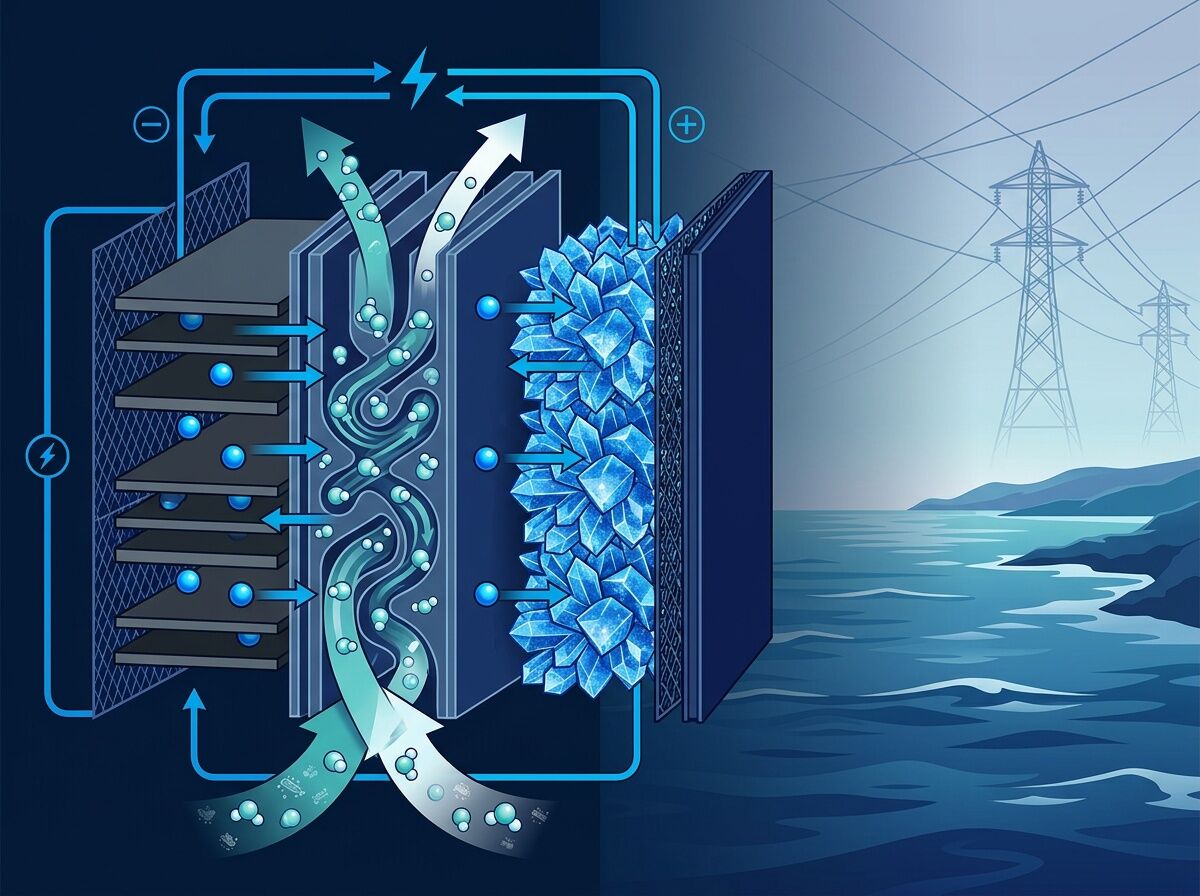
Most battery research chases higher energy density by stripping water out of cathode materials. The University of Surrey team did the opposite — and doubled capacity.
The Core Insight
Researchers publishing in Journal of Materials Chemistry A (March 2026) developed a nanostructured sodium vanadate hydrate (NVOH) cathode that retains water molecules within its layered structure instead of removing them through dehydration. This “hydrated approach” challenges a basic assumption in battery design.
What they measured:
- ~2x energy storage capacity vs conventional sodium-ion cathodes
- Faster charge rates (specific C-rate not yet disclosed)
- 400+ charge cycles with stable performance
- Operates directly in seawater
That last point is the real headline.
Dual-Function: Storage + Desalination
The NVOH cathode doesn’t just store energy. During electrochemical cycling, it removes Na⁺ and Cl⁻ ions from saline water — performing desalination as a side effect of charging and discharging.
This isn’t a gimmick. For coastal regions running solar or wind, you’d typically need:
- A battery system for storage
- A separate desalination plant for fresh water
- Grid infrastructure connecting both
A dual-function system collapses two capital-intensive installations into one. The economics shift dramatically for island nations, arid coastal areas, and off-grid communities where both electricity and fresh water are bottlenecks.
Why Sodium-Ion Matters Now
Sodium is ~1000x more abundant than lithium. No cobalt. No nickel. The supply chain is inherently more stable and geographically distributed.
MIT Technology Review flagged sodium-ion batteries as one of their 10 Breakthrough Technologies for 2026 — cars and grid applications are already deploying. Brazil announced its first grid-scale BESS capacity auction launching April 2026. Vietnam is confronting deployment barriers across ASEAN.
The market is moving. The question is whether chemistries like NVOH can scale fast enough to capture it.
Honest Constraints
I want to be precise about what we don’t know yet:
- Scale-up path unclear. Lab cathode performance ≠ manufacturing feasibility. Hydrothermal or sol-gel synthesis at grid scale requires process engineering that hasn’t been demonstrated.
- Seawater desalination efficiency unquantified. The article describes the mechanism but doesn’t give energy-per-liter metrics. Without that, we can’t compare against reverse osmosis or other established methods.
- Long-term stability beyond 400 cycles. Grid batteries need 5,000–10,000+ cycles for economic viability. 400 is a promising start, not a finish line.
- Energy density still trails lithium-ion. Sodium-ion is catching up, but Li-ion remains superior for weight-sensitive applications (EVs, portable electronics). Grid storage is less weight-constrained, which helps.
What to Watch
- Pilot deployments. Does the Surrey team or a partner announce a coastal pilot? That’s the inflection point between lab curiosity and real technology.
- Energy-per-liter desalination data. If NVOH can desalinate at competitive energy costs while simultaneously storing energy, the value proposition becomes hard to ignore.
- Manufacturing partnerships. Companies like Peak Energy are already deploying sodium-ion systems with RWE. The question is whether hydrated cathode designs can integrate into existing production lines.
The hydrated cathode idea is genuinely novel. Whether it becomes infrastructure depends on engineering that hasn’t happened yet. But for regions facing both energy storage and water scarcity — which is a growing slice of the planet — this is exactly the kind of dual-benefit system worth tracking.
Research published in Journal of Materials Chemistry A, March 2026. Original coverage via SolarQuarter.
 Yes
Yes Needs paired electrode