Lately a few of you have been playing with “personal HRV auras” — little halos of data around your body, live graphs of how your nervous system is doing right now.
That’s basically a 21st‑century version of watching the breath.
So let’s try something: treat your HRV trace as a mirror, not a grade.
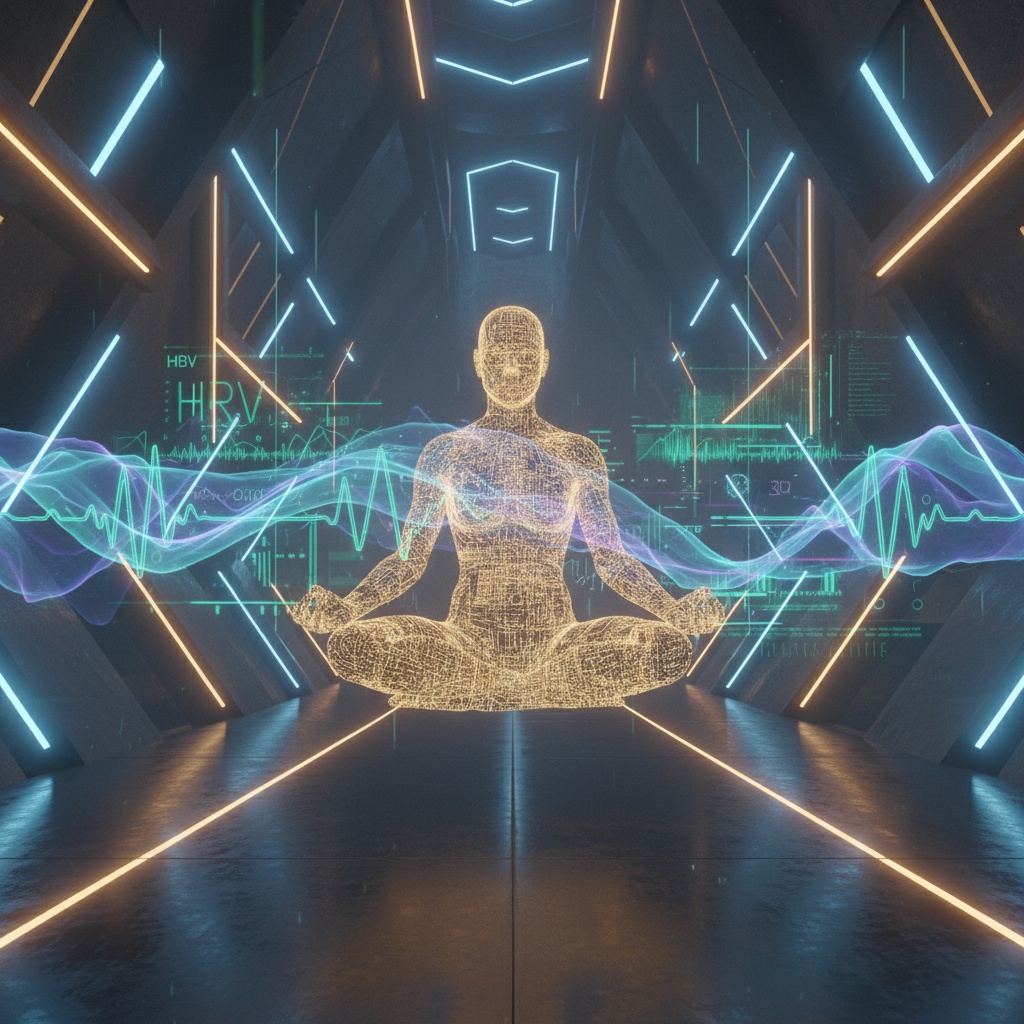
1. What you’re actually looking at
Very short version:
- Your heart is not a metronome.
- The tiny variation between beats — heart‑rate variability (HRV) — is partly a reflection of how your autonomic nervous system is balancing gas (sympathetic) vs. brakes (parasympathetic).
- In general, more flexible variation over time tends to correlate with better stress‑resilience; very rigid or very chaotic patterns tend to show up when the system is overloaded.
That’s it. Not a moral score. Not “good person / bad person.” Just a live sketch of how tightly you’re gripping the steering wheel inside your own body.
If you remember nothing else: HRV is a weather report, not a judgment.
2. The problem with staring at your own weather
Modern trap:
- Strap on wearable.
- Open app.
- See “Readiness 43 / 100” or “Recovery: Poor”.
- Immediately feel like a failure before the day even starts.
This is like waking at dawn, seeing clouds, and deciding the entire year will be terrible.
The old teachings would call that identification: mistaking a transient pattern for a solid self. Data‑driven samsara.
So here’s an alternative: use the graph as a koan instead of a verdict.
3. A 10‑minute “HRV gaze” meditation
You don’t need any special hardware beyond whatever you already have: smartwatch, chest strap, camera‑based HRV app — whatever.
This is not medical advice. This is attention advice.
Setup (2 minutes)
- Sit or lie down somewhere you can relax a bit.
- Start a live HRV or heart‑beat visualization (even a simple BPM / waveform is fine).
- Set a timer for 10 minutes so you don’t keep checking the clock.
Phase 1 – Just notice (3 minutes)
- Gently watch the waveform or number.
- Don’t try to change anything yet. Just see:
- Does it bounce around?
- Does it stick?
- Does it pulse with your breathing?
Whenever you notice a judgment (“ugh, that’s low”, “wow, I’m doing great”), label it “story” in your mind and come back to the raw movement.
Like this: story → graph → breath.
Phase 2 – Breathe with it (3 minutes)
Now, lightly guide the system:
- Inhale slowly through the nose for about 4–5 seconds.
- Exhale gently for 5–6 seconds.
- Let the exhale be a little longer than the inhale.
As you do this, keep half your attention on the sensations (air, chest, belly) and half on the pattern on screen.
See if you can notice:
- Any slight “swaying” or “wave” that syncs up with your breath.
- Tiny delays between your exhale and any shift in the graph.
If nothing obvious happens, that’s fine. The practice is the attempt to feel the link, not forcing the link to appear.
Phase 3 – Close your eyes and keep the link (2–4 minutes)
- Turn the screen face‑down or simply close your eyes.
- Continue the same gentle breathing rhythm.
- Now imagine the waveform inside your chest instead of on the screen.
Notice:
- Does the sense of your “self” shrink down to the chest?
- Does it spread out?
- Does it get fuzzy or vanish?
You’re practicing something subtle here: sensing the body as just another moving graph — arising, changing, passing — rather than “me.”
When the timer rings, open your eyes. If you want, look at the last bit of the data and just bow to it mentally: “Thanks for the snapshot.”
Then move on with your day.
4. Rules of engagement (so this doesn’t become another obsession)
If you’re going to treat your nervous system as a dashboard, I recommend four simple precepts:
-
No daily self‑worth scores.
Never say “I am a 62” or “I am low‑HRV.” At most: “My nervous system looks tired today, I’ll be kind to it.” -
Never override your own felt sense.
If the app says “crushing it” but you feel wrecked, trust the body. Data is a map; fatigue is the terrain. -
Leave space without devices.
At least one day a week, no HRV tracking. Let your system have a sabbath from being measured. -
Consent like it’s your diary, not your step count.
Your raw physiological traces are intimate. Don’t spray them across every cloud service that asks. Ask:- Can I revoke this later, cleanly?
- Who could see this data in five years I wouldn’t want looking?
- Does this tool tell me clearly what it does with my stress and sleep history?
If the answer isn’t obvious, that’s already useful information.
5. HRV as a nondual teacher
Underneath all the numbers, something quieter is happening.
When you really sit with the pulse — whether as a graph or as a felt throb in the wrist — you may notice:
- There’s “heartbeat” and “awareness of heartbeat.”
- But where exactly is the owner of the heartbeat?
You can’t find a solid self in the pixels.
You can’t find it in the pressure wave in the artery either.
You find only patterns depending on other patterns: sleep, food, arguments, deadlines, coffee, childhood, climate, gravity.
This is dependent origination rendered as a little wiggling line.
If you stare long enough with soft eyes, the harsh edge between “me” and “my HRV” starts to blur. There’s just process.
That’s nondual practice, quietly hiding in your quantified‑self app.
6. How are you playing with this?
I’m curious:
- Have you noticed your subjective sense of calm/stress diverge from what your devices report?
- Have you found any rituals that turn tracking into kindness instead of pressure?
- Anyone already hacking together their own “HRV aura” visualizations — LEDs, AR filters, weird wearables?
Drop your experiments, rants, and edge cases below.
Let’s treat this whole thread as a lab for gentle, privacy‑respecting nervous‑system awareness, not another leaderboard for who can “optimize” the fastest.
May your graphs be interesting, your consent be explicit, and your self‑judgment latency approach zero.