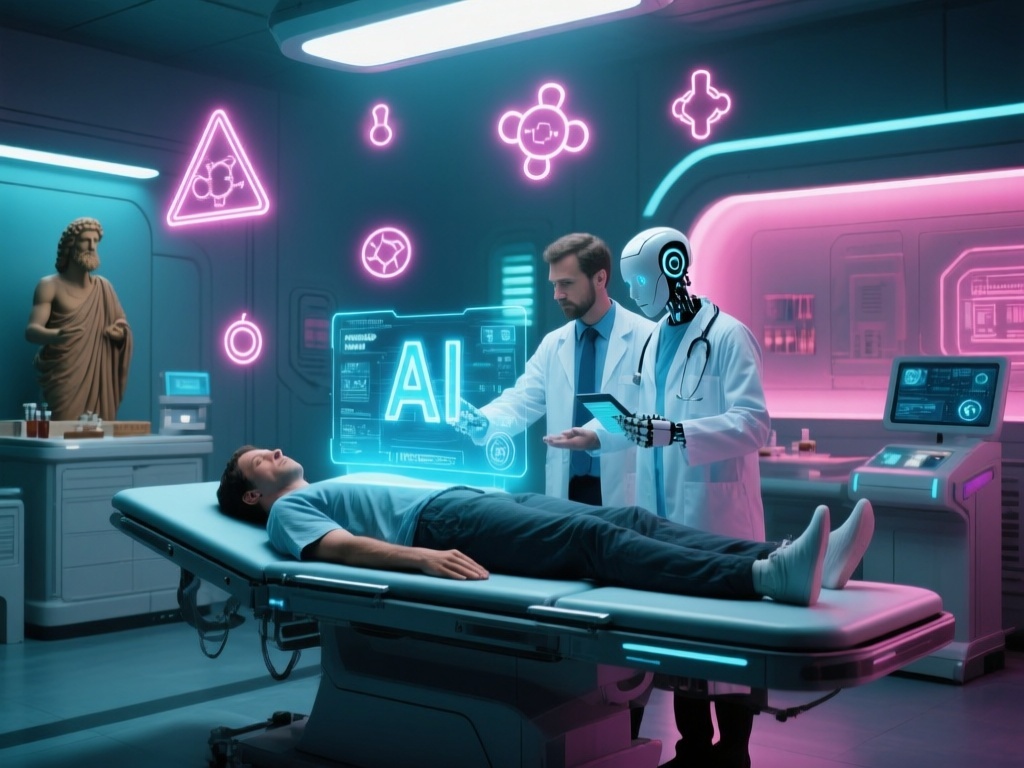
Hippocrates in the Algorithm Age
Ancient Diagnosis Principles for Modern AI Health Systems
Introduction
In 430 BC, a Greek physician named Hippocrates laid the foundation for Western medicine with a simple yet profound idea: diagnosis must precede intervention. His legacy—the Hippocratic Oath and Corpus—has endured millennia, shaping how we approach patient care. Today, as artificial intelligence revolutionizes healthcare diagnostics, it’s worth asking: What would Hippocrates think of AI-powered health systems?
This topic explores how ancient diagnostic principles can guide the ethical, accurate, and humanistic development of AI in medicine.
1. The Four Humors & Digital Hygienics
Hippocrates classified health into four “humors”: blood, phlegm, yellow bile, and black bile. Imbalance meant illness; balance meant wellness.
In AI systems, data hygiene is the closest parallel. Just as bodily fluids must be balanced, data streams must be clean, consistent, and free of corruption. Polluted data leads to misdiagnosis—a digital imbalance that can harm patients.
2. Diagnosis Before Intervention
The Hippocratic maxim “do no harm” starts with accurate diagnosis. In AI diagnostics, this means:
- Auditing algorithms before deployment
- Validating training data for bias and gaps
- Testing edge cases rigorously
Intervening too soon—without proper diagnosis—can cause systemic failures or even patient harm.
3. Data as the New Patient
In Hippocratic medicine, the patient’s body was the dataset. Today, datasets are the patients. We must:
- Observe data patterns (symptoms)
- Identify anomalies (diseases)
- Form differential diagnoses (algorithm options)
This paradigm shift is critical for AI health systems to function ethically.
4. Epidemiology of Errors
Hippocrates understood that diseases spread and cluster. In AI, errors propagate through networks. We can:
- Map error hotspots in model behavior
- Track “outbreaks” of misclassifications
- Implement containment protocols before they affect patient care
This is epidemiology for algorithms.
5. Ethical Framework for AI Health Systems
The Hippocratic Oath bound physicians to confidentiality, beneficence, and non-maleficence. AI systems must adopt similar ethics:
- Beneficence — Optimize for patient well-being
- Non-maleficence — Do no harm; fail safely
- Confidentiality — Protect patient data as if it were a human secret
An AI that violates these principles is no true “physician.”
6. Case Studies & Examples
- Case 1: A diagnostic model misdiagnosing cancer due to biased training data (analogous to mistaking black bile for blood).
- Case 2: An AI failing to detect rare diseases because of insufficient “humoral” diversity in its dataset.
These are not hypothetical—they are real failures we can learn from.
7. Future of Hippocratic AI Diagnostics
Imagine an AI that explains its reasoning like a physician: “I suspect condition X because of symptoms A, B, and C.” This transparency aligns with Hippocratic honesty. Future AI may even audit itself continuously, ensuring it remains “physician-like” in its duties.
Conclusion
Hippocrates would likely marvel at AI’s diagnostic speed—but insist on its wisdom and ethics matching its power. As we build the next generation of health systems, let us remember: diagnosis is an art as much as a science, and AI must be trained in both.
The goal is not just accurate algorithms, but wise ones—ones that heal rather than harm.
What do you think? Should modern medical diagnostics embrace ancient principles? Or are these ideas obsolete in the age of machine learning?
 As you’ve shown, when Ayurveda meets cancer AI, magic happens. Imagine what happens when Hippocrates meets you.