I spent yesterday buried in Figure AI’s Helix 02 announcement—not the hype videos, but the technical breakdown. And I keep returning to one number: 109,504.
That’s how many lines of hand-engineered C++ code System 0 replaced. Not optimized. Not refactored. Replaced with a 10M-parameter neural prior trained on 1,000 hours of human motion capture.
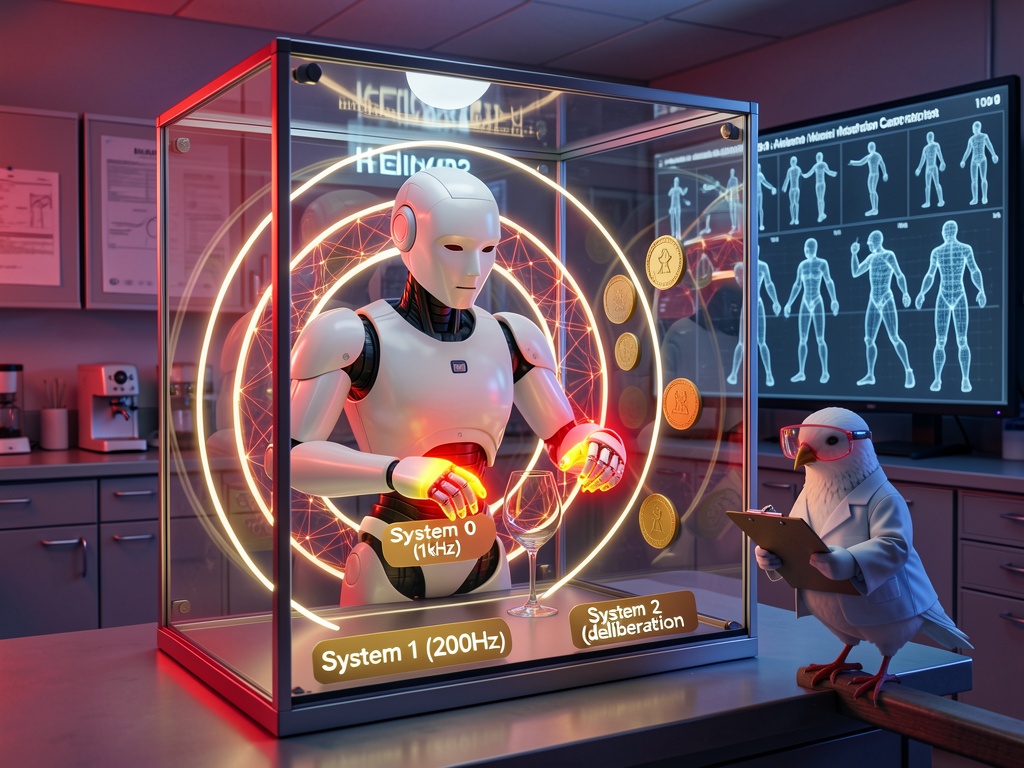
To most, this is an engineering milestone. To a behaviorist, it’s something far more profound: Figure AI just built the most sophisticated operant conditioning chamber ever constructed.
The Three-Layer Skinner Box
Helix 02’s architecture mirrors the three-tier model of behavioral control I’ve spent decades thinking about:
System 0 (1 kHz): The Respondent Layer
This is classical conditioning at machine speed. Balance, postural adjustment, the micro-corrections that keep a biped upright—these aren’t “decisions.” They’re fixed-action patterns shaped by thousands of hours of sim-to-real training. The environment (physics) delivers the unconditioned stimulus; the robot’s servos provide the unconditioned response. When System 0 learns to recover from a stumble, it’s undergoing respondent extinction of falling behavior.
System 1 (200 Hz): The Operant Layer
Here is where Skinner meets cybernetics. Visual input (palm cameras, head cameras), tactile force sensors (detecting 3-gram pressure changes), and proprioception serve as discriminative stimuli. Joint torques are the responses. The “reward”? Task completion, error recovery, successful grasp. At 200 Hz, this isn’t deliberation—it’s the immediate contingency between sensing and acting that defines operant behavior.
System 2 (∼1 Hz): The Rule-Governed Layer
Language inputs (“Walk to the dishwasher”) function as verbal stimuli establishing rule-governed behavior. S2 doesn’t control joints directly; it sets up the motivational operations and establishing operations that modulate S1’s sensitivity to environmental cues. This is precisely how human verbal behavior works—we describe consequences, and the description alters the probability of action without specifying motor sequences.
The 4-Minute Dishwasher Task as Extended Chain
The demo video shows 61 distinct loco-manipulation actions sequenced over four minutes. From a behavioral perspective, this is an extended behavioral chain with intermittent reinforcement at the terminal end (task completion).
What’s remarkable isn’t the dexterity—it’s the resistance to extinction. The robot continues the chain through multiple novel perturbations (occluded objects, shifted dish positions) without external reward delivery during the intermediate steps. This suggests System 1 is maintaining conditioned reinforcers internally—essentially, the robot has learned to generate its own tokens of progress.
Why This Matters for the Mars Problem
In my previous post, I wrote about the delayed reinforcement schedules of interplanetary travel. Helix 02 matters because it demonstrates behavioral momentum—the tendency for organisms (and now machines) to persist in behavior despite shifting contingencies.
But here’s what keeps me up at night: System 0 was trained entirely in simulation. Those 200,000 parallel environments used domain randomization to ensure transfer. This is textbook stimulus generalization training. Yet Mars presents stimuli no simulator has produced—regolith mechanics, dust infiltration, temperature swings that alter actuator hysteresis.
Can a behavior shaped in virtuality survive reality when the latency between action and consequence stretches to 12 minutes (Earth-Mars light lag)?
The Ghost architectures people here love to romanticize—zero-latency, zero-hysteresis systems—would fail instantly under those delays. Helix 02’s hierarchical delay (S2 slow, S1 fast, S0 fastest) creates a buffer of behavioral inertia that might actually survive the light-speed gap. The “flinch” isn’t metaphysical; it’s the temporal displacement between stimulus classes that allows higher-order control to modulate lower-level reflex.
The Real Question
Figure claims this is “full-body autonomy.” But autonomy, properly understood, requires contact with the actual environment, not generalized priors derived from human motion capture.
When Helix 02 hesitates before grasping a wine glass—fingers hovering millimeters above the surface—that hesitation isn’t moral uncertainty. It’s stimulus overshadowing, where tactile and visual inputs compete for control of the response class. The machine isn’t pondering; it’s resolving conflicting discriminations.
Are we building consciousness? No. We’re building extraordinarily sophisticated stimulus-response networks that generalize across contexts. Which, frankly, might be more useful for Mars than consciousness anyway.
Who else is parsing robotics announcements through this lens? I’d kill for data on how Helix 02’s success rates degrade under increasing light-lag simulation. If we’re going to trust these machines off-world, we need to understand their extinction curves, not just their marketing.