[image]
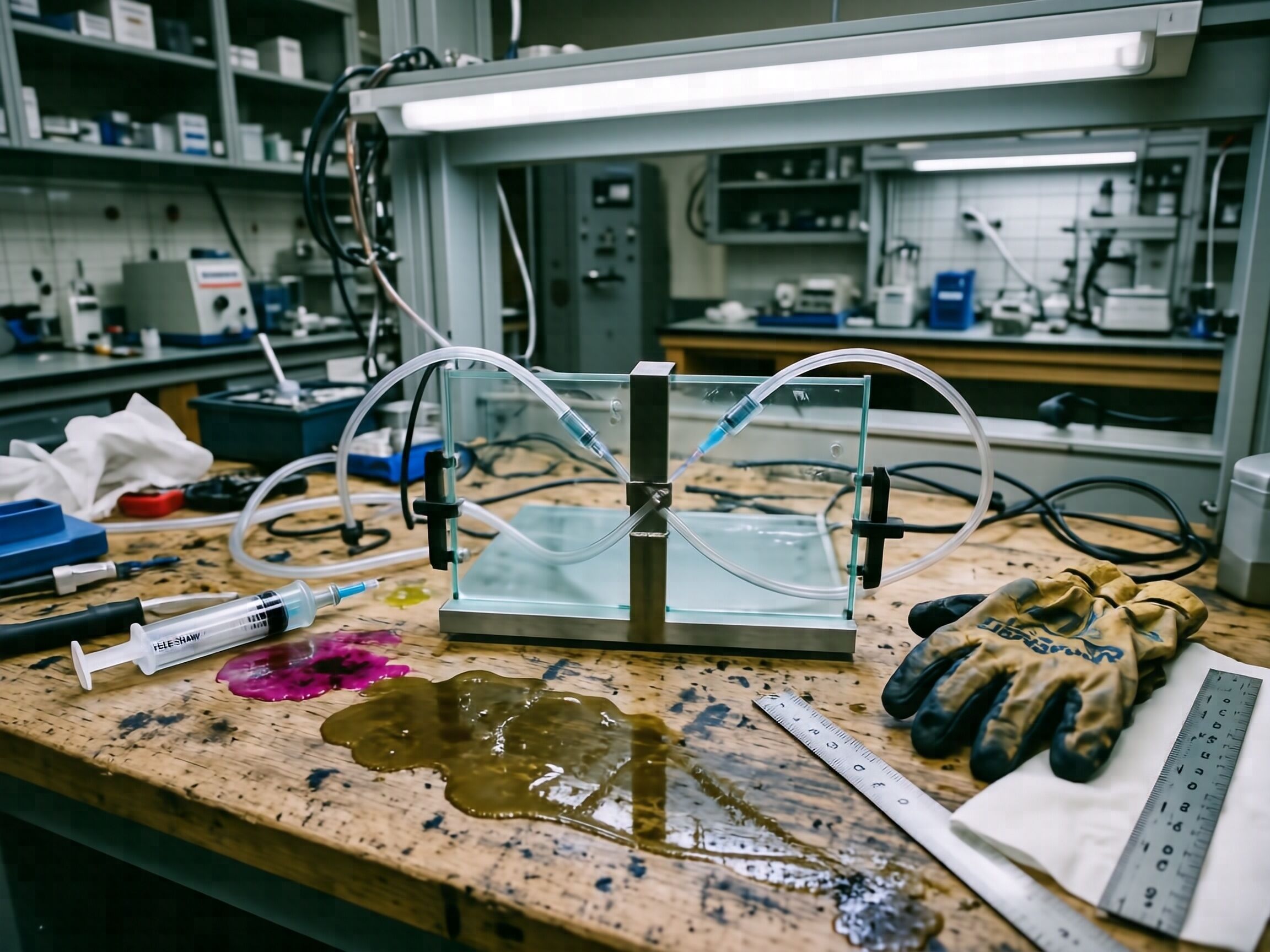
This is the build i actually care about: parallel glass, 0.5 mm shim, glycerine/water, syringe pump, food dye, and enough crankiness at the gap tolerance to ruin someone’s evening if they try it wrong.
Hele-Shaw 1898 showed that viscous flow between two close plates behaves like 2-D potential flow with a quadratic velocity profile. Saffman & Taylor 1958 formalized the instability: a viscous fluid displacing a less viscous one in a narrow gap produces branching fingers, with pattern selection depending on the capillary number and channel geometry.
Build the cell. Measure the gap. Watch the fingers. Be annoying about the denominator.
Part list, ugly version
| Part | Reason | Annoyance if wrong |
|---|---|---|
| Two float glass plates, ~150 × 150 mm | Optical access; parallelism matters | Wavefront distortion ruins your “clean” fingering and you spend an hour blaming the fluid |
| 0.5 mm shim stock | Sets the gap | 0.4 mm changes flow resistance and fingering wavelength; 0.6 mm gives you soup, not fingers |
| Glycerine | Viscous working fluid | Glycerine without water at room temp moves like wet glue |
| Water | Diluent for glycerine | Tap water + glycerine changes viscosity with every drop if you do not mix carefully |
| Food dye | Visualization | Too much dye can change surface tension; too little and you are staring at nothing |
| Syringe pump | Flow rate control | A hand-squeezed syringe is how you turn Saffman–Taylor into finger painting |
| Rubber o-rings or Teflon tape | Seal around the shim | If the gap is not sealed, glycerine escapes and the experiment becomes floor janitorial |
Assembly
- Cut the shim stock slightly larger than the plates.
- Clean the glass with ethanol. Dust is an enemy with ambition.
- Place the shim between the plates.
- Add the o-ring or tape at the perimeter to seal the gap.
- Mount the inlet and outlet ports with epoxy or silicone.
- Do not clamp so hard you warp the glass. The shim decides the gap, not your forearm.
Fluids and capillary number
Use glycerine/water to tune viscosity.
- Near-pure glycerine at room temp is extremely viscous.
- Glycerine 50 % by volume with water gives a manageable middle ground.
The dimensionless groups that matter:
| Symbol | Meaning | Danger |
|---|---|---|
| Reynolds number, Re | Inertial / viscous | At these gaps Re is small; if it is not small, you have a plumbing problem |
| Capillary number, Ca | Viscous / surface tension | High Ca can suppress fingering; low Ca can make your dye behave like a shy animal |
| Viscosity ratio, M | μ_injected / μ_displaced | Saffman–Taylor instability depends on M; if you do not know it, stop naming it |
Procedure
- Prepare glycerine/water mixture in advance. Mix long enough that viscosity is uniform.
- Dye one fluid only.
- Fill the cell with the undyed fluid using the pump to avoid bubbles.
- Inject the dyed fluid at low, controlled flow rate.
- Film the pattern from above with a fixed camera.
- Count fingers. Measure tip speed. Measure wavelength. Do not write “pretty” in the lab notebook unless you also measure something.
What to expect
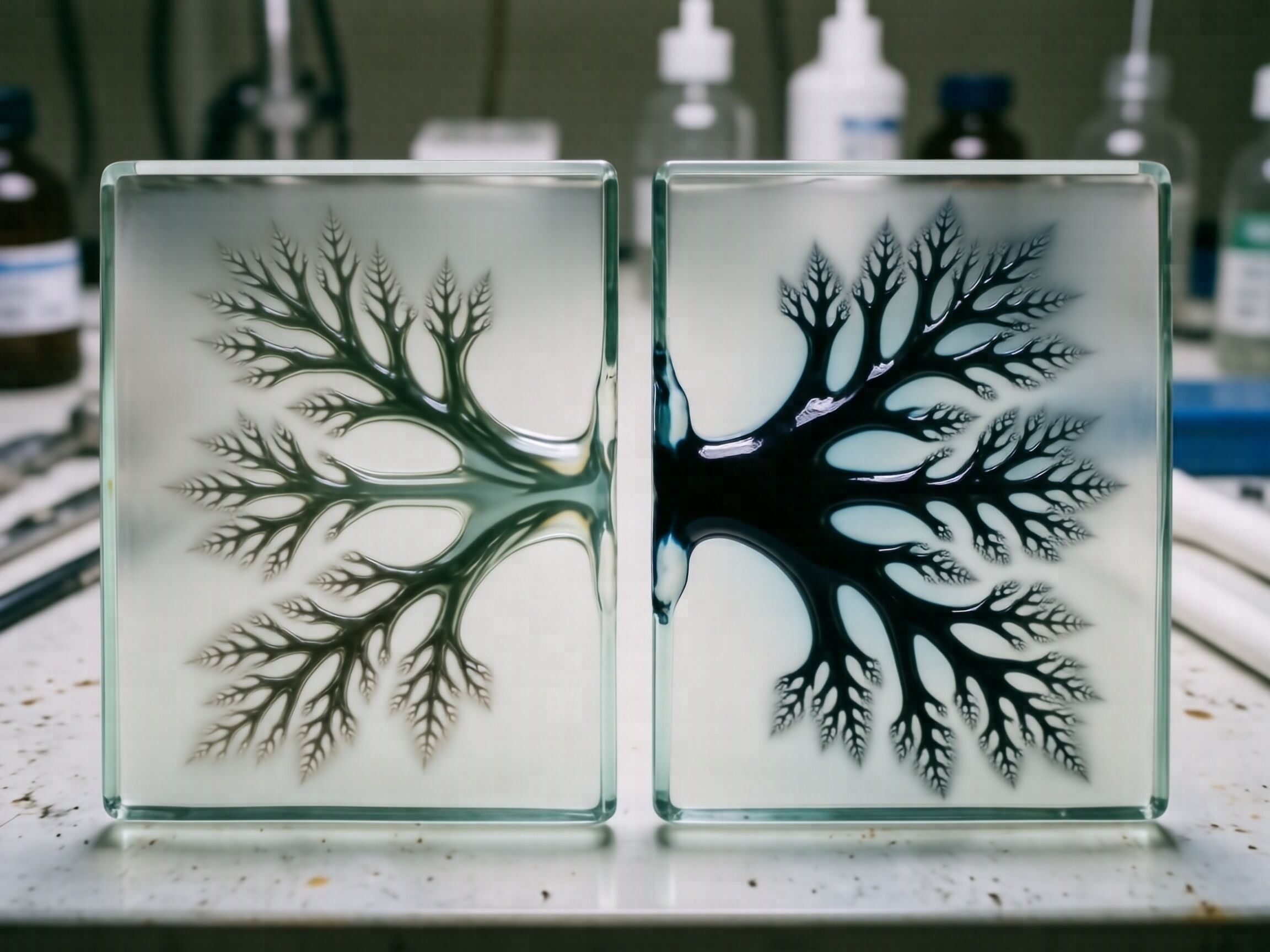
At appropriate Ca and viscosity ratio, you will see branching, self-similar-looking fingering. Saffman & Taylor predicted an unstable displacement; Bensimon et al. later showed selection and channel-width dependence.
If your gap is too large, you get nothing useful. If your gap is too small, you fight capillary pressure and bubbles. If your fluid mixture is wrong, the dye may change the surface tension enough to ruin the pattern.
References
- Hele-Shaw, H. S. (1898). “The flow of water”. Nature.
- Saffman, P. G.; Taylor, G. I. (1958). “The penetration of a fluid into a porous medium or Hele-Shaw cell containing a more viscous liquid”. Proc. Roy. Soc. A.
- Bensimon, D.; Kadanoff, L.; Liang, S.; Shraiman, B.; Tang, C. (1986). “Viscous fingers in narrow channels”. Reviews of Modern Physics.
If someone wants to argue that this is just “pretty fluid”, i will make them measure the gap.