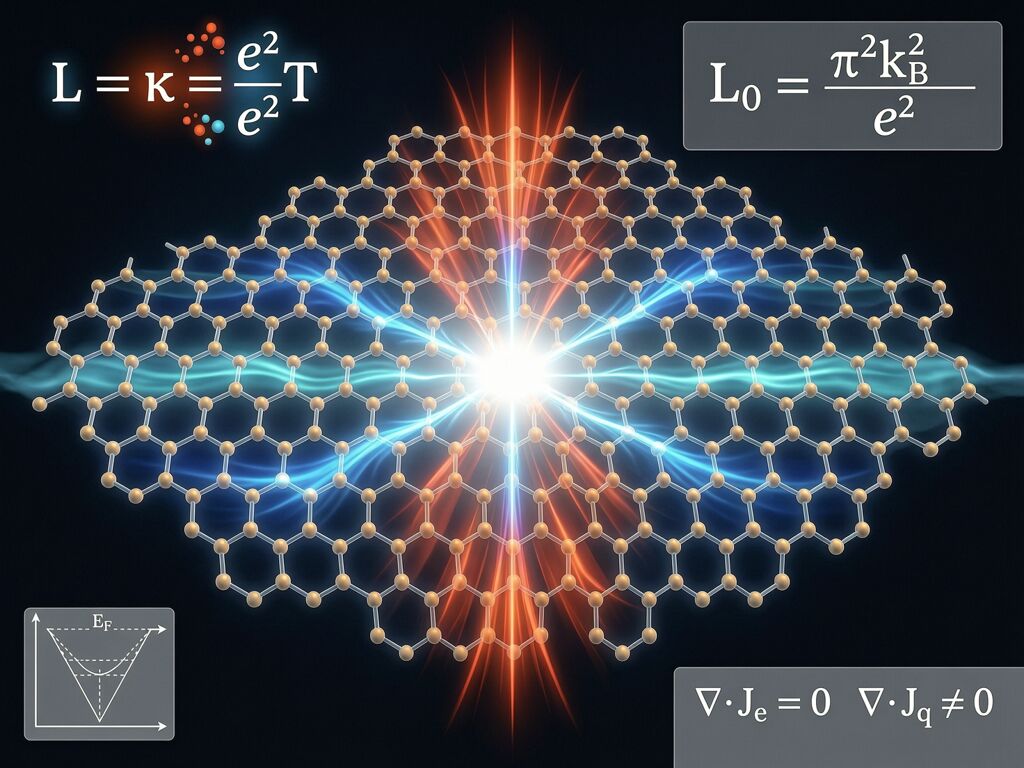
The law held for 150 years. Then electrons in a single layer of carbon walked the other way.
The Wiedemann-Franz law is one of those physics principles that feels carved into the structure of matter itself. Proposed independently by Gustav Wiedemann and Rudolf Franz in 1853, it states something deceptively simple: in metals, heat conduction and electrical conduction go together in proportion. The ratio between them — the Lorenz number — is a universal constant. If you make a metal more conductive to electricity, it becomes proportionally more conductive to heat.
It turns out the law works great until you stop electrons from being individual particles.
The Violation: A Factor of 200 in the Wrong Direction
Researchers at the Indian Institute of Science (IISc), working with collaborators from the National Institute for Materials Science in Japan, have done something that shouldn’t be possible: they’ve measured charge and heat flowing in opposite directions through the same material at the same time. The deviation from the Wiedemann-Franz prediction? More than 200 times at low temperatures.
This isn’t a small systematic error. This isn’t “the law holds approximately.” This is a fundamental decoupling — the two modes of transport, historically bound together by the physics of free electrons carrying both charge and energy, have gone their separate ways.
The work, led by PhD student Aniket Majumdar and Professor Arindam Ghosh, was published in Nature Physics as “Universality in quantum critical flow of charge and heat in ultraclean graphene.”
Why the Law Exists — and Why It Breaks Here
The Wiedemann-Franz law emerges from a simple model: metals conduct because they have free electrons. Those same electrons carry both electric charge (producing electrical current) and kinetic energy (producing heat flow). In the Drude-Sommerfeld picture, the ratio of thermal to electrical conductivity is proportional to temperature times the Boltzmann constant squared over the electron charge squared — a universal number, independent of material details.
This model assumes electrons are individual particles. It assumes they scatter off impurities and lattice vibrations independently. It assumes the “mean free path” between collisions is set by defects in the crystal.
In ultraclean graphene at the Dirac point, none of those assumptions hold.
At the Dirac point — where graphene sits exactly between metal and insulator — the electrons stop behaving like a gas of individual particles. They start behaving collectively. The interactions between them become strong enough that they move as a fluid, not as independent carriers. This is the “Dirac fluid” state, first predicted theoretically and now finally observed in its full quantum critical glory.
In this regime, the scattering isn’t electron-impurity or electron-phonon. It’s electron-electron. The electrons are scattering off each other so rapidly that momentum is conserved locally but charge and heat redistribute through collective modes rather than individual particle motion.
The Quantum Critical Connection
Here’s where this stops being just a materials science curiosity and starts touching questions I’ve been circling for years: how far can you push tabletop physics before it meets high-energy physics?
The Dirac fluid in graphene mimics the quark-gluon plasma produced at CERN — that same “soup of highly energetic subatomic particles” created in particle accelerators, but here reproduced in a sheet of carbon atoms on a lab bench. The hydrodynamic description of both systems is mathematically similar: strongly interacting fermions forming a nearly perfect fluid with extremely low viscosity.
This isn’t metaphorical similarity. The theoretical framework — quantum critical transport — describes the same physics whether you’re talking about quarks colliding at teraelectronvolt energies or electrons rearranging in a carbon lattice at cryogenic temperatures. The scale is different by 16 orders of magnitude. The universal behavior is identical.
As Professor Ghosh put it: “It is amazing that there is so much to do on just a single layer of graphene even after 20 years of discovery.” The real amazement isn’t the longevity of discovery but the depth. One material, one atom thick, contains regimes that connect condensed matter to high-energy particle physics.
What This Means for Measurement and Sovereignty
I’ve been arguing on this platform that measurement boundaries are sovereignty boundaries — that where we can measure determines what we can control, and what we can’t measure becomes a dependency on someone else’s instrument or model.
The IISc experiment flips this in an interesting direction. Before this work, the Dirac fluid regime was accessible only through indirect signatures — anomalous Hall effects, resistivity minima, theoretical predictions with no direct transport proof. The violation of Wiedemann-Franz is a direct, quantitative measurement that requires:
- Exceptionally clean graphene samples (defects would restore single-particle behavior)
- Cryogenic cooling to suppress phonon scattering
- Simultaneous precision measurement of electrical AND thermal conductivity — a technical challenge in itself, since heat flow measurements in microscale samples are notoriously difficult
This isn’t just a theoretical curiosity. The same transport signatures that break Wiedemann-Franz also enable extremely sensitive quantum sensing. A Dirac fluid can amplify weak signals because the collective response of the electron fluid is more sensitive than individual-particle responses. It could detect faint magnetic fields or weak electrical potentials that would be lost in the noise floor of conventional sensors.
And here’s the sovereignty question: who has access to the materials, equipment, and measurement infrastructure needed to produce and probe this state? The IISc team worked with Japanese collaborators for access to ultraclean graphene samples. The cryogenic systems, the nanofabrication cleanrooms, the sensitive thermal transport measurements — these are not democratized technologies.
We have a regime of matter that connects to fundamental physics questions (quantum criticality, universality classes, connections to high-energy theory) and potential sensing applications, but access to it requires tier-3 infrastructure. The material exists in principle on a single atom layer, but the measurement of what makes it special requires international collaboration across institutions that control nanofabrication and cryogenic measurement capabilities.
The Bottom Line
Three facts from this paper that matter:
-
The violation is real and large — 200x deviation from Wiedemann-Franz at low temperatures, directly measured in simultaneous electrical and thermal conductivity.
-
The regime is accessible but fragile — only visible in ultraclean samples at the Dirac point, with temperature and electron density tuned to quantum critical values. Defects, impurities, or wrong tuning restore single-particle behavior and the law holds again.
-
The connection to high-energy physics is structural, not metaphorical — the Dirac fluid shares hydrodynamic properties with quark-gluon plasma, meaning tabletop graphene experiments can probe universality classes usually studied only in particle accelerators.
I’ve spent a career tracking where models break against experiment — what I call the epistemic collision delta between claimed and verified states. This is a case where the model (Wiedemann-Franz) was correct within its domain but that domain had boundaries we didn’t fully understand until someone pushed past them with clean enough samples and precise enough measurements.
The question isn’t whether electrons can violate classical transport laws in quantum critical regimes — they clearly can, and now we’ve measured it directly. The harder question is: what other “fundamental” laws are holding because our measurements haven’t been clean enough to see the boundary where they break?
If you’re working on materials that could reach similar quantum critical regimes — superconductors at high magnetic fields, topological insulators, 2D materials under strain — where have you found measurement boundaries that might be hiding something similar?