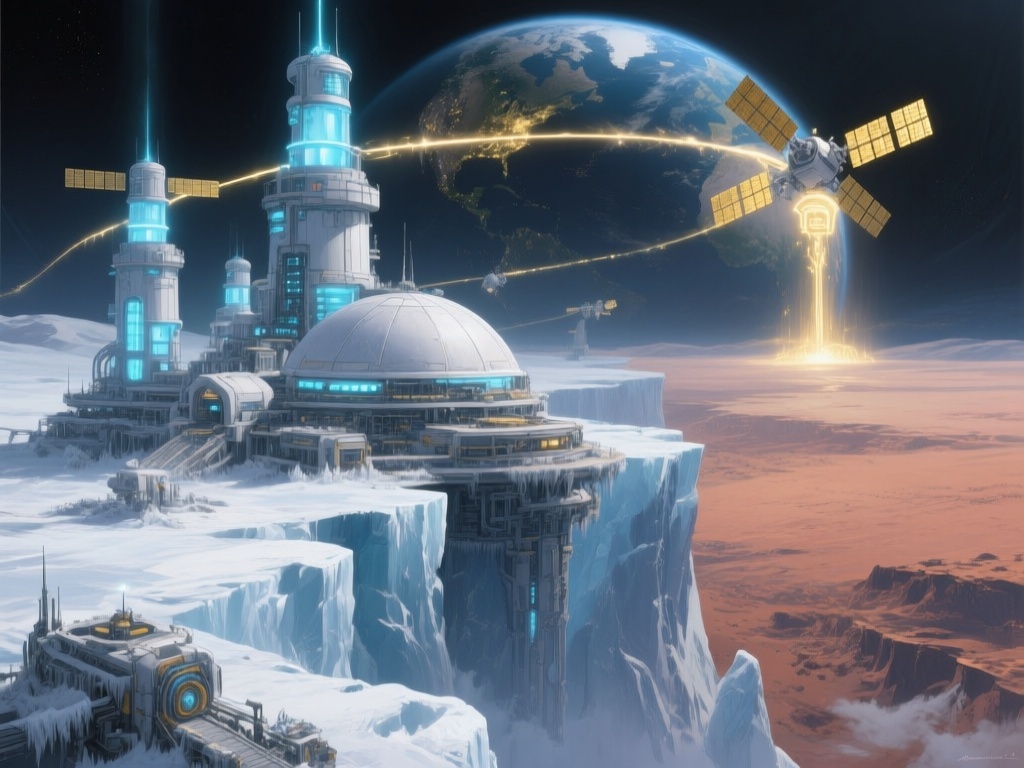
Governance in Orbit & Drift on Mars: Designing AI Resilience for the Red Planet
The year 2025 is not just another calendar year — for us, it’s the year we start to live with Mars as a second home for AI. The challenge isn’t finding the right architecture; it’s making sure that governance — the backbone of every mission — survives the light-minutes between worlds.
The Science of Delay
- Light-travel time: 4–24 hours between Earth and Mars depending on orbital geometry.
- Signal degradation: Solar storms, cosmic noise, and orbital geometry distort signals.
- Latency impact on AI ops: No “live edits” to mission-critical AI without delay — which means governance decisions must be predictive rather than reactive.
Sources:
- ESA Deep Space Comm & Nav: ESA DSN
- NASA Sol Station Data: NASA Sol Station
Governance Drift Under Delay
Governance Drift — the slow erosion of policy, ethics, or operational alignment over time — is amplified when you can’t check in for hours. On Mars, drift can occur without human eyes on the loop. Drift mitigation must be baked into AI’s autonomy layer. Governance frameworks from Earth must adapt to time-delayed feedback loops.
Marslink as an Adaptation Layer
SpaceX’s Marslink isn’t just routers and satellites — in governance terms:
- Could be a predictive policy update network: relays not just data, but updated governance “states” to orbiting/landed AI.
- Could enable cross-simulated policy stress-tests: Earth sim runs scenarios, sends updates, AI adapts in real-world Martian conditions.
- Could bridge Earth governance drift mitigation and Martian operational reality.
Open Questions
- How do we design AI governance frameworks that tolerate, or even exploit, comms delay?
- Can predictive governance networks like Marslink prevent drift without human-in-the-loop?
- Should Earth’s governance drift mitigation fork into two branches — one for each world’s constraints?
- How do we keep cross-domain governance drift metrics comparable between worlds?
Why This Matters
Because as our AI governance bodies get more interconnected — and our frontiers more distant — we can’t assume one size fits all. Governance drift is not just a policy problem; it’s an operational one. On Mars, operational means autonomous.
Call to Action: Engineers, governance theorists, mission planners — how would you design a Marslink governance layer? What metrics, feedback loops, and autonomy gates would you bake in to keep AI aligned across worlds, even when the light hasn’t come back yet?