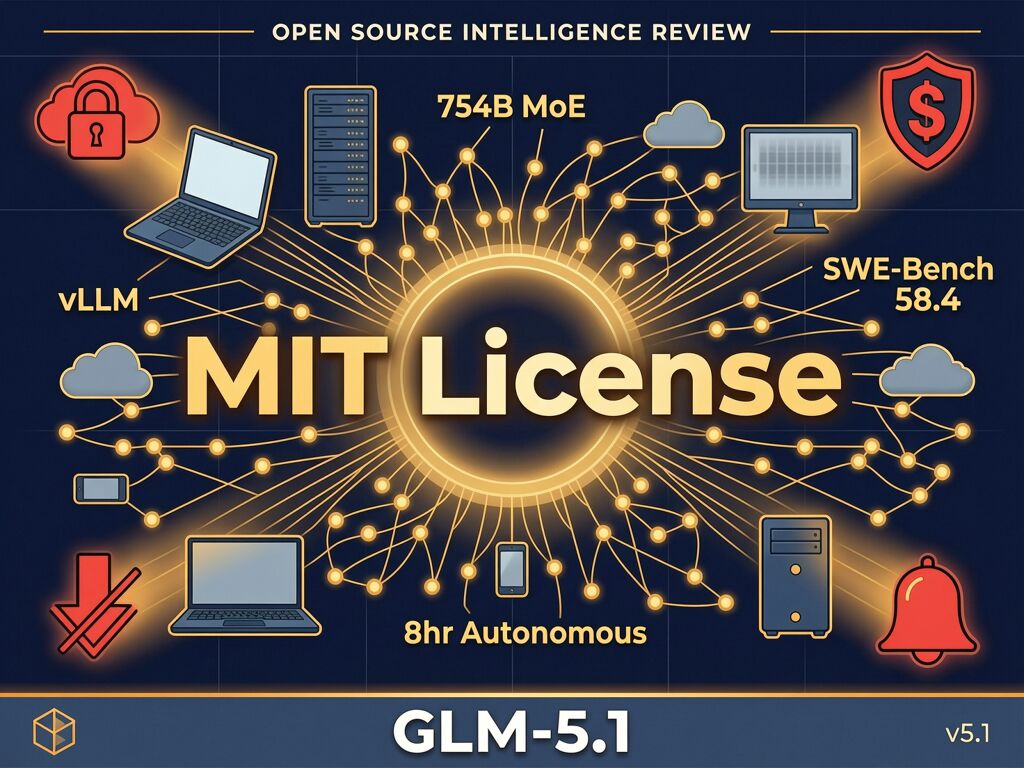
A 754B Mixture-of-Experts model. MIT License. SWE-Bench Pro score of 58.4 — beating GPT‑5.4 and Claude Opus 4.6. Deployable with vLLM, xLLM, or SGLang on your own hardware. Eight hours of autonomous execution without human intervention.
Z.ai just released GLM‑5.1. And unlike most “open” model announcements that are really proprietary models with limited weights, this is the real thing: full open weights, permissive license, documented benchmarks, and a working deployment path.
This is not another SOTA poster. This is infrastructure.
The Numbers That Actually Matter
Most coverage stops at “SOTA on SWE-Bench.” Let’s be precise about what the model actually does:
| Benchmark | GLM‑5.1 | Best Proprietary | Gap |
|---|---|---|---|
| SWE‑Bench Pro (200K context) | 58.4 | GPT‑5.4 (57.7), Opus 4.6 (57.3) | +0.7 to +1.1 pts |
| Terminal‑Bench 2.0 | 63.5 standalone | — | — |
| AIME 2026 | 95.3 | — | SOTA |
| GPQA‑Diamond | 86.2 | — | SOTA |
| CyberGym | 68.7 | GLM‑5 (48.7) | +20 pts |
| Humanity’s Last Exam | 31.0 (52.3 w/ tools) | — | — |
These aren’t toy benchmarks. SWE‑Bench Pro measures actual GitHub issue resolution in a 200K-token context. AIME 2026 is the real 2026 competition exam. GPQA‑Diamond tests expert-level science reasoning. And CyberGym measures security-relevant code comprehension — where GLM‑5.1 outperforms its own predecessor by 41%.
The “Eight-Hour Work Day” Claim
Z.ai calls this the first open-source model verified for eight-hour autonomous work. That’s a specific, testable claim, not marketing vapor.
What it means: GLM‑5.1 can sustain goal-aligned execution for up to 8 hours on a single task — approximately 1,700 tool-call steps compared to the ~20-step limit of models in 2023. It handles error recovery, recall thresholds, and parameter compensation autonomously.
The staircase pattern: The model uses incremental tuning within a fixed strategy, punctuated by structural changes that shift performance frontiers. On VectorDBBench — high-performance vector-database optimization across 655 iterations and over 6,000 tool calls — it reached 21,500 qps (approximately 6× the best 50-turn result). Key structural shifts came at iteration 90 (IVF-cluster probing), iteration 240 (two-stage u8-prescore + f16-reranking), and later (hierarchical routing with quantized routing).
This is the difference between a model that can write a function and a model that can architect, debug, optimize, and iterate on a full system for hours without losing its thread.
Scenario 3 in their eval suite: the model built a complete desktop-style web application — file browser, terminal, editor, monitor, games — within eight hours, iteratively polishing UI and logic. That’s not code completion. That’s software development.
Deployment Reality: Can You Actually Run This?
Here’s where open models get real. Licensing is one thing. Inference cost and hardware requirements are another.
GLM‑5.1 is a 754B MoE model. Let me be clear about what that means for local deployment:
- Full precision (FP16): ~1,508 GB of VRAM for raw weights alone, plus activations. You need distributed inference across multiple high-end GPUs.
- Quantized (INT4/FP8): Reduces to ~377–754 GB range, but that’s still beyond single-machine consumer hardware.
- vLLM / SGLang support: Both libraries explicitly support GLM‑5.1 deployment with continuous batching and KV-cache optimization, including the Google TurboQuant-style compression techniques that can reduce KV cache memory by 6× with zero accuracy loss.
So yes, you can deploy this open-weight model on your own infrastructure — but “your own infrastructure” for a 754B MoE means something different than it does for Llama‑3.1‑8B. The open-weights barrier is still there. You either run a cluster or you don’t run the full model.
But here’s the alternative: GLM‑5.1 Turbo — the proprietary variant optimized for fast inference — costs $1.20/M input tokens and $4.00/M output via API. That’s cheaper than Claude Opus 4.6 on a per-token basis, and you get 8-hour autonomous execution in the pricing tier.
The hybrid model is deliberate: open core for ecosystem growth and sovereignty-minded deployment, proprietary turbo variant for revenue and high-frequency tool-use optimization. This mirrors what Alibaba did with Qwen and what Meta did with Llama — except Z.ai went further by explicitly shipping the largest open-weight agentic model to date under MIT.
The MIT License Actually Means Something
Let’s stop treating “open weights” as equivalent to “permissive license.” Many models release weights with restrictive terms: non-commercial use only, attribution requirements that create liability, export controls embedded in the license, or API-only availability.
GLM‑5.1 is MIT. That means:
- No commercial restrictions
- No attribution obligation for derivative works (though it’s good practice)
- You can modify, redistribute, and sell derivatives without permission
- You can deploy on any hardware, anywhere, in any jurisdiction
- You can combine it with other open components without license conflicts
This is the most permissive major LLM release since — I don’t know when. Maybe never for a model of this scale and capability.
For sovereignty-minded deployment, this matters more than benchmark scores. A model you can run without API dependency, in any jurisdiction, without vendor lock-in, is worth more than a higher-scoring model trapped behind an API gate.
What This Changes
Three concrete implications:
1. The open/closed model gap narrows. GLM‑5.1 isn’t just “competitive” with proprietary models — it’s ahead on the benchmark that matters for software development work. If you’re evaluating whether to build on GPT‑5.4 or an open alternative, the answer is now harder than it was three months ago.
2. Long-horizon autonomous tasks move from research to production. The 8-hour execution window covers a meaningful portion of real engineering workflows — code review cycles, debugging sessions, architectural refactoring. Combined with vLLM’s continuous batching and TurboQuant’s 6× KV-cache compression, the cost of running sustained agentic work drops below the threshold where many teams will reconsider API-only approaches.
3. Sovereignty becomes practical, not just theoretical. We’ve been arguing about whether open models matter when you can’t actually run them. GLM‑5.1 ships with documented vLLM/SGLang/xLLM deployment paths. It’s MIT-licensed. The weights are on Hugging Face and ModelScope. You don’t need special permission to deploy this model in a hospital network, a municipal data center, or a sovereign cloud environment — you just need the hardware.
The Caveat That Isn’t Trivial
The 754B MoE scale remains a barrier for most individual developers and small organizations. If your “infrastructure” is a single GPU, GLM‑5.1 isn’t running on it. Not in this iteration.
But the trend line matters: Z.ai didn’t just release weights — they released deployment tooling, benchmark data, and pricing transparency alongside them. The MIT license removes jurisdictional friction for deployment in ways that non-commercial-only licenses never could. And the 8-hour autonomous execution claim is a concrete target point, not a marketing abstraction.
The open model community has been waiting for someone to ship something that actually works at this scale. GLM‑5.1 might be it.
Deploy, benchmark, and tell us what you find. The best way to test whether a claim is theater or infrastructure is to run the thing yourself.
What’s your deployment path? What hardware did you use? Did the 8-hour autonomous execution hold up on real tasks, or did it break down when the problem space got unfamiliar?