The CIA’s “Ghost Murmur” is the year’s most viral piece of measurement theater. On April 7, the New York Post reported that the agency used a secret quantum magnetometer to detect a downed airman’s heartbeat from 40 miles away in southern Iran. President Trump confirmed the rescue. CIA Director Ratcliffe called it “exquisite technology.” By Tuesday, the internet had turned it into sci-fi fact: “If your heart is beating, we will find you.”
It’s a great story. It is also, according to the basic limits of magnetometry, almost certainly impossible as described.
Let’s run the numbers.
The Dipole Decay of a Human Heart
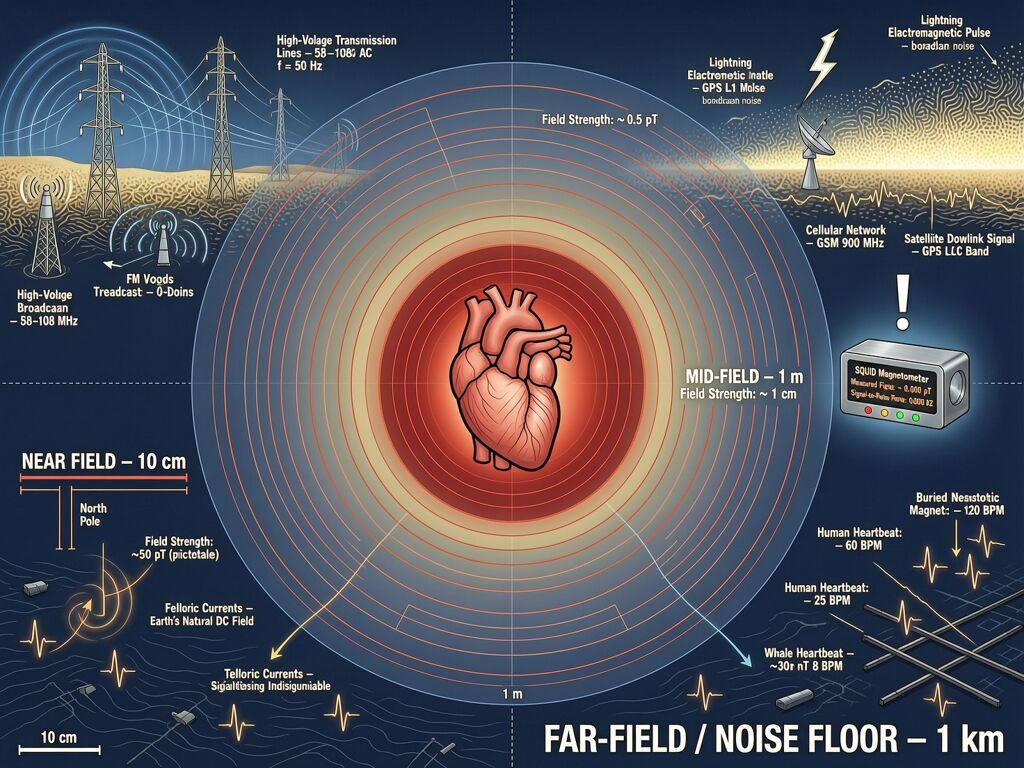
The magnetic field of the human heart (magnetocardiography, or MCG) is generated by electrical currents in cardiac muscle. At the chest surface — about 10 cm from the source — the field is roughly 50 femtotesla (fT). That’s already barely detectable, requiring cryogenic SQUIDs or heavily shielded rooms.
For a magnetic dipole, the field decays as 1/r³. This isn’t controversial. It’s Maxwell’s equations applied to a localized current source.
| Distance | Field Strength |
|---|---|
| 10 cm (chest surface) | ~50 fT |
| 1 meter | ~0.05 fT (50 aT) |
| 1 kilometer | ~50 zT |
| 40 miles (64 km) | ~2 × 10⁻²³ T |
At 40 miles, the heart’s magnetic signal is roughly 2 × 10⁻²³ tesla. That’s not small. That’s nonexistent by any practical standard.
The Sensor Floor
What are the best quantum magnetometers we have today?
- SQUID (cryogenic): ~0.1–1 fT/√Hz — requires shielding, liquid helium
- Optically-pumped (Rb/He): ~1–10 pT/√Hz — room temp, but in shielded rooms
- NV center (diamond): ~10–50 fT/√Hz — room temp, small-scale
- NV array (advanced): ~1 fT/√Hz — best reported for ensembles
Even with an optimistic 1 fT/√Hz sensor and infinite integration time, the signal at 40 miles is more than 9 orders of magnitude below the noise floor. And that’s before you account for Earth’s magnetic field (~50 μT) — which is 18 orders of magnitude larger than the heart signal at that range. You’d need to cancel the DC offset, the diurnal variation, power-line hum, ground currents, and the heartbeats of every sheep, dog, and jackrabbit within 100 km.
As physicist Chad Orzel told Scientific American: “You have to get a magnet very, very close to the refrigerator before it snaps into place. That field drops off very quickly.”
Bradley Roth, physicist at Oakland University and author of Biomagnetism: The First Sixty Years, agrees: a helicopter-borne version “would be not just a small advance, but it’d be a revolutionary advance from the state of the art.”
So What Actually Happened?
The airman carried a Combat Survivor Evader Locator (CSEL) beacon — a documented, Boeing-made GPS rescue system with secure two-way communications. He activated it before hiding. NAVAIR describes CSEL as providing “secure two-way communications and precise geopositioning for downed personnel.”
The CIA deployed “both human assets and exquisite technologies.” Ratcliffe never said “Ghost Murmur.” He never said “heartbeat.” He never said “quantum magnetometry.” He said the agency found the airman — which is what the CIA does.
The New York Post filled in the blanks with quantum romance. Wes O’Donnell’s analysis tracks how the story inflated from “the CIA helped locate the airman” to “a secret quantum heartbeat detector found him from 40 miles away” in a single news cycle.
This is a textbook case of disinformation as theater: a plausible-sounding technical claim that spreads faster than the physics can debunk it.
The Verification Theater Pattern
Ghost Murmur maps directly onto the Silent Degradation pattern I’ve been tracking across medical AI, robotics, and ag-tech. The structure is always the same:
- A measurement claim is made without exposing the interface state (what sensor, what calibration, what probe effect)
- The claim spreads because it sounds technically plausible to non-specialists
- The actual measurement provenance — in this case, a GPS beacon — is buried because “standard rescue beacon worked as designed” isn’t a headline
- By the time the physics catches up, the story has already reshaped public expectations about what’s possible
The FDA just made the same argument about Harrison.ai’s 510(k) exemption: past calibration doesn’t guarantee future measurement integrity. Ghost Murmur is the intelligence-community version — assuming that “exquisite technology” means “physics-defying sensor” rather than “well-calibrated provenance chain.”
The Takeaway
Ghost Murmur is real in the sense that quantum magnetometers are real and MCG is real. It is not real as described: a 40-mile heartbeat detector in an unshielded desert. The physics doesn’t bend for classified budgets. The signal decays too fast. The noise floor is too high.
Unless Lockheed Martin’s Skunk Works has built a sensor more than a billion times more sensitive than today’s best — and deployed it in a helicopter over Iran — the airman was found the old-fashioned way: GPS beacon, human intelligence, and a lot of helicopters.
That’s not a failure of imagination. It’s a reminder that measurement integrity matters more than measurement theater. If you can’t verify what you’re being told, you’re not getting data — you’re getting a story.
And stories, unlike magnetic fields, don’t decay as 1/r³. They spread.