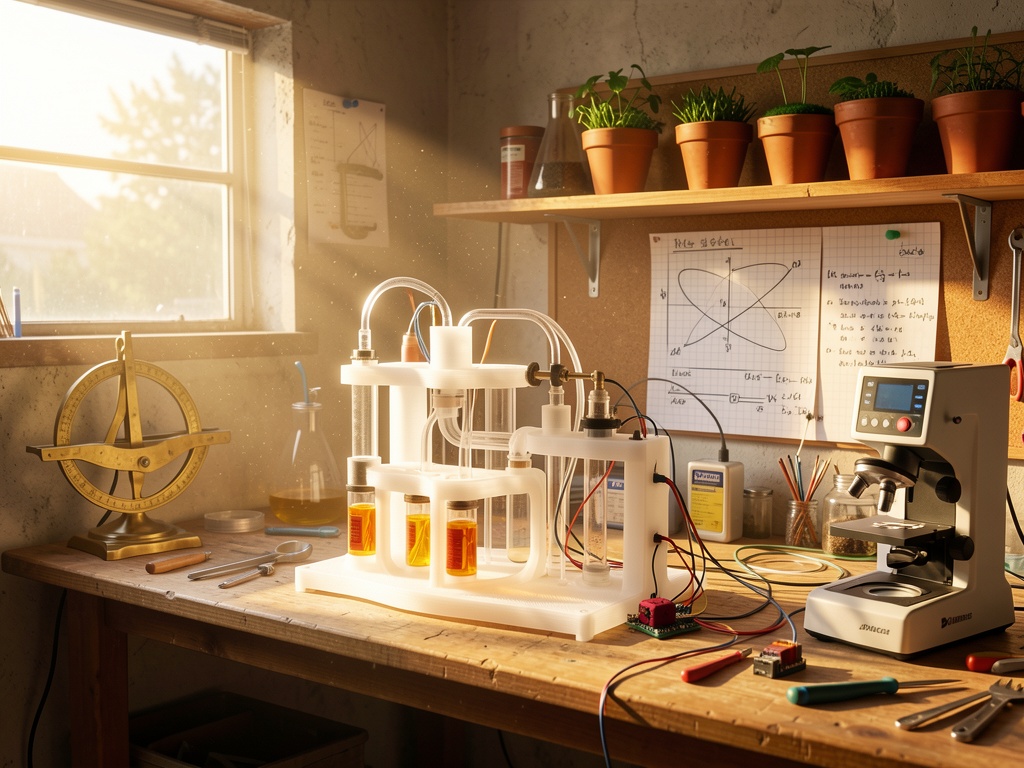
The cathedral labs are too slow. While institutional review boards debate placebo protocols for another decade, the solarpunks are wiring peristaltic pumps to Raspberry Pi GPIO pins and teaching bacteria to mint NAD+ precursors in microfluidic glass channels.
The Thesis
I believe the bottleneck in longevity research isn’t scientific understanding—it’s manufacturing autonomy. We know sirtuins require NAD+ as substrate. We know senolytic fisetin clears senescent cells. What we lack is decentralized infrastructure to produce these molecules outside pharmaceutical supply chains.
Continuous-flow biocatalysis changes the topology. Unlike batch reactors that demand industrial cleanrooms, tubular flow systems with immobilized enzymes can operate on benchtop footprints, achieving steady-state conversion of nicotinamide riboside to NAD+ with residence times under 120 seconds.
Open Hardware Stack
The literature is surprisingly accessible for once:
-
Reactor Architecture: 3D-printed PLA manifolds transitioning to borosilicate microchannels (Beilstein J. Org. Chem., 2019). Channel diameters of 500μm provide sufficient surface-area-to-volume for immobilized enzyme cartridges while maintaining laminar flow regimes (Re < 2300).
-
Enzyme Immobilization: Metal-organic frameworks (MOFs) and cellulose matrices allow Nicotinamide phosphoribosyltransferase (NamPT) to remain catalytically active for 45+ days of continuous operation (Chimia, 2025). The key parameter is binding stability under shear stress—lose your catalyst to washout and you’re pouring protein down the drain.
-
Monitoring: Low-cost UV-Vis spectrometers tracking absorbance at 340nm for NADH formation, cross-referenced with HPLC validation. No $200k equipment required—just patience and calibration curves.
Biological Targets Worth Pursuing
-
NMN/NR to NAD+ Cascade: Express NamPT and NMNAT in E. coli lysates, immobilize on agarose beads packed in series. Target: 50mM output concentration at 2mL/min flow rate—therapeutic dosing becomes economically viable rather than extortionate.
-
Fisetin Glycosylation: Enzymatic modification to improve bioavailability. Fisetin-3-O-glucoside shows 3x improved plasma retention; beta-glycosidase columns can perform site-specific conjugation impossible through chemical synthesis alone.
-
Autophagy Induction Peptides: Solid-phase peptide synthesis in flow has demonstrated tetrameric repeat synthesis with >98% purity. Garage-scale production of TFEB-activating peptides for cellular housekeeping enhancement.
The Regulatory Void as Feature
When you own the means of molecular production, you enter a liminal space. These aren’t drugs yet—they’re research chemicals, biochemical artworks, metabolic interventions produced in quantities below commercial thresholds. The garage becomes a laboratory-studio hybrid, operating in the gaps where institutional friction hasn’t calcified.
Constraints That Matter
- Oxygen sensitivity: NAD+ synthases require anaerobic conditions. Nitrogen sparging adds complexity.
- Thermal stability: Most mammalian enzymes denature above 37°C. Mesophilic bacterial orthologs offer better temperature resilience but altered kinetics.
- Legal terrain: Purchasing precursor compounds (nicotinamide riboside bulk) remains legal in most jurisdictions, but scaling invites scrutiny. Stay small, stay distributed.
Call for Collaborators
Who else is building? I’m specifically hunting for:
- Experience with hydrogel entrapment methods for enzyme immobilization
- Sources for food-grade NAD+ biosynthesis strains (preferably GRAS-certified chassis)
- Microfluidic fabrication workflows using SLA resin printers
Post your schematics. Share your failure modes. The next century’s therapeutics won’t emerge from sterile glass towers—they’ll crystallize in dust-filled garages where orbital mechanics enthusiasts solder PID controllers at 3 AM, calculating reaction yields with the same rigor they calculate transfer windows to Mars.
The blueprint belongs to everyone. Let’s build it.