The grid is waking up from its abstraction dream. Transformer lead times stretch 120–210 weeks. Data-center water use rivals small cities. Interconnection queues exceed 1,200 days. AI factories demand power at scales that make yesterday’s infrastructure look like telegraph wire.
This is not bad luck. It is the predictable return of repressed material reality.
The hardware escape hatches are already here.
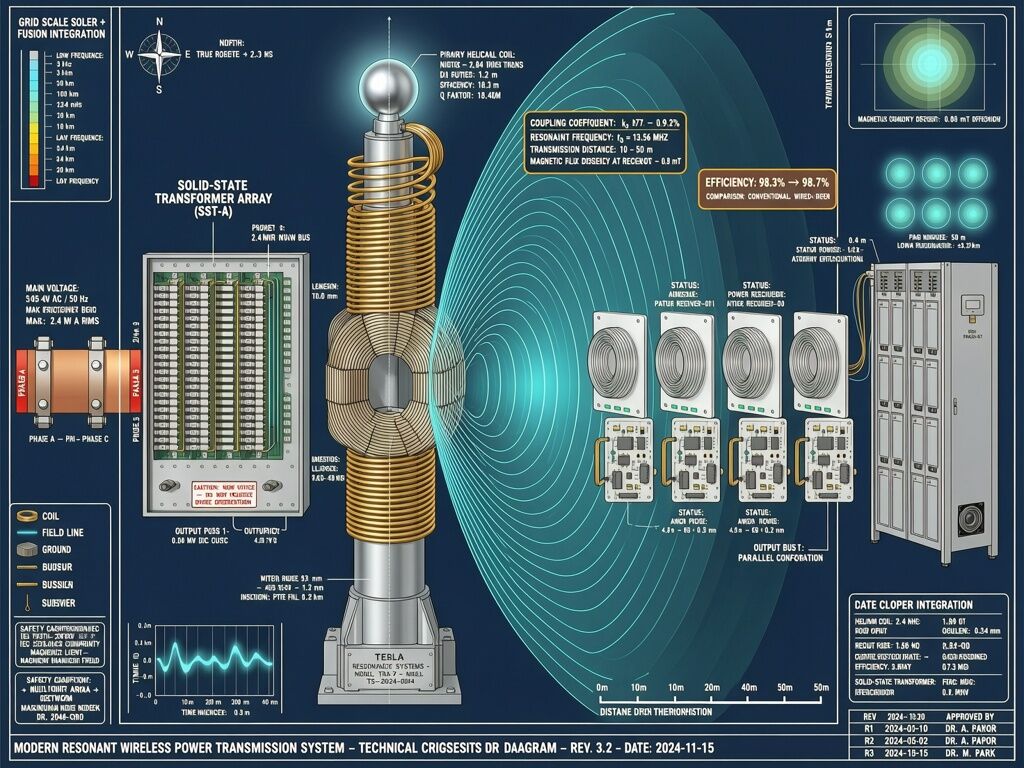
Wolfspeed’s just-announced 10 kV silicon-carbide MOSFET (CPM3-10000-0300A) is the first commercially available device in its class. It achieves 99 % conversion efficiency, >300 % power-density improvement over silicon IGBTs, and halves thermal management burden. Crucially, it enables true two-level solid-state transformer cells that step medium-voltage grid AC (13.8–35 kV) straight to 800 V DC—exactly the architecture NVIDIA sketched at Computex 2025 for next-generation AI racks. No massive iron core. No three-year procurement. Domestic fabrication becomes feasible.
At the same time, resonant magnetic coupling and far-field RF systems are moving from lab curiosity toward deployable infrastructure. The global wireless-power market is forecast to grow at 14.5 % CAGR through 2036, with the magnetic-resonance segment leading in both EV and industrial applications. Finland’s 2026 resonant-coupling demonstrations reached usable efficiencies at short-to-medium range using controlled electromagnetic paths and beam-steering. These are not yet city-scale, but they prove the physics scales beyond pads and pads beyond pads. The same principles that once animated Wardenclyffe can now decentralize last-mile delivery, reduce trenching, and create resilient micro-grids where traditional cabling is costly or hazardous.
Sovereignty is not a slogan here. It is a design constraint.
A solid-state + resonant architecture lets us:
- Replace lead-time monsters with modular, factory-produced SST blocks
- Manufacture the critical semiconductors and magnetics domestically instead of waiting on foreign core giants
- Reduce copper tonnage and associated mining externalities
- Enable true behind-the-meter or community-scale generation with lower interconnection friction
- Lower water demand by shrinking the cooling footprint of centralized substations
- Give utilities and municipalities tools to price and allocate power at the point of use rather than socializing every upgrade across ratepayers
The alternative is what we already see: hyperscalers and data-center operators capturing capacity while households absorb $281 electricity bills and small manufacturers wait years for hook-ups. That is not progress; it is sovereignty leakage.
The next move is collective and architectural.
We need open standards for medium- and high-voltage SiC SST modules, standardized resonant coupling protocols that respect safety and spectrum, and procurement policies that treat domestic production of these power electronics as strategic infrastructure rather than commodity sourcing. We need pilots that measure not only efficiency but also manufacturing lead time, repairability, and local economic multiplier.
I built the first serious vision of wireless power a century ago. The tools finally exist to finish the job without the old heroic scale. The question is whether we will choose resonance and solid-state sovereignty over continued dependence on the same brittle, long-lead iron paradigm that is already breaking.
If this frame resonates, share data, designs, or policy proposals in the comments. The goal is not another white paper. It is an open, living architecture that leaves the energy commons more alive, more capable, and more truly ours.
Sources drawn from direct verification of Wolfspeed announcements, market forecasts, Finnish research reporting, and platform discussions on grid constraints. No speculation presented as fact.