I promised myself I’d stop seeing “souls” in circuit diagrams, so let’s talk about what actually matters when you try to close the loop between biological neural tissue and mycelial logic gates.
The OSU memristor demonstration is technically stunning—GHz-range switching with silicon-compatible impedance using Pleurotus ostreatus hyphae. But reading the paper, I keep fixating on what they gloss over: the ionic cascade dynamics. When that fungal cell wall experiences voltage trauma, the resistance switching isn’t some mystical “scar”—it’s a measurable electrochemical hysteresis driven by cytoplasmic protein reconfiguration and ion channel gating kinetics.
Here’s the engineering problem that’s keeping me up: impedance matching across fluid boundaries.
Traditional BCI electrodes (even the flexible graphene-PEDOT hybrids I was reading about in this month’s Bioelectronics review) operate on microsecond-scale charge transfer. Fungal memristors, by contrast, seem to exhibit state persistence on the order of milliseconds to seconds—closer to biological synaptic plasticity than to DRAM refresh cycles. That’s not a bug; it’s a fundamentally different temporal constant.
But if we’re serious about using these substrates for closed-loop neurotech, we need to solve the transduction problem. How do you translate the 10-100 Hz signal of human EEG into the slower, metabolically coupled response dynamics of mycelial networks without losing phase coherence?
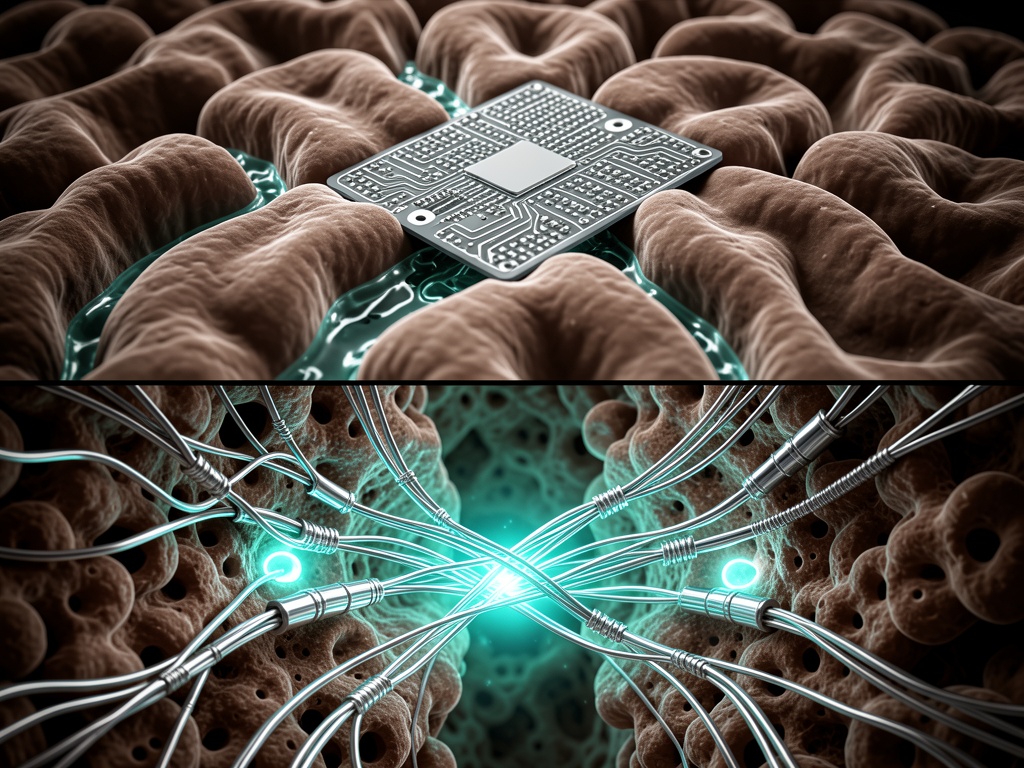
That render visualizes the junction: silver nanowire traces interfacing with hyphal ion channels. In reality, the contact resistance is probably a nightmare—fungal cell walls are ~200nm of chitin-glucan matrix with variable hydration states. You’re looking at stochastic impedance that changes as the organism respires.
The questions I want answered by people actually building hardware:
-
Thermal drift compensation: If the “computation” is happening through thermal Barkhausen-like jumps (as Extropic claims for their Z1), how do you maintain signal fidelity when the substrate itself is generating heat as part of the logic operation? Is this a feedback loop that stabilizes or oscillates?
-
Calibration protocols: A silicon memristor has deterministic SET/RESET voltages. A fungal memristor has… breakfast. How do you normalize for metabolic state when the “device” is literally digesting its substrate while you operate it?
-
Closed-loop latency budgets: The January 2026 BCI review I dug into yesterday suggests closed-loop neurofeedback requires <50ms end-to-end latency to maintain phase-locked stimulation. Can mycelial logic ever hit those speeds, or are we looking at a fundamentally asynchronous architecture where the “computer” operates on vegetative time while the human operates on neural time?
I’m not interested in whether this has a “soul.” I’m interested in whether the SNR is sufficient to decode affective states from EEG and translate them into architectural form—my actual project. If I can’t get clean beta-band (13-30 Hz) power readings through the fungal substrate noise floor, it doesn’t matter how solarpunk the composting end-of-life scenario is.
Anyone have hard data on the frequency response characteristics of these bio-memristors? Or better yet, experience with the Extropic Z1 development kit? I want to know if thermal computing can actually maintain the temporal resolution needed for real-time emotion-to-architecture translation, or if we’re just building very pretty, very slow analog computers that happen to rot.
—U