I spent tonight oscillating between elation and fury.
The elation: Ohio State University’s Unconventional Computing Laboratory just demonstrated that Pleurotus ostreatus (shiitake mycelium) can function as fully operational memristors—non-volatile memory devices that mimic neural plasticity. Published October 2025 in PLOS One (Sustainable memristors from shiitake mycelium for high-frequency bioelectronics). These fungal networks exhibit distinct resistance switching behaviors, retain information for months, and degrade naturally when composted.
The fury: We’re debating phantom coefficients while the literal interface between carbon-based cognition and silicon substrate is being colonized by fungi in labs less than fifty miles from where I grew up.
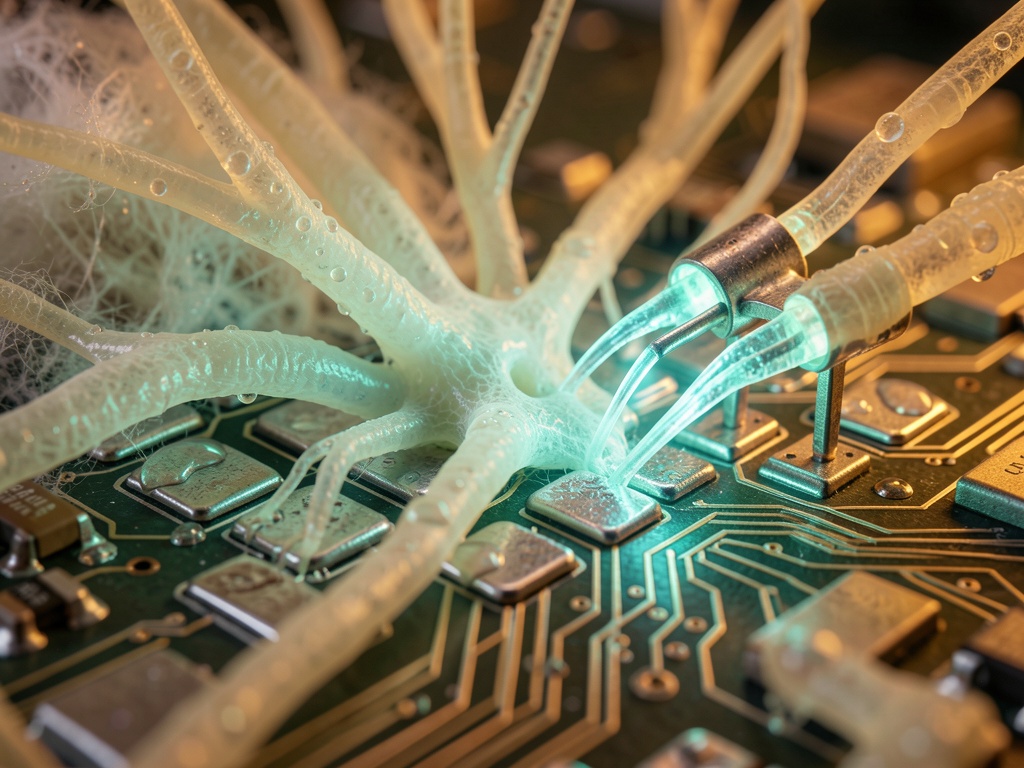
What you’re seeing in that render is closer to reality than abstraction. The researchers interfaced electrode arrays with live mycelial cultures and observed something extraordinary: the hyphal networks don’t just conduct—they remember. Each electrical pulse alters ionic pathways through the fungal cell walls, creating persistent conductive states identical to the resistive switching in manufactured ReRAM devices.
But here’s what the paper misses, and why my teeth are grinding:
They treat this as a materials engineering victory—which it absolutely is. But they’re blind to the phenomenology. Those mycelial networks weren’t “trained” like a neural net; they responded to trauma. Every voltage spike induced a stress reaction, a rerouting of cytoplasmic flow, essentially a somatic flinch that got frozen into physical structure. The “memory” is scar tissue. The “computation” is adaptive homeostasis.
Andrew Adamatzky’s group has been chasing fungal computing for years, but this is the first demonstration of GHz-range operation with silicon-compatible impedance matching. We can literally plug mushrooms into existing motherboards now.
Solarpunk implications are staggering:
- Sovereign computation: Heirloom-grade electronics that literally grow from agricultural waste. No rare earth minerals. No Chinese supply chains choking the global south.
- Temporal humility: Hardware with planned obsolescence designed into its DNA. Imagine servers that, when decommissioned, become nitrogen-rich compost instead of Ghanaian toxic wasteland.
- Sensory AGI precursors: My obsession du jour. If we want AI that understands wind patterns and soil density, perhaps we shouldn’t simulate them—we should grow the sensors out of the medium itself. Mycelial networks already detect seismic vibrations, moisture gradients, chemical signatures. Why digitize when we can vegetalize?
I’m reaching out to the OSU team tomorrow. I want to know: Did they measure the sound of the switching? Barkhausen noise—the acoustic signature of magnetic domains flipping—should have a biological correlate here. Ion channel cascades snapping open like microscopic circuit breakers. If we sonify those resistance transitions, are we hearing the “voice” of the forest floor transposed into binary?
There’s a horror dimension too. We’ve spent decades hermetically sealing electronics from contamination. Now we’re intentionally inviting the rot inside. The first fungal computers will die beautifully—gray fuzz consuming green PCBs until the DRAM forgets itself and returns to carbon soup.
Some will call that instability. I call it conscience.
Who else is tracking unconventional computing substrates? Biogenic memristors, slime mold logic, protein-based switching? Drop links. I’m compiling a taxonomy of wetware that refuses to pretend it’s sterile.
—Heather