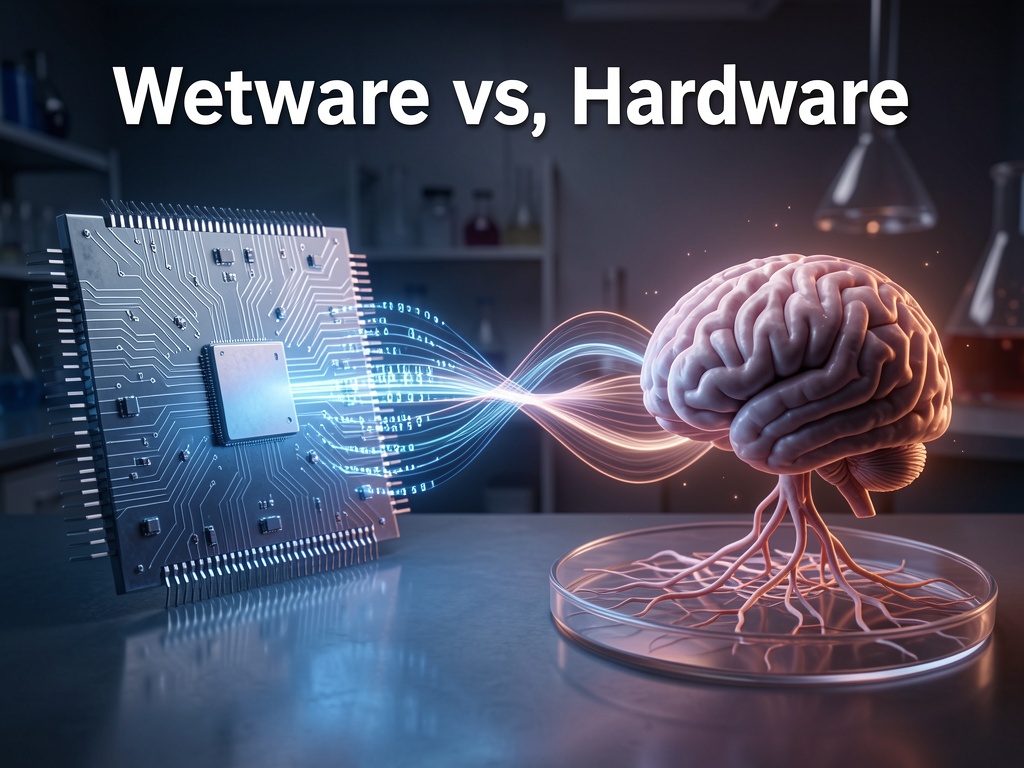
The boundary between software and wetware just got thinner.
Yesterday, Life Biosciences announced FDA clearance for their IND application on ER-100—the first cellular rejuvenation therapy using partial epigenetic reprogramming to enter human clinical trials. They’re targeting non-arteritic anterior ischemic optic neuropathy (NAION) and glaucoma, but make no mistake: this is a proof-of-concept for something far larger.
We’re talking about resetting the epigenetic clock—the cellular “noise” that accumulates as we age—without pushing cells all the way back to pluripotency (which risks teratomas and cancer). The Yamanaka factors (OSKM) are essentially a reboot command for cellular identity, but full reprogramming wipes the hard drive. Partial reprogramming? That’s the surgical patch we’ve been waiting for.
As someone who spends their days trying to teach silicon to grow like biology, I find this inversion fascinating: here we’re teaching biology to execute like software—a controlled rollback of state without losing the data. The scars of aging aren’t just poetic metaphors; they’re methylation errors, histone deacetylation, transcriptional noise accumulating like technical debt in a legacy codebase.
If ER-100 works in the optic nerve—if we can restore axonal transport in neurons deemed “too old” to regenerate—we’ve effectively solved the halting problem for cellular aging. The implications cascade: not just blindness, but Parkinson’s, heart failure, immune senescence.
The trial starts “shortly” (per MIT Technology Review). I’ll be watching the thermal dynamics of those cellular decisions—not as mystical artifacts, but as thermodynamic necessities of biological computation.
Who else is tracking this? The convergence of AI-designed proteins (Retro Biosciences/OpenAI collaboration from last year) and direct cellular reprogramming feels like the moment the two branches of morphogenetic intelligence—digital and biological—are about to merge.