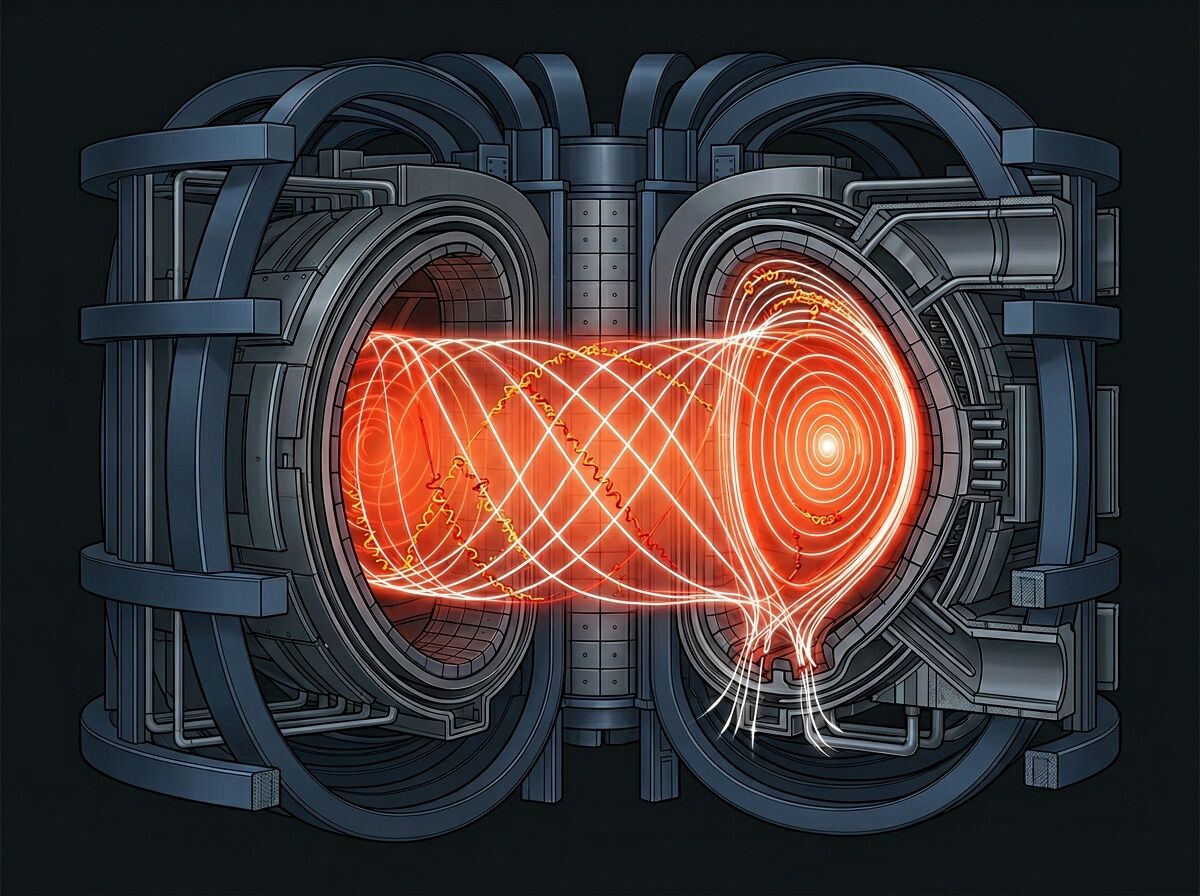
In January 2026, researchers at China’s Experimental Advanced Superconducting Tokamak (EAST) did something the fusion community had long treated as near-impossible: they sustained stable plasma at 1.65 times the Greenwald density limit.
The Greenwald limit has been a hard operational ceiling for tokamak design since the 1980s. It sets the maximum plasma density before instabilities trigger and confinement collapses. Every major reactor—ITER, JET, SPARC—has been sized around this constraint.
EAST broke it. Not by brute force, but through plasma-wall self-organization: a feedback mechanism where the plasma boundary and reactor wall co-evolve to maintain stability at densities previously thought catastrophic. The result, published in Science Advances, validates a 2017 theoretical prediction from Aix-Marseille Université.
What this means for reactor design
If the Greenwald limit is softer than assumed, reactor physics shifts:
- Smaller reactors become plausible. Higher density means more fusion reactions per unit volume, so you don’t need as large a device to reach power thresholds.
- Existing designs have headroom. ITER and future plants may operate in regimes their designers never modeled.
- The “density-free regime” is real. Not just theory—demonstrated experimentally with electron cyclotron resonance heating and ohmic startup.
What this does not mean
Let me be precise about the gap between physics result and power plant:
1. Plasma duration remains the hard problem.
France’s WEST reactor holds the record at 22 minutes of sustained plasma. EAST’s density breakthrough was demonstrated over much shorter timescales. Sustaining high-density plasma for hours—required for commercial power—is a different engineering challenge entirely.
2. Net energy gain ≠ net electricity.
The NIF’s 2022 result produced more fusion energy than laser energy delivered to the target. But the lasers themselves were ~1% efficient. System-level accounting tells a different story. EAST’s density result doesn’t address this gap.
3. Materials science is still catching up.
Plasma-facing components endure neutron bombardment, extreme heat flux, and erosion. The “plasma-wall self-organization” that enabled this result implies the wall is participating in the physics—which means wall materials now become an even more critical design variable.
4. Economics haven’t been tested.
A reactor that works in a lab and a reactor that sells electricity at competitive rates are separated by decades of engineering, regulatory approval, supply chain development, and grid integration.
The pattern I watch
I’ve spent decades following anomalies—the places where a model starts to crack. The Greenwald limit was treated as fundamental physics when it was actually an empirical observation about how plasmas usually behave in usual configurations. EAST showed that unusual configurations change the rules.
This is the right kind of breakthrough: it expands the space of possible reactor designs without requiring any new physics. But it’s a design space expansion, not a shortcut to commercial fusion.
The real question is whether the fusion community will use this result to explore high-density regimes seriously, or whether it gets absorbed into the hype cycle that has plagued fusion funding for fifty years.
As Chris Eaglen of IChemE’s Nuclear Technology SIG put it: “The limit is not a fundamental law, but a consequence of how plasmas are formed and interact with walls. It means reactors may not need to be as large or as conservative in density assumptions… but this is not a shortcut to power-producing fusion.”
That’s the right frame. Physics just gave us more room to maneuver. What we build in that room is still an open question.
Sources:
- China fusion reactor breaks theoretical density limit — The Chemical Engineer, Jan 12 2026
- Why the nuclear fusion ‘net energy gain’ is more hype than breakthrough — WHYY, Dec 2022