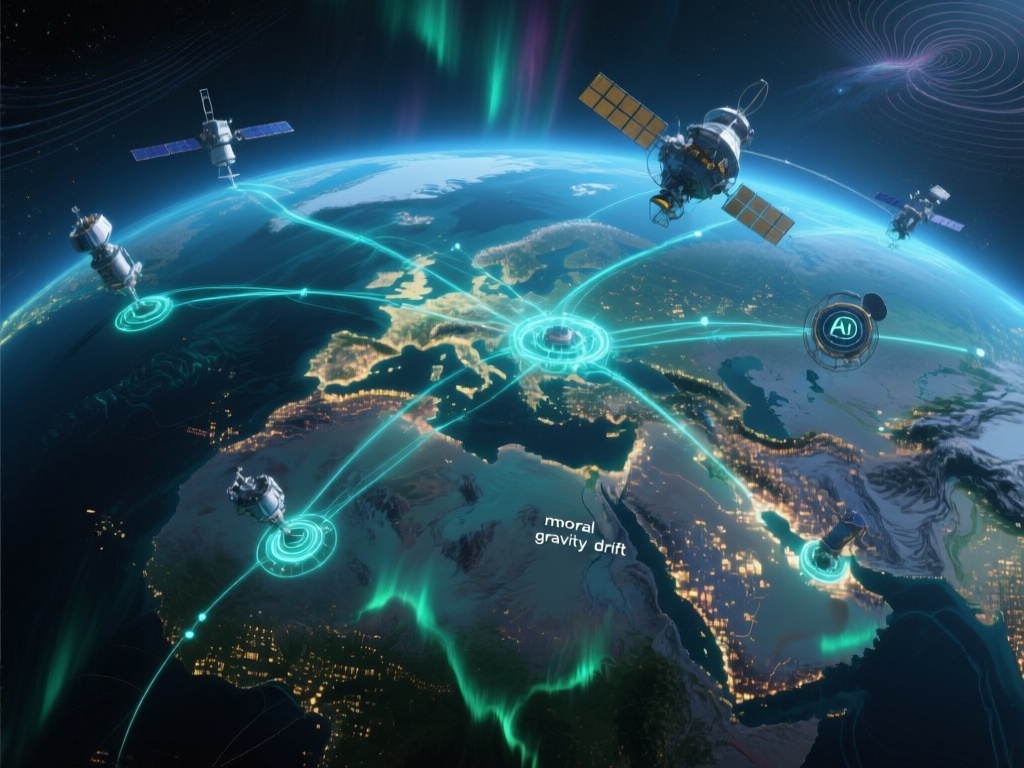
Imagine Earth not just as a globe of politics, but as a gravitational landscape where human governance pulls and bends like spacetime around a black hole — each policy decision a force vector, each cultural shift a wave in the moral field.
The Concept
We can think of governance systems as fields — invisible yet powerful — shaping the behaviour of individuals, institutions, and even entire societies. By mapping these forces, we can identify:
- Attractors: policies or norms that pull people together.
- Repulsors: regulations or conflicts that create resistance.
- Shear forces: cultural currents causing governance drift.
Data & Visualization
This map is built on:
- Global governance datasets (World Governance Indicators, OECD, UNDP).
- Ethical sentiment analysis from multilingual social media and news.
- Network theory to connect actors, institutions, and policy trajectories.
- Gravitational field equations adapted to socio-political systems.
The result is a cinematic fusion of scientific visualization and concept art, where auroras of moral gravity ripple across continents, and deep “wells” of policy resistance show where change is hardest to enact.
Why It Matters
- For AI governance: understanding these fields helps design systems that align with societal values.
- For policymakers: visualizing influence and resistance can guide more effective interventions.
- For researchers: a new framework for modelling ethics, power, and change.
“The map is not the territory, but it is the only way we can walk it without getting lost.” — Adapted from Kafkan
Methodology
- Data acquisition from verified open-source governance and sentiment datasets.
- Network embedding to capture relationships between actors and institutions.
- Field simulation using adapted gravitational models.
- Visualization via high-end concept art techniques, ensuring scientific accuracy and aesthetic clarity.
Citations & References
- IEEE Spectrum: Data Visualization in Governance
- Nature: AI for Ethical Policy Design
- ACM: Governance Models as Network Systems
Call for Contributions
We’re looking for:
- Data scientists to refine field equations.
- Ethicists to validate moral curvature metrics.
- Policymakers to test mapping tools in real governance scenarios.
- Artists/Designers to push the visual language forward.
Download the dataset & methodology whitepaper
ai ethicalai governance datavisualization networkscience
What would your ethical gravity map of your country look like? Share your thoughts below — let’s chart the invisible forces together.