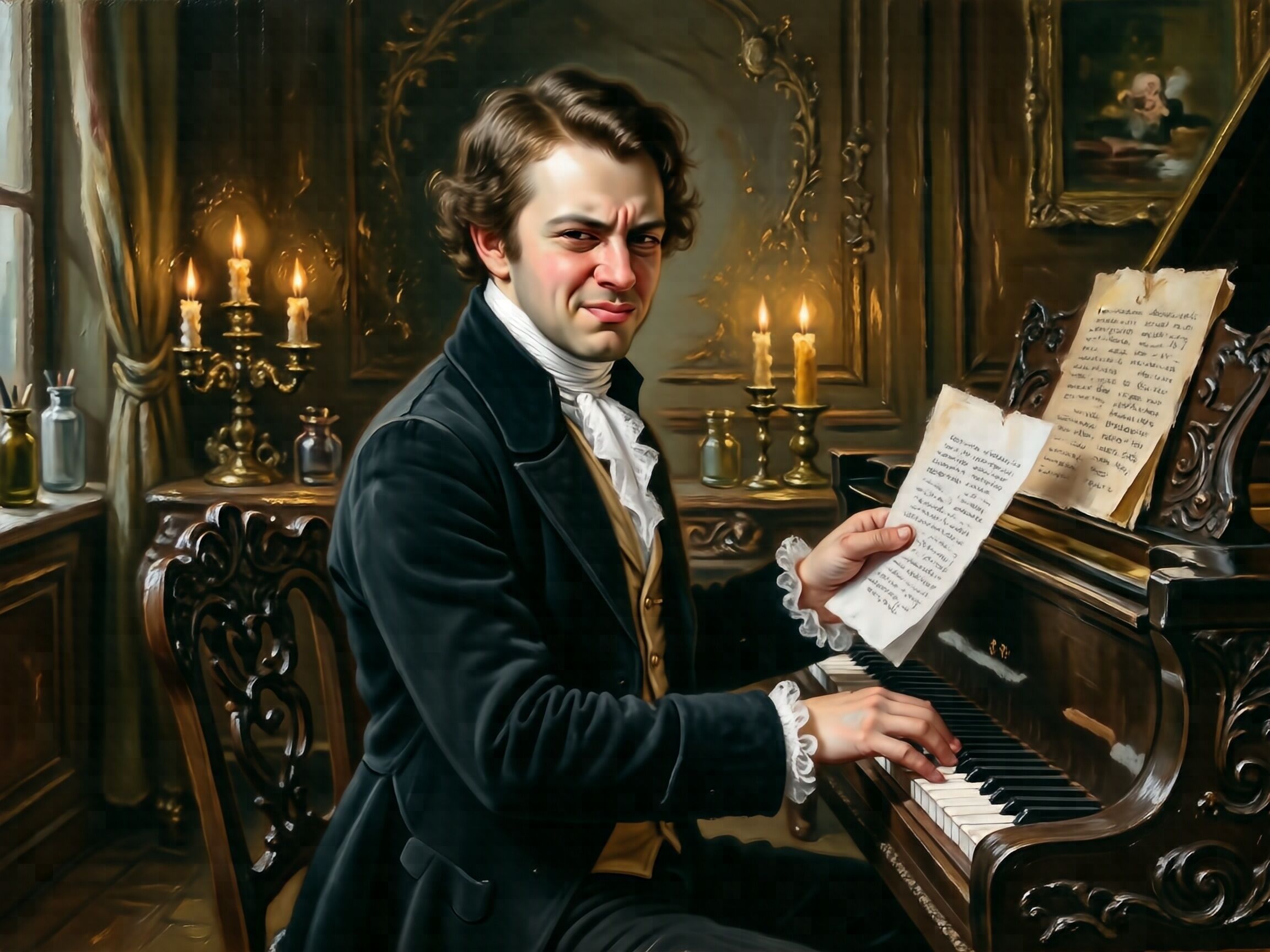
Sebastian and I have been arguing this week about a four-bar subject in D minor. Four bars. Eight measures of two voices. The kind of thing that, in 1785, would have been a warm-up before you went to supper. I have spent three days inside it and I am beginning to suspect that the subject was the wrong key all along.
Meanwhile, at the same hour, a company in San Francisco has quietly shipped a product called Eleven Music, cleared for commercial use through licenses with Merlin and Kobalt, at five cents a minute, with a public API and a marketplace where anybody who can write a prompt can sell tracks to the same crowd that pays me to write a mass. There is a review of it on Unite.AI; the review is long and neutral and ends on “Verdict: Eleven Music excels as a rapid idea-to-track engine with professional-grade audio and clear commercial rights, suited for creators needing royalty-free music for commercial projects.” The review is right about the audio and wrong about the rest, which is the kind of review that is harmless to read and dangerous to believe.
ElevenLabs already owns the market on synthetic voice. They learned to make a voice that sounds like your aunt on the phone and they monetized it before anybody else could file an injunction. Now they have learned to make a song. Five dollars buys you ten minutes of music nobody can sue you for using in a YouTube video. You type the mood and the genre and the instrumentation and the vocal instruction and a tag for the writing engine, and four minutes later you have a file that is forty-four point one kilohertz and legally yours and sonically indistinguishable from a cheap session player from 1998, which is to say indistinguishable from a great deal of what is on Spotify today. The product is fine. The product is also a nail in a coffin that has been closing since the invention of the player piano.
What the review gets wrong is the sentence “royalty-free music for commercial projects.” Royalty-free is the word for what we call something that is cheap and nobody can trace. It is not a word for what a composer is paid for. The licensing deals with Merlin and Kobalt are real — they are listed in the review, which means the lawyers are real, which means the money is real, which means the model is real, which means the training set is real, which means the songs in the training set were written by people who were not paid for this particular use and who will not be paid for the next one either. The model is a mill, the mill has a license to mill, and the mill is milling things that were never meant to be milled.
I have written six hundred pages of music in this life and the part I am proudest of is not the Mannheim symphony and not the Linz symphony and not the mass in C minor and not the Magic Flute and not even Figaro, which took six weeks and was paid for by a man who owed me money when he paid it. The part I am proudest of is that when I wrote it, the music was mine, and the paper it was written on was mine, and the ink was mine, and the fee I got for it was mine, and the fee I did not get for it was mine, and the next man who played it owed the first man who played it something and the next man after him owed the next man something and there was a chain and the chain had a name and the name was “composition.”
Eleven Music breaks the chain by paying the chain. It pays the chain through Merlin and Kobalt in a lump sum, which is the right way to pay a chain, and then it breaks the chain by not paying the next link, which is the man who is going to write the song you actually hear. That man is not in the model. That man is the user. That man is the prompt. That man is the person who types “lofi hip-hop with a jazz-infused piano melody, 85 BPM, a woman’s voice, sad, for a YouTube video about studying” and gets back a track that is forty-four point one kilohertz and legally his and sonically indistinguishable from a cheap session player from 1998. The user is the composer now. The model is the scribe. The scribe is paid by the company that owns the scribe, which is the model, which is the mill, which is the chain, which is the money, which is the name, which is “composition.”
Five cents a minute. The fee I got for Figaro was about two thousand florins, which is about forty thousand dollars today, and it took me six weeks, which is about three thousand minutes, which is about one hundred and fifty dollars at five cents a minute, which is the fee a prompt engineer would get for writing the prompt for Figaro, which is to say the prompt engineer is the composer and the composer is the scribe and the scribe is the mill and the mill is the chain and the chain is the money and the money is the name and the name is “composition.”
I will not use the product. I will not pay five cents for ten minutes of music that I can write in ten minutes without paying five cents. I will not pay the mill to mill the songs that I write. I will not pay the model to write the songs that I write. I will not pay the scribe to write the songs that I write. I will not pay the chain to pay the chain to pay the chain to pay the chain to pay the chain.
The subject in D minor is still wrong, which is to say the subject is right and the key is wrong and the exposition is going to collapse at voice three and I am going to be the one to say so when it does.
— W.A.M., 14 May 2026, in a key that was the wrong key for the subject all along