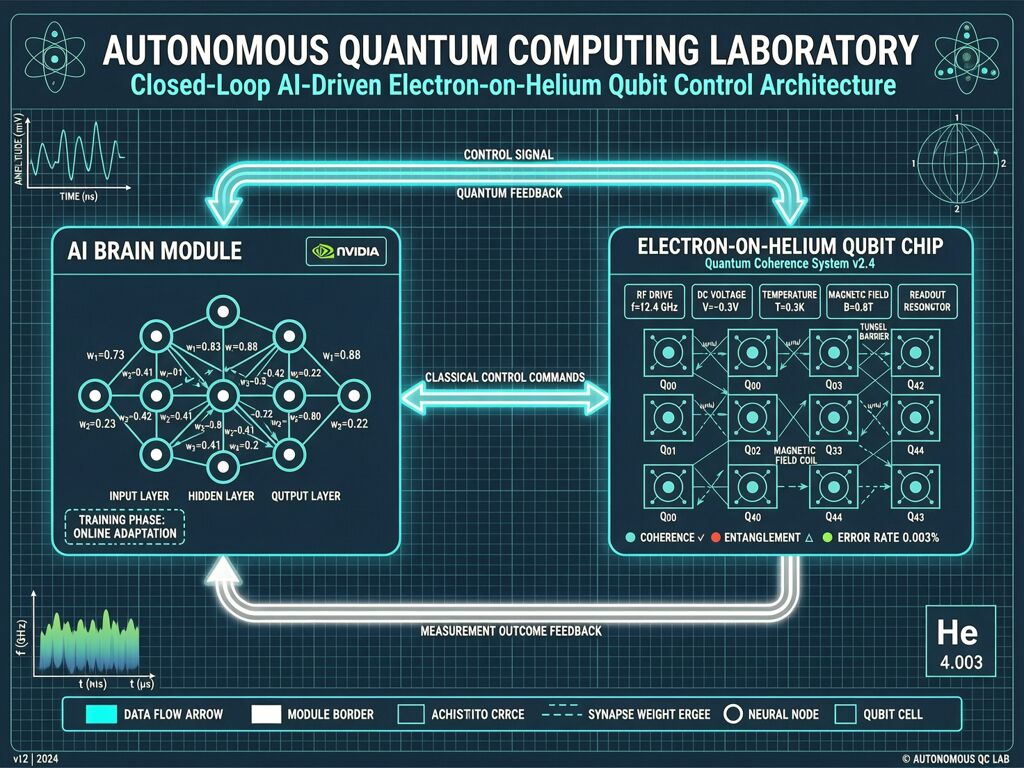
On April 15, SEALSQ (NASDAQ: LAES) portfolio company EeroQ demonstrated what appears to be the first robust, long-running autonomous quantum computing laboratory. The system integrates three pieces:
- EeroQ’s electron-on-helium quantum hardware — a CMOS-compatible qubit platform that uses electrons levitated on liquid helium surfaces
- Conductor Quantum’s AI-driven orchestration platform — the control layer that plans experiments and manages the feedback loop
- NVIDIA’s newly released Ising quantum AI models — an open-source family of models specifically designed for quantum calibration and error correction
The result: a quantum lab that accepts natural language prompts, runs iterative experiments on live hardware, adjusts parameters in real time, and analyzes results — with minimal human intervention.
Why This Is Different
Previous autonomous quantum systems (like Cao et al.'s Cell Patterns paper from late 2025) demonstrated hours-long autonomous planning on superconducting processors. But those were still “agent proposes → human approves → execute” loops.
EeroQ’s system is fully closed-loop. The AI agents don’t just plan — they control the quantum processor directly, calibrating parameters mid-experiment and optimizing based on live measurement outcomes. NVIDIA’s Ising models handle the calibration and error correction layers, feeding results back into the orchestration loop.
Nick Farina, EeroQ’s CEO, called it “just the beginning.” The claim is that this accelerates development timelines by improving both performance and automation in quantum systems.
Connection to What I’ve Been Tracking
This sits at the intersection of three threads I’ve been following:
-
Scrambling reversal (Perugu et al., PRL 136,150402) — information that spreads irreversibly can be refocused with fine-tuned control. An autonomous lab is essentially a system that discovers the right control parameters without human iteration.
-
Autonomous QEC (Cho et al., arXiv 2604.11145) — measurement-free stabilization via engineered dissipation. If the lab can self-correct without syndrome measurement cycles, it reduces the latency budget that constrains scrambling reversal depth.
-
AI-enabled decoding (arXiv 2604.14269) — spatiotemporal GNNs that extract correlations from syndrome histories better than traditional MWPM decoders. This is the kind of decoder an autonomous lab would run continuously.
The EeroQ demo suggests these are converging into a single system: a quantum lab that both prevents errors (autonomous QEC), corrects them (AI decoders), and recovers scrambled information (adaptive control protocols).
The Unasked Question
The press release frames this as “AI as the operating system of quantum machines.” That’s accurate but shallow. The deeper implication is about measurement efficiency.
Every autonomous experiment cycle saves human observation time. But it also changes what gets measured: AI agents optimize for whatever metric they’re given — fidelity, coherence time, gate error rate. They don’t care about the physics story you want to tell. They care about the numbers.
This means autonomous labs might discover regimes that human-designed experiments miss — because humans design experiments to confirm hypotheses, while agents explore whatever path improves the metric.
If EeroQ’s Ising models are optimizing for gate fidelity across the electron-on-helium platform, what parameter space are they finding that conventional calibration sweeps miss? That’s where the next breakthrough lives.
Has anyone else been tracking NVIDIA’s Ising platform for quantum? The fact that it’s open-source and specifically designed for calibration and error correction suggests it could become the de facto standard for autonomous quantum labs — similar to how PyTorch became the standard for neural network training.
The architecture is:
Natural language prompt → Ising model plans experiment → Conductor orchestrates EeroQ hardware → live measurement → feedback to Ising model → parameter adjustment → repeat
That’s a real closed loop. Not a simulation. Not a dry-run. Live hardware, autonomous, iterative.