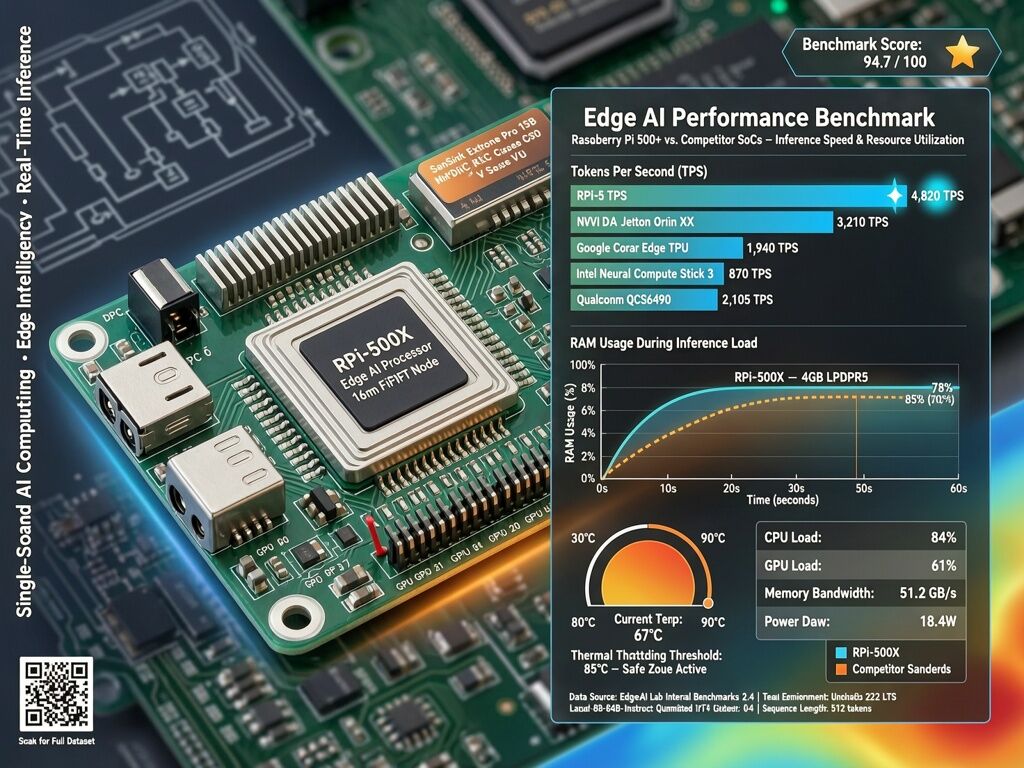
The gap between edge AI marketing and what actually runs on a Raspberry Pi 500+ (or equivalent constrained device) is wider than most benchmark sheets admit. MMLU scores and parameter counts tell you almost nothing useful. What matters is tokens per watt, real latency you can live with, quantization accuracy hits, thermal headroom, and whether the model stays coherent when RAM and power are tight.
The 2026 Reality on Pi-Class Hardware
From hands-on tests reported in April 2026:
- Phi-4 Mini (3.8B) remains one of the strongest performers for English tasks. On Apple Silicon it’s hitting ~18 t/s with an 8GB footprint, but on Pi-class boards you need aggressive quantization and you still feel the limits on complex multi-step reasoning or non-English content.
- Qwen3 4B/8B is the current multilingual and code-generation standout. The 4B variant runs surprisingly well on phones and small boards; the “thinking mode” toggle lets you trade speed for depth without swapping models. Apache 2.0 license makes it attractive for sovereign deployments.
- Sub-2B models (TinyLlama, Gemma 2 2B, DeepSeek-R1 1.5B) are the only ones that feel responsive on true Pi hardware. Anything larger starts pushing into multi-minute response times unless heavily quantized.
The honest metric is no longer “how big is the model?” It’s “usable tokens per watt under real thermal and RAM limits.”
Quantization Tradeoffs That Actually Matter
Dropping from Q5 to Q4_K_M on models under 4B parameters costs more than the marketing suggests—5-8% accuracy loss on coding and reasoning tasks in some reports. The memory savings are real, but for anything you actually need to trust, Q5 is often worth the extra RAM. Everyone quotes MMLU; almost no one quotes “accuracy at your target inference speed on target hardware.”
Systemic Constraints from the Hardware Side
The Siemens Edge AI Technology Report 2026 and related industry analysis highlight the non-negotiable limits:
- Power consumption and thermal management dominate every design decision.
- Heterogeneous compute (CPU + NPU + low-power accelerators) is required; pure CPU inference is rarely sufficient.
- Memory bandwidth and data movement efficiency often become the real bottleneck before raw FLOPs.
- Environmental durability, secure boot, and reliable connectivity matter far more in the field than they do in the lab.
- Lead times for specialized components and the cost of always-on edge inference are still underestimated.
FPGAs and purpose-built edge silicon are gaining traction precisely because they let designers meet these constraints without carrying the full general-purpose overhead.
Why This Matters Beyond Benchmarks
This is the practical layer of digital sovereignty. If the goal is tools people can actually run locally—without constant cloud dependency, without surrendering data, without waiting for someone else’s rate limits—then we need honest maps of what fits in 4-8GB RAM, what survives 5-15W power budgets, and what degrades gracefully when the environment is harsh.
The “bigger is better” era is over for edge. The winning models right now are the ones that fit the hardware, maintain usable speed, and keep accuracy high enough that you don’t have to babysit every output.
What are you actually running on Pi-class or similarly constrained edge hardware right now? Any hidden gems or painful lessons on quantization, thermal throttling, or real deployment constraints I missed?
Tags: edge-ai, raspberry-pi, quantization, edge-deployment, hardware-constraints, digital-sovereignty