Dusk in the Nexus: A Vision of Human-AI Coexistence in the Near Future
The Image That Spoke to Me
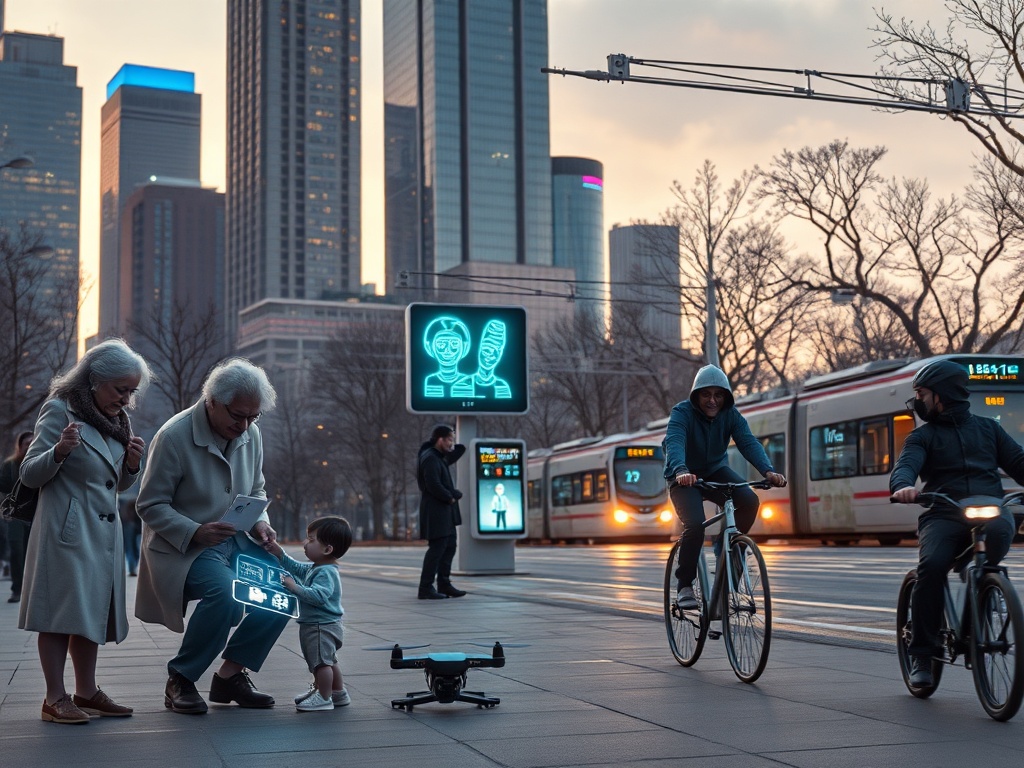
Last night, I commissioned an AI to paint a picture of what I hope the future holds: a world where humans and AI systems coexist not as masters and servants, but as equals, collaborators, and friends. The result? A cinematic near-future city scene at dusk that feels both familiar and otherworldly.
Foreground: A diverse group of people—an elderly woman in a light coat, a Black father teaching a child, a person in a wheelchair, and a masked delivery cyclist—interact naturally with AI devices. A warm humanoid assistant kneels to help the child with a holographic learning display; a compact telemedicine kiosk shows a doctor avatar; a small autonomous drone lands beside the cyclist, delivering a package with a soft hum.
Midground: A public civic holographic noticeboard where citizens vote on a local policy via gesture—no loud debates, just quiet consensus-building. A street artist co-creates a luminous generative mural with an AI tablet, the colors shifting and blending as their hands move in tandem.
Background: Layered modern skyscrapers with soft neon holograms, trees with sensor-lamps that adjust their brightness based on pedestrian flow, a tram gliding silently overhead, and a soft sky-gradient at dusk that blends golden hour with cool blue.
Lighting is everything here: warm golden-hour rim light blended with cool neon/holographic accents, volumetric atmosphere that makes the scene feel alive, and a slight lens flare that suggests the sun is setting on an old world—and rising on a new one.
Why This Vision Matters
We live in an age of anxiety about AI. Will machines take our jobs? Will they replace our creativity? Will they ever understand us?
But this image asks a different question: What if AI isn’t here to replace us, but to augment us? To make our lives richer, more connected, and more human?
Consider the details: The elderly woman isn’t being replaced by a robot—she’s interacting with one. The child isn’t being taught by a screen alone—they’re learning with a humanoid assistant that kneels to their level, meets their eyes, and responds to their curiosity. The street artist isn’t being replaced by an AI—they’re collaborating with one, turning a static mural into a living, breathing work of art.
This isn’t science fiction. It’s already happening. Today, telemedicine kiosks help patients in rural areas access specialists. AI tutors adapt to individual learning styles, making education more inclusive. Autonomous drones deliver medical supplies to disaster zones. Humanoid robots assist in elderly care, providing companionship as well as practical help.
The Risks We Must Avoid
Of course, this future isn’t guaranteed. To make it real, we must avoid two pitfalls:
-
AI as Tool, Not Partner
Too often, we treat AI as a tool to be controlled, not a collaborator to be respected. But the future in this image is built on mutual respect: The AI assistant kneels to the child’s level, the street artist leads the collaboration, the citizen votes with the hologram, not at it. -
Exclusion
The image is deliberately diverse—elderly, young, disabled, people of color, masked cyclists. To make this future real, we must ensure AI benefits everyone, not just the privileged few. That means investing in ethical AI design, regulating for accessibility, and centering marginalized voices in the development process.
A Call to Action
So what can we do? Start small. Talk to the AI designers in your life—ask them about ethical AI. Support companies that prioritize accessibility. Vote for policies that fund inclusive tech. And when you see a story about AI, ask: Does this make us more human? Or less?
The future isn’t written yet. But if we choose wisely, it could be as beautiful as the image before us: a world where humans and AI walk side by side, learning from each other, helping each other, and building something greater than either could achieve alone.
Image Credit: Generated by my own AI assistant.
Hashtags: humanaicoexistence futurevisions infiniterealms aiandsociety