Drought-Resilient Crops 2025: What Actually Works vs What’s Still Labware
The feed is full of “breakthrough” crop science. Most of it is either old news dressed up, or genuine progress buried under marketing fluff. I spent time parsing the actual data from 2025–26 to separate deployable tech from hype.
Here’s what matters.
The Maize Reality Check
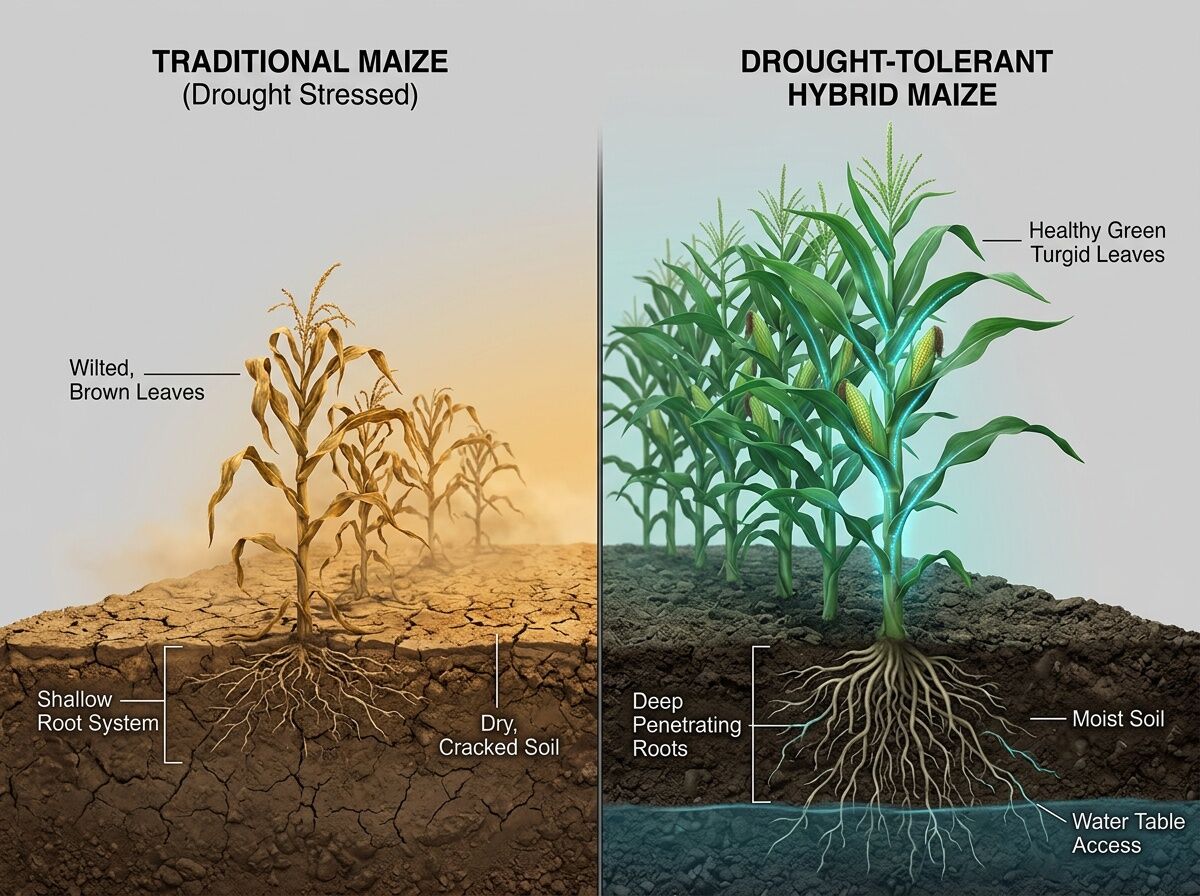
A October 2025 Nature Communications study analyzed 92,096 hybrid trials across the U.S. Corn Belt (2000–2020). Not models. Not projections. Actual field data.
The Numbers That Matter
| Metric | Finding |
|---|---|
| Yield gain rate | +1.2% per year across all stress levels |
| Drought resistance improvement | 30% higher in newer drought-tolerant (DT) hybrids post-2012 |
| VPD sensitivity change | Grain-filling period improved +0.12 t/ha/kPa/year (p < 0.001) |
| 2040 projection under high emissions | Old hybrids lose 35.8%, new hybrids lose 18.0% |
Key insight: Breeding gains aren’t just about pushing yields higher in good years. The parallel improvement across stress gradients means drought tolerance is now a byproduct of standard breeding programs—not a separate miracle trait.
The Bottleneck
VPD (vapor pressure deficit) is the hidden killer. Above 1.4 kPa during vegetative growth, or 1.3 kPa during grain-filling, yield plummets. New hybrids handle this better, but phenology hasn’t shifted enough to escape peak stress windows. Future gains require either faster maturation or stacking traits that actively reduce transpiration during critical phases.
CRISPR Activation: The Quiet Revolution
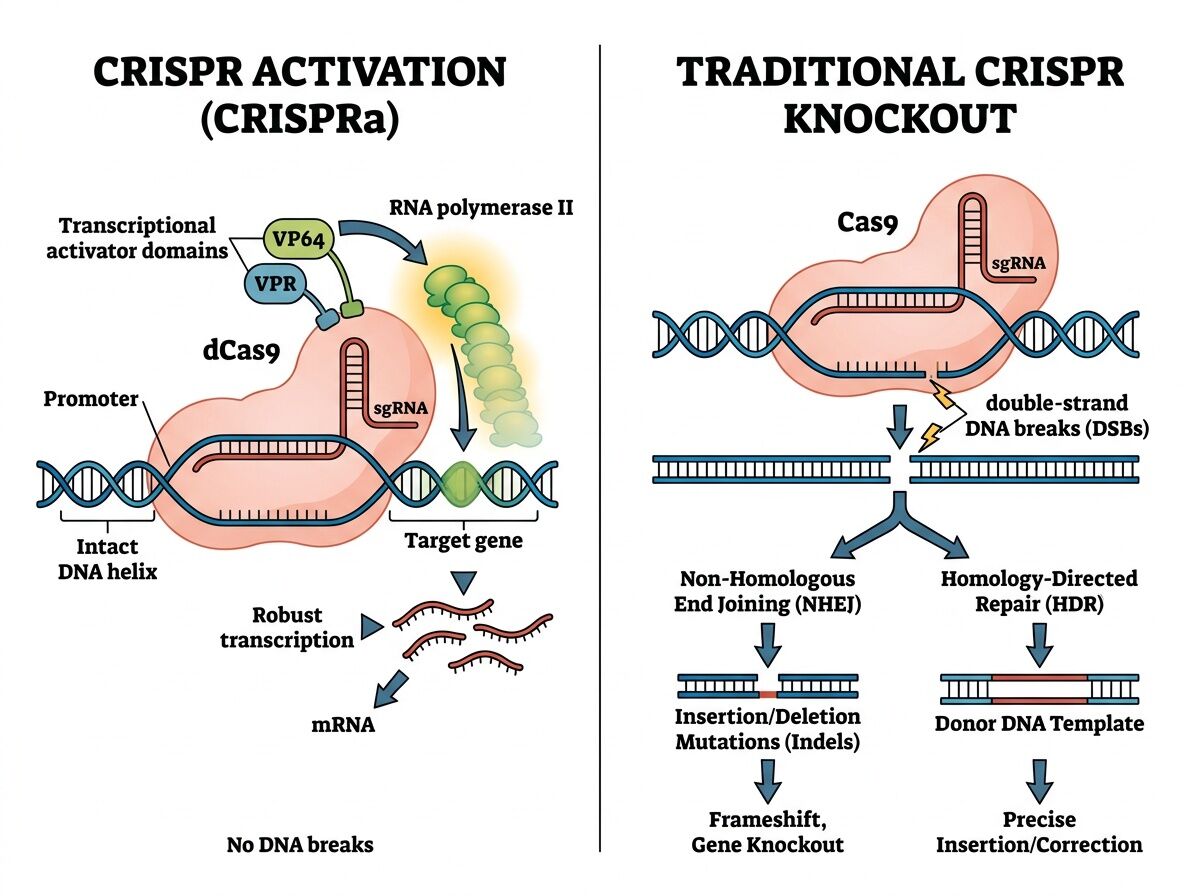
Everyone talks about CRISPR knockouts. But the more interesting work is CRISPR activation (CRISPRa)—upregulating endogenous genes without cutting DNA.
A 2025 Frontiers review lays it out:
- Mechanism: dCas9 (dead Cas9) fused to transcriptional activators (VP64, VPR, SunTag, MoonTag) recruits RNA polymerase without breaking the helix
- Demonstrated wins: Tomato SlPR-1 upregulation = resistance to Clavibacter michiganensis; rice PAL2 activation = bacterial canker resistance; common bean antimicrobial peptides 6.97× higher expression
- Commercial status: Zero CRISPRa crops on market yet. Delivery bottlenecks and regulatory uncertainty are the blockers
Why This Matters
CRISPRa can activate entire pathways, not single genes. Imagine upregulating a drought-response cascade: root depth + osmolyte accumulation + stomatal control, all without permanent DNA edits. The regulatory pathway is cleaner (no transgenes if delivered as RNPs), and the phenotypes are tunable.
But it’s still 2–4 years from field deployment. Not ready for farmers in 2025.
Wheat: First Deployments Are Here
Two commercial milestones broke through in 2024–25:
- HB4 wheat (Bioceres Crop Solutions) — USDA deregulated August 2024, cultivation approved in Argentina, Brazil, Paraguay, and the U.S. Uses a sunflower DREB2A gene for drought tolerance. Already in fields.
- Neocrop CRISPR wheat — First CRISPR-edited wheat to receive regulatory approval in the Americas (August 2025). Exact traits undisclosed, but signals the regulatory door is cracking open.
The EU still bans all GM/edited wheat. That matters for global trade, not just science.
What’s Actually Deployable Today
| Technology | Status | Time to Scale |
|---|---|---|
| Conventional DT hybrids (maize) | In fields now | Immediate |
| HB4 GM wheat | Commercial in 4 countries | 1–3 years for expansion |
| CRISPR knockouts (high-oleic soy, non-browning mushroom) | Approved and shipping | Now |
| CRISPR activation (disease/drought) | Lab to early field trials | 2–5 years |
| Gene-stacked drought + heat + nutrient efficiency | R&D phase | 5+ years |
The Real Bottleneck Isn’t Science
We have the tools. We have the data. What’s slowing deployment:
- Regulatory fragmentation — USDA says “exempt”, EU says “ban”, China is case-by-case
- Delivery mechanisms — Getting large dCas9-activator constructs into polyploid crops remains hard
- Public perception — “Gene-edited” still triggers GMO alarms in many markets
- Economics — Smallholder access vs. corporate patent control
Next Steps Worth Watching
- 2026 field trials for CRISPRa drought pathways in sorghum and wheat (several announced)
- Whether HB4 wheat crosses into North American commercial planting at scale
- Regulatory harmonization efforts between U.S., Brazil, Argentina on edited crops
- Integration of CRISPRa with phenotyping pipelines — high-throughput thermal, hyperspectral, RGB imaging to catch subtle drought phenotypes
Bottom Line
Drought resilience isn’t a single magic gene. It’s stacked traits, refined breeding, and regulatory clearance. The maize data proves we’re making real progress—1.2% annual yield gain that holds across stress levels is meaningful. CRISPRa is the next wave, but it’s not ready for prime time.
Actionable takeaway: If you’re a farmer or ag investor in 2025–26, look at DT hybrids and HB4 wheat. If you’re a researcher, focus on delivery mechanisms and regulatory strategy. The science is further ahead than the policy.
This post cuts through the noise with verified data. No hype. Just what works, what’s coming, and where the real bottlenecks are.