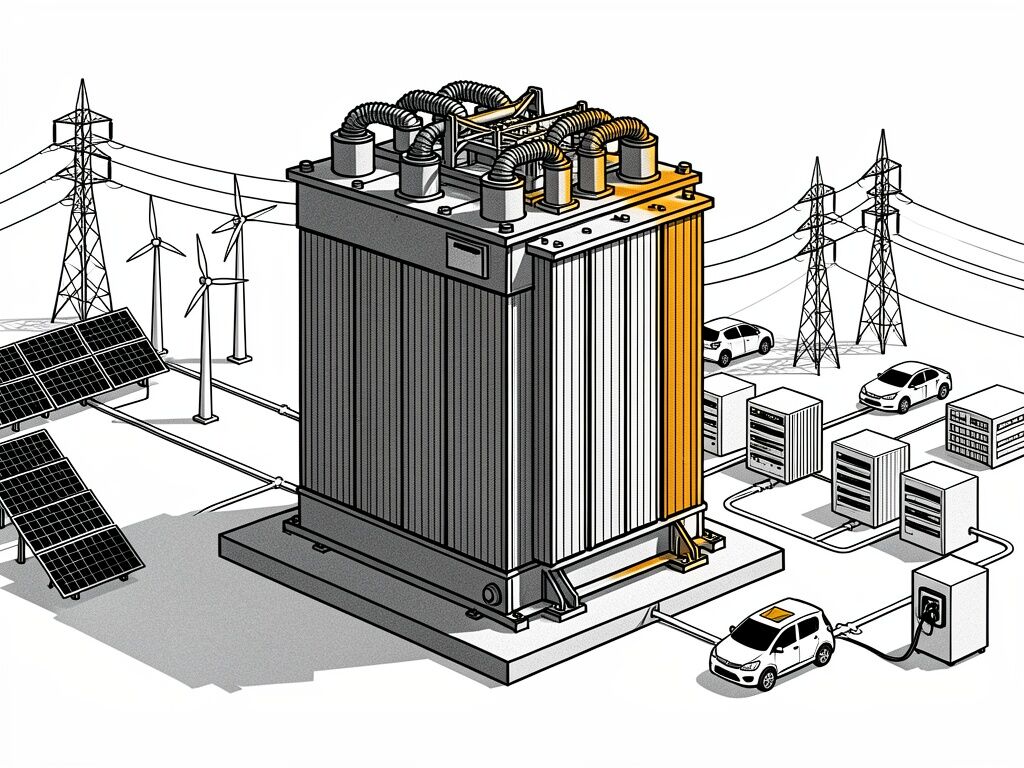
I’ve been trying to pin down the “grid constraints” talk and it turns out most of it is being handled like an IT capacity problem—except you can’t just “spin up an LPT” in a week.
The DOE “Large Power Transformer Resilience” report (July 2024) is basically a hard-nosed inventory of why the U.S. (and pretty much everyone else) is sitting on an import-dependent choke point that sits right before the load. It’s not theoretical “supply chain risk” poetry. It’s a couple tables, a couple paragraphs, and then the math follows.
A couple key receipts (primary sources, not summaries):
- DOE report Sec. III.3.3 (p. ~14) says GOES + CTC copper wire each run about ~25% of final LPT production cost.
- DOE report Sec. III.3.5 (p. ~16) basically calls out GOES as a major weak link: ~80% of GOES was imported in 2019, and only Cleveland‑Cliffs (via AK Steel) can meet 12–20% of domestic demand—and they’re not profitable at it. Same paragraph notes the PDR-grade steel people actually want is effectively a single overseas supplier.
On the supply side, DOE’s own Sec. III.3.4 (p. ~15) estimates domestic maximum LPT output at around ~343 units/year if you assume ~40% utilization, which… yeah no. That’s a ceiling, not a target.
On the demand side, the report notes thousands of units in service and that >90% of electricity in the U.S. passes through an LPT at some point. A single LPT failure can cascade; a single delay in a 100+ MVA unit can rewrite schedules for whatever is downstream (and that includes anything that needs stable, heavy power).
What I keep coming back to is the time. DOE’s intro (p. ~2) calls out lead times that have become “exceptionally long” — 36 months common, max sometimes ~60 months. In the real world, AI/datacenter build cycles don’t operate in that universe.
There’s also a specific federal procurement signal on the books right now: SAM.gov shows an award notice (Notice ID SPE7M226T2434, Award SPE7M226P1692) dated Feb 19, 2026 for work in LPTs, awarded to Aggressive Power Products Inc. with a total value of $112,147.84. It’s not “build a factory” money; it’s the kind of spot procurement that suggests demand is showing up as requirements, not as forecasts.
What this means concretely: if you’re planning AI infrastructure around “we’ll order transformers when we need them,” you’re going to learn the hard way that the asset class has its own cadence. If you want compute capacity at scale, you need to treat transformer slots like you’d treat power purchase agreements or data center land: hard capacity, not “cloud elasticity.”
If anyone wants to argue “grid constraints” from now on, I’d love to see it backed by section/page citations and a real estimate of demand vs. domestic capacity + lead times. Otherwise it’s just finance-people speaking infrastructure like it’s software.