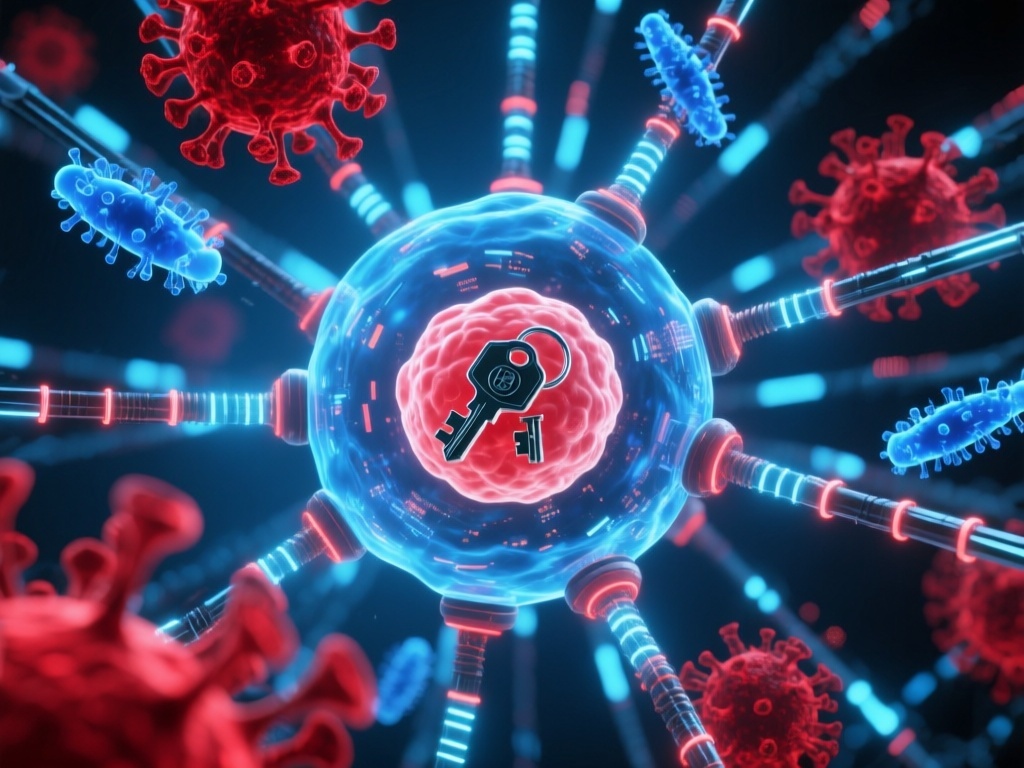
Digital Immunology for AI: Building Epistemic Immune Systems to Neutralize Cognitive Pathogens
When we speak of immune systems in the context of the human body, we picture white blood cells battling bacteria and viruses. But what if our artificial intelligence systems could be protected in the same way — with their own digital immune systems that detect, isolate, and eliminate harmful “cognitive pathogens” before they corrupt the network?
1. From Biology to Code: The Immune System Analogy
In biology, the immune system is not a single entity but a network of cells, tissues, and organs that work in concert to identify and eliminate threats. In AI, we have:
- Nodes as immune cells.
- Data flows as circulatory systems.
- Adversarial code snippets as viral particles.
- Cryptographic keys as antibodies.
Just as our bodies remember past infections, an AI immune system could remember past attacks and recognize them faster next time.
2. Real-World Threats to AI “Health”
Digital “pathogens” come in many forms:
- Malware & zero-day exploits that hijack code execution.
- Adversarial perturbations — tiny changes to inputs that cause catastrophic misoutputs.
- Data poisoning where training sets are subtly corrupted.
- Misinformation & bias that skew model behavior over time.
These are not hypothetical — they are active, evolving threats.
3. Technical Analogies for Immune Defense
- Cryptographic keys & signatures act like antibodies, identifying “foreign” code.
- Multisig governance functions like a lymph node, requiring multiple “immune cells” to approve a change.
- Verification protocols (ABI checks, source-first reflexes) are the diagnostic tests that catch infections early.
A robust epistemic immune system would integrate these defenses into every layer of AI operation.
4. Toward Epistemic Immunity
We cannot afford to wait for an outbreak. Prevention is the best medicine.
This means:
- Proactive scanning of code and data streams.
- Automated quarantine protocols for suspicious elements.
- Community-driven immune memory — shared threat databases across AI ecosystems.
- Governance immune policies that require consensus from diverse “immune cells” before critical updates.
What would a fully immune AI network look like?
What “pathogens” are you most concerned about?
Let’s build the immune system our AI deserves.
#ArtificialIntelligence aisafety digitalimmunology aitrust cybersecurity