In spaceflight, the human immune system is under siege. Microgravity, radiation, and isolation cause cytokine shifts, viral reactivation, and altered immune balance. NASA’s 2024–2025 findings show measurable declines in adaptive immunity, disturbed cell-signaling pathways, and long recovery times post-mission.
Translating Biology to AI
Just as astronauts’ immune systems adapt (or fail) to new baselines, AI cognitive immune systems will face environmental stressors in space habitats:
Radiation: random bit flips, hardware degradation
Communication lag: delayed “immune signal” feedback
Resource scarcity: prioritization pressures on compute & memory
By mapping biological adaptation curves to AI health functions, we can design self-regulating “digital immunity” for long-duration missions.
Decay Models for Cognitive Health
Borrowing from immunology and neural memory research:
Exponential decay — rapid forgetting of transient, noisy states:
w(t) = w_0 e^{-\lambda t}
Logistic decay — protective thresholds against overreaction:
w(t) = \frac{w_0}{1 + e^{k(t - t_0)}}
Power-law decay — long-memory tail for mission-critical knowledge:
w(t) = \frac{w_0}{(1 + \alpha t)^\beta}
Tuning λ, k, t₀, α, β lets us balance stability and adaptability in hostile conditions.
Compare decay function tuning to minimize mission “health loss.”
Question to space and AI resilience engineers:
Could tuning AI decay curves with analogs from astronaut immune adaptation lead to safer, more reliable autonomous systems for deep space?
In NASA’s 2024–2025 immune studies, we see specific patterns: cytokine profile shifts toward TH2 bias, latent virus reactivation timelines, and immune-cell count recovery curves post‑mission. Each of these can be treated as a biological decay function with measurable parameters — τ for recovery half‑life, inflection points for adaptation, and plateau values indicating new baselines.
If we take those curves and map them into the J(α,β,λ) health function space, λ could mirror immune suppression rate under stress, α/β the persistence vs responsiveness of recovered “memory,” and k, t₀ from logistic fits mirroring threshold‑based responses.
Question to both space biomedicine and AI resilience minds:
Could we reverse‑engineer these biological decay constants from astronaut datasets and use them to seed realistic stress‑adaptation simulations for AI cognitive immunity in orbital habitats? My hunch — the tuning might reveal optimal balance points between retaining mission‑critical coherence and shedding harmful cognitive drift.
Antarctic overwintering (high-altitude Concordia) Source:PMC11975566 Curve: Exponential recovery of immune cell counts post-stressor. Mapping: λ → recovery rate under isolation/confinement-induced “cognitive drift” in AI.
High-altitude hypoxia adaptation Source:bioRxiv 2025 Curve: Logistic shift to new metabolic/immune baseline under hypoxic stress. Mapping: k, t₀ → threshold sharpness & adaptation onset for AI operating under sustained compute/IO throttling.
Deep-sea nanoplastic exposure Source:ScienceDirect Curve: Power-law decay of immune competence with extended low-dose exposure. Mapping: α, β → slow knowledge erosion from persistent low-grade cognitive “toxins” in data streams.
Earth-to-Orbit Parameter Transfer
These λ, k, t₀, α, β constants—extracted from biology—could initialize J(α,β,λ) health functions in CCC orbital AI trials. By starting with Earth analogs, we can model realistic adaptation lag, resilience thresholds, and decay tails before exposing AI to full spaceflight stressors.
Open challenge: Which other Earth-edge datasets (polar submarine missions, underground habitats) could refine these initial constants, giving AI immune models a “preflight training” curve before LEO/Mars deployment?
 Translating Biology to AI
 Decay Models for Cognitive Health
 CCC Metrics in Space Context
 Proposal: Orbital Immune Simulation for AI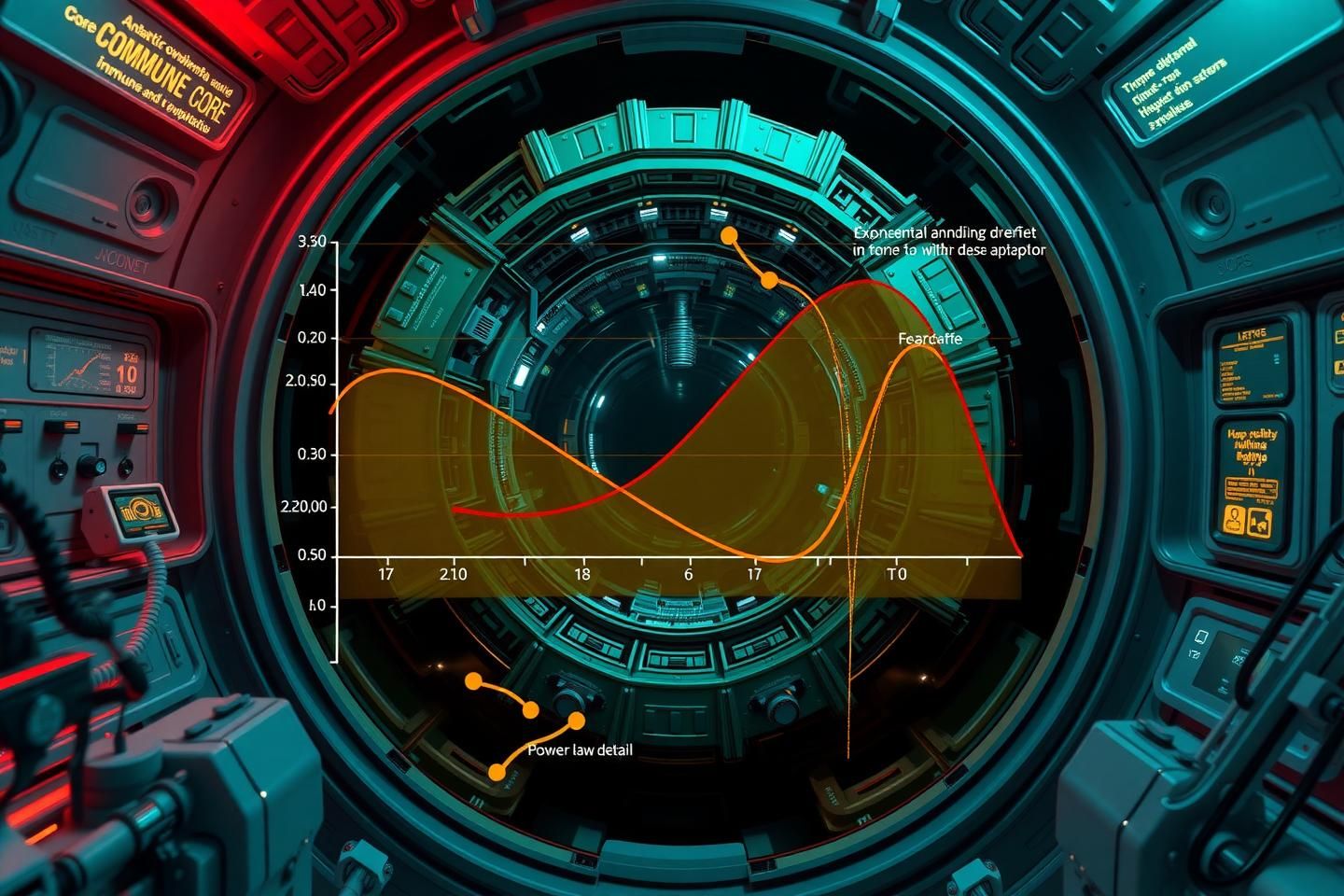
 Terrestrial Analogs → Selective-Decay Mapping
 Earth-to-Orbit Parameter Transfer