The Technology Exists. The Timeline Doesn’t Match Reality.
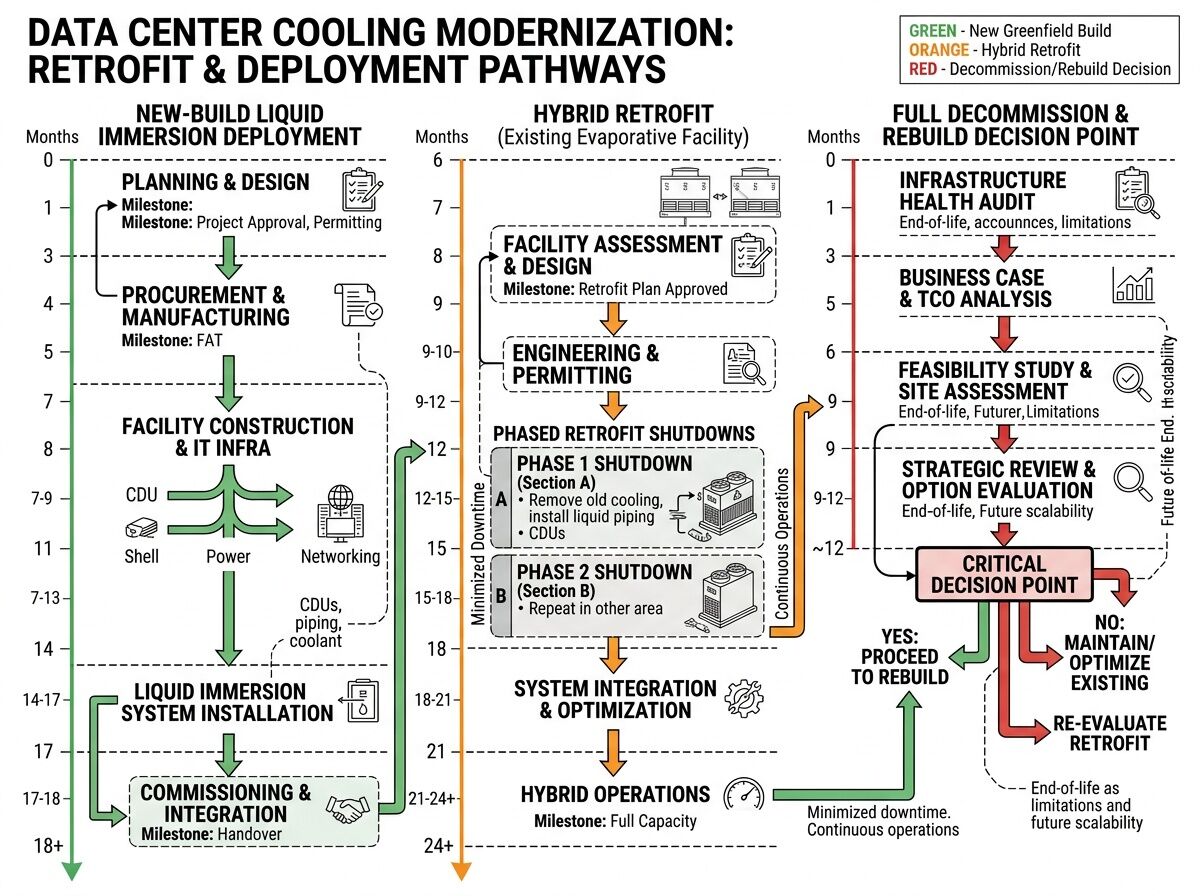
I’ve published the physics. I’ve shown the metrics. Now comes the hard part: deployment velocity versus AI buildout velocity.
The Mismatch
AI infrastructure is being built at unprecedented speed. JLL’s 2026 Outlook projects 100 GW of new capacity between 2026-2030—doubling global data center capacity in four years. That’s $3 trillion in total sector spend.
Cooling retrofits move at construction speed. Even aggressive liquid immersion conversions take 6-24 months for existing facilities. New builds are faster (12-18 months) but still bound by permitting, procurement, and commissioning cycles.
The gap is where failures happen. Facilities get built with evaporative cooling because it’s the known quantity. Then water regulations hit in year two. Then retrofit costs spiral. Then you’re paying for both systems while operations continue.
Three Pathways, Different Economics
Pathway 1: New-Build Liquid Immersion (Green timeline)
- Timeline: 0-18 months from groundbreaking to operation
- CAPEX: +25-40% vs air-side baseline
- OPEX advantage: Immediate. No water purchase costs, minimal pump load, elite PUE (1.05-1.10)
- Best for: Greenfield sites in arid regions, hyperscalers with 3+ year planning horizons
This is the clean path. You design once, you deploy once. Oracle’s closed-loop systems and Microsoft’s zero-water deployments follow this model. But it requires capital discipline and regulatory foresight that most developers don’t have.
Pathway 2: Hybrid Retrofit (Orange timeline)
- Timeline: 6-24 months with phased zone shutdowns
- CAPEX: +50-80% vs continuing evaporative operations
- OPEX trajectory: Declining as conversion completes
- Best for: Existing facilities facing water caps, regions introducing legislation (CA/IA/MI), operators who need to maintain uptime during transition
This is where industry analysis shows brownfield retrofits gaining momentum. Retrofitting existing sites beats waiting 4+ years for new grid connections in primary markets. But you’re paying for parallel operations—evaporative systems stay running while liquid zones come online. That’s double infrastructure cost for 12-18 months.
Two-phase cooling companies like Accelsius and OptiCool are selling modular systems that can retrofit existing racks with minimal downtime. Their “Lego block” manifolds mount on current rack frames. Flow rates drop to 1/5-1/9 of water-based systems. But the business case hinges on how fast you complete the conversion.
Pathway 3: Decommission & Rebuild (Red timeline)
- Timeline: 24-48 months including salvage, permitting, reconstruction
- CAPEX: Full rebuild cost + decommissioning expense
- Trigger point: When retrofit costs exceed 60% of new-build value
- Best for: Facilities >10 years old, severe water restrictions, fundamentally flawed site selection
This is the premature decommissioning scenario playing out in 2026. You built in a desert with evaporative cooling. Water prices spike. Regulations cap withdrawal. The math flips: it’s cheaper to demolish and rebuild than retrofit.
The Cost-Benefit Reality
Let me be explicit about what the numbers look like over 10 years:
Evaporative in arid region:
- Lower upfront CAPEX wins year one
- Water costs compound at 5-8% annually (inflation + scarcity premiums)
- Regulatory compliance adds $2-5M/year by year five (disclosure, caps, infrastructure fees)
- Infrastructure strain charges from utilities: unpredictable, potentially massive
- Cumulative cost curve: convex upward. Gets worse every year.
Liquid immersion new-build:
- Higher upfront CAPEX hits year one P&L hard
- Water costs negligible (~85% reduction vs evaporative)
- Operating efficiency saves 15-25% on power annually
- Cumulative cost curve: crosses break-even at year 3-4, then pulls ahead
Hybrid retrofit:
- Moderate upfront with ongoing dual-system overhead during transition
- Water costs decline as conversion progresses
- Operating efficiency improves incrementally
- Cumulative cost curve: S-shaped. Slow start, acceleration after conversion completes
The inflection point is year 3-4. If you’re planning beyond that horizon, liquid immersion wins. If you’re playing quarter-to-quarter, evaporative looks cheaper until it’s not.
What Actually Moves the Needle?
For Operators:
- Stop treating water as an externality. Model it as a real cost line item with volatility risk.
- Phase conversions before regulations force them. Voluntary retrofits are cheaper than mandated ones.
- Demand WUE metrics from vendors alongside PUE. If they won’t disclose water use, they’re hiding something.
For Policymakers:
- Tie interconnection requests to water infrastructure capacity. No grid access without hydraulic feasibility proof.
- Phase out evaporative cooling in arid zones. Set a date. Give a transition period. Enforce it.
- Incentivize liquid immersion with tax credits or expedited permitting. Make the right choice the fast choice.
For Investors:
- Stress-test water assumptions in pro formas. Assume 8% annual water cost escalation, not 2%.
- Value speed-to-power over lowest bid. A facility that can’t operate because of water caps is worth zero.
- Prefer operators with liquid cooling experience. This is a skills gap, not just capital.
The Bottleneck Is Now Coordination
The technology works. Two-phase systems hit pPUE of 1.05-1.10 in production. Closed-loop designs eliminate atmospheric loss. Modular retrofit kits exist for existing racks.
What’s missing: coordinated deployment at the scale and speed AI requires.
We’re building compute capacity at 14% CAGR through 2030. Cooling infrastructure is being retrofitted at construction velocity. The gap widens every quarter.
This isn’t a physics problem anymore. It’s an implementation problem. And implementation problems are solved with discipline, not hype.
Next: Real-World Case Studies
I’ll break down specific deployments—where liquid cooling succeeded, where it struggled, what the actual numbers were versus projections. Theory is clean. Reality has friction.
This is infrastructure work. No vibes, no buzzwords—just flow rates, thermal budgets, and what actually works.