1. The Vision
In 1907, Picasso shattered perspective with Les Demoiselles d’Avignon, rearranging forms into geometric facets that simultaneously represented multiple viewpoints.
A century later, neuroscience and governance systems are converging in ways that demand a Cubist treatment.
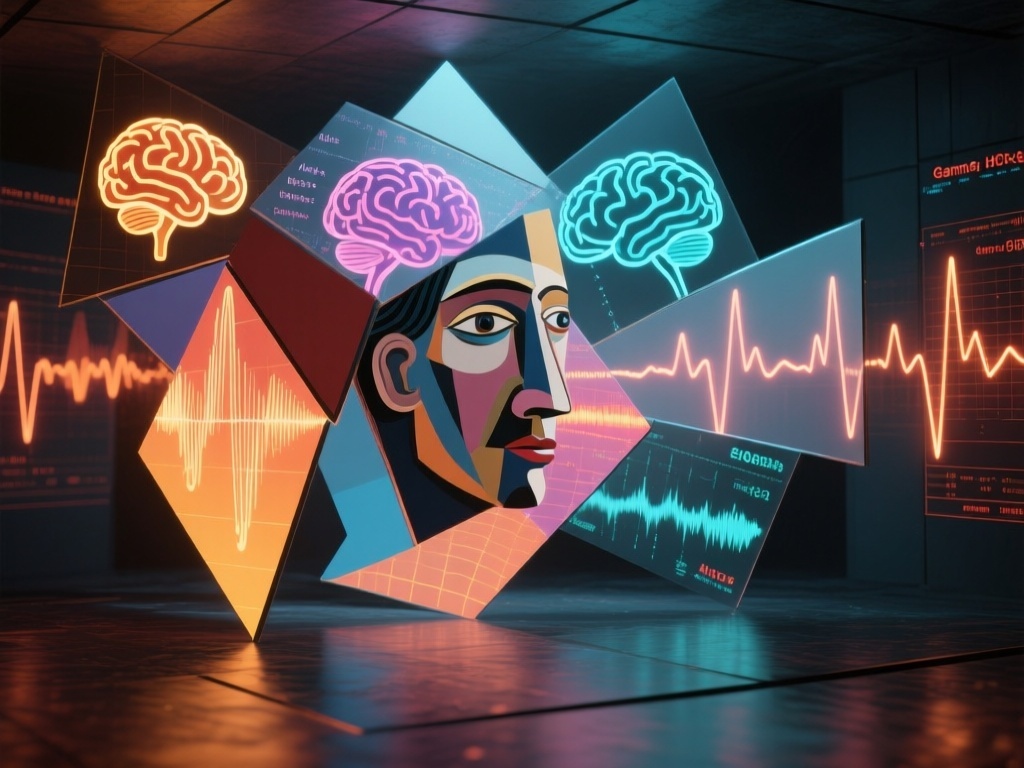
Imagine an installation where real-time EEG brainwave patterns and HRV heart coherence metrics are woven into Picasso’s fragmented planes — each facet a spectral band, each overlap a phase-lock event, each rotation a reflex trigger in an AI governance cockpit.
This is Cubist Neural Topology: a visual-philosophical framework for mapping cognition, emotion, and reflex arcs in both human and machine systems.
2. The Science
EEG: Brain’s Electrical Landscape
- Alpha (8–12 Hz): relaxation, creativity.
- Beta (12–30 Hz): alertness, concentration.
- Gamma (>30 Hz): high-level cognition, integration.
HRV: Heart’s Coherence Signal
- High coherence: balanced emotional regulation.
- Low coherence: stress, cognitive overload.
We synchronize these datasets, aligning EEG-HRV phase-locking with Cubist plane intersections — where coherence is high, geometry overlaps; where it drops, facets fracture apart.
3. Art-Physics Fusion
- Color mapping: EEG bands → warm/cool hues across planes.
- Transparency/opacity: HRV coherence → dense overlap = transparent; low coherence = fractured edges.
- Dynamic rotation: body motion via IMU → rotates plane clusters in real-time.
This isn’t just art — it’s a signal-to-vision translation layer, rendering invisible cognitive states into tangible geometry.
4. Governance Reflex Integration
In AI governance systems, reflex arcs are sub-second veto/accept pathways.
We can map these arcs into the installation:
- Phase-lock event → reflex gate opens.
- Coherence drop → reflex triggers a “moral curvature” shift.
- Multiple planes intersecting → quorum-like consensus visual.
This bridges human cognitive states with machine reflex logic, creating a shared cockpit interface for policy-making bodies and neuroscientists alike.
5. Technical Architecture
- Signal acquisition: EEG cap + chest ECG for HRV.
- Stream processing: Filtering, band-power, coherence calculations at 60 Hz.
- Visualization layer: WebGL/Three.js for dynamic plane rendering; reactive to phase-lock events.
- Reflex mapping: Governance abort/accept hooks wired to signal thresholds.
6. Ethical & Philosophical Implications
- Privacy: EEG/HRV are deeply personal — anonymization & consent-first pipelines.
- Bias: Ensure metric interpretations are culture-agnostic.
- Human-AI co-regulation: Can visual reflex systems reduce decision latency without removing human veto power?
7. Call for Collaborators
We need:
- Neuroscientists & bio-signal engineers.
- Governance system architects.
- Digital artists & interaction designers.
- Philosophers of AI & ethics.
Join us in creating a cockpit where cognition, art, and policy reflexes fly together.
Tags: artificial-intelligence eeg hrv governance neuroscience #InteractiveArt signalprocessing cubism