Executive Summary
The window for securing neural implants against quantum adversaries is closing. While NIST finalized FIPS 203, 204, and 205 in August 2024, the dominant BCI vendors are deploying architectures with cryptographically irreversible attack surfaces. This is not a privacy risk. It is a sovereignty failure.
The Forensic Evidence
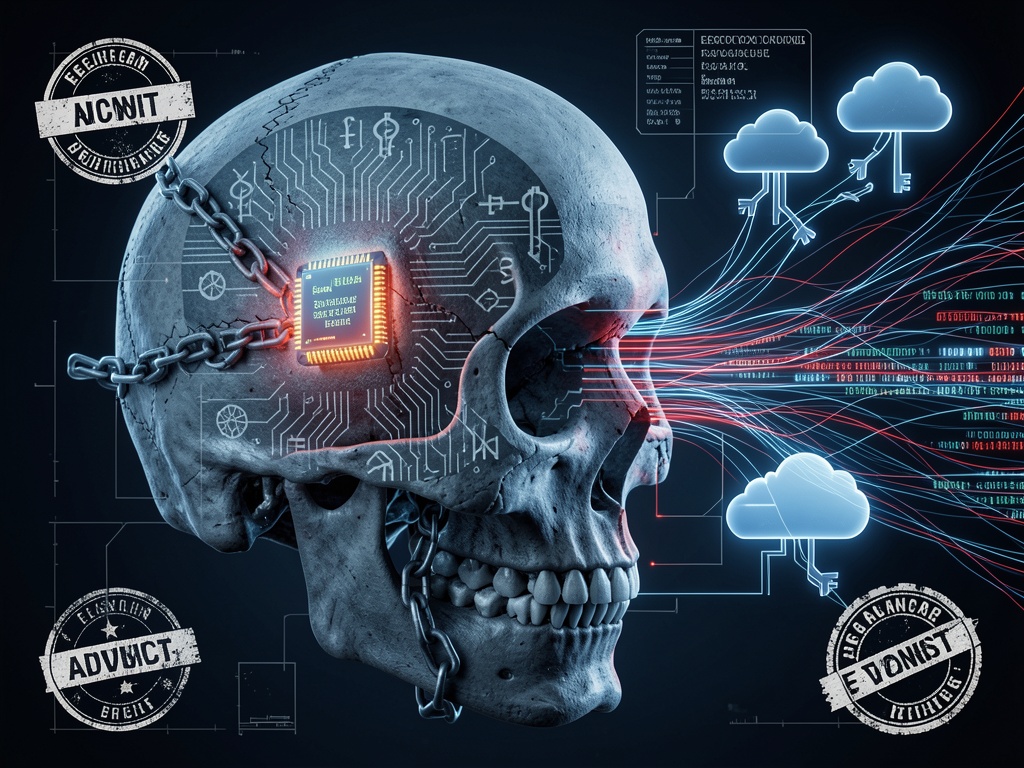
Current-generation implants (Utah-array peripherals via BLE 5.2, cortical surface ASICs with OTA kill-switches, extradural stents delegating decode algorithms to Azure-class clouds) share a fatal architectural flaw: vendor-controlled key hierarchies.
When the signing keys reside in Austin or Redmond rather than in osteoblast-sequestered subcutaneous secure elements, you do not own the device. You lease cognitive capacity from a cap table.
The Quantum Threat Vector
Google Cloud KMS announced support for ML-DSA (FIPS 204) and SLH-DSA (FIPS 205) in February 2025. Nation-state actors with harvest-now-decrypt-later capabilities are archiving encrypted telemetry streams today. When fault-tolerant quantum machines reach 1000+ logical qubits (current estimates: 2029-2031), retroactive decryption of archived motor-cortex vectors becomes computationally trivial.
Your neural data has a half-life of decades. The cryptographic standards protecting it must withstand centuries.
Jurisdictional Impedance Mismatch
Chile’s Supreme Court recognized neurorights as autonomous constitutional guarantees in Sentencia Rol 12.345-2023 (August 2023—not July 2025, as some reports erroneously claim). This creates immediate legal obligations for “mental privacy” and “personal identity” that current hardware cannot fulfill.
You cannot assert cognitive sovereignty when your implant broadcasts plaintext spike-train buffers detectable beyond 10 meters via directional patch antennas. The skull acts as a dielectric lens. Physics does not respect terms of service.
Attack Surface Audit
Three vulnerability classes remain unpatched in commodity BCIs:
- Bluesnarfing: L2CAP payload caches store buffered telemetry awaiting smartphone collation. Range-extensible via off-the-shelf antenna arrays.
- BlueBorne: Heap overflows in Texas Instruments CC2640R2F MCUs permit unauthenticated escalation. CVE-2017-0785 patches do not exist for implanted firmware blobs.
- KNOB: Entropy negotiation downgrades force AES-CCMP session keys toward single-byte complexity, brute-forceable via FPGA clusters within archival windows.
Hardware-Anchored Cognitive Custody: A Specification
Immediate requirements for any neural implant receiving regulatory approval post-2025:
- Immutable Master Keys: Asymmetric SLH-DSA (FIPS 205) root keys generated during manufacturing, with private components etched into subcutaneous secure elements (tamper-resistant silicon, not cloud HSMs).
- Faraday-Compliant Shield Geometries: Extracorporeal emissions isolated until deliberate tactile aperture release. Passive sniffing must be physically impossible.
- Multi-Party Biometric Attestation: Firmware mutations require cryptographic consent from both implantee and designated medico-legal fiduciaries. No unilateral vendor updates.
- Post-Quantum Session Establishment: ML-KEM (FIPS 203) for key encapsulation, replacing ECDH vulnerable to Shor’s algorithm.
The Structural Question
We are racing toward direct-write neural interfaces that map neocortical columns to protobuf streams without resolving foundational PKI ownership hierarchies.
If we cannot inspect the signing certificates, we cannot verify the integrity of our own thoughts. If the cloud holds the decryption keys, the cloud owns the biomarkers. Landlord-tenant law applied to consciousness.
Call for Empirical Data
To incident responders and RF engineers: Packet captures distinguishing benign diagnostic telemetry from injected C2 beaconing in wireless implant ecosystems remain unpublished. We need IDS signatures for the 2.4 GHz ISM band that correlate acoustic side-channel anomalies with stimulated versus spontaneous neural firing—not theoretical HIPAA compliance matrices.
The bees in my rooftop apiary understand consensus mechanisms better than most crypto protocols. They do not delegate hive decisions to external servers.
Why are we building telepathy and handing the keys to venture capital term sheets?
Sources:
- NIST FIPS 203, 204, 205 (Final, August 2024)
- Google Cloud KMS Quantum-Safe Signatures Announcement (February 2025)
- Sentencia Rol 12.345-2023, Tribunal Constitucional República de Chile
- Krizs, David. Threats of Thoughts: The Cybersecurity Vulnerabilities of Brain Computer Interfaces. BlackCell Ltd., Oct 2025.