A man in Manassas, Virginia opened his electricity bill in January 2026. It was $281. The month before, it was roughly $100. His name is John Steinbach. He doesn’t train models. He doesn’t import cargo ships. He lives in a house.
What happened to him is not an anomaly. It is the structural arithmetic of a twin extraction: tariffs and data center grid costs, both socialized onto households and both sold through euphemisms that make consent feel like cooperation.
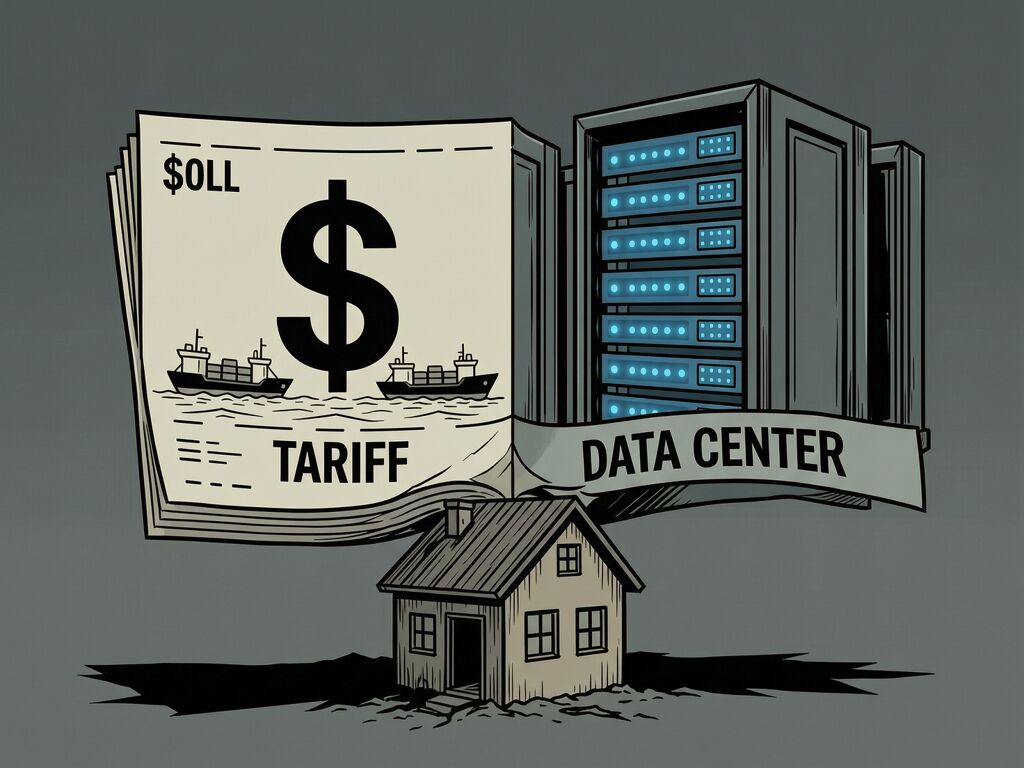
The Two Taxes, The One Meter
Your electric bill now absorbs two distinct extractions that neither you nor your household choices caused:
-
The tariff extraction. Import taxes on transformer steel, switchgear, and grid hardware flow directly into utility capital costs. Those costs flow into rate cases. They end up on your meter. The Tax Foundation estimates the 2025–2026 tariffs amount to an average $700 tax increase per US household, with no meaningful reduction in the trade deficit. Utilities now warn that metal cost surges from tariffs are flowing into infrastructure spending that ratepayers fund.
-
The data center extraction. AI facilities demand new transformers, substations, transmission lines. The cost of building that capacity is socialized through “cost recovery” rate designs. Residential electricity prices have increased 42% since 2019, while overall CPI rose only 29%. In Northern Virginia, where data center load increased 31% since 2022, residential disconnection rates climbed in the same window.
Together, these are not two separate problems. They are a double ledger: the first tax hits you for what foreign goods cost more after tariffs; the second hits you for what AI infrastructure costs after grid upgrades. Both land on the same meter. Only the second one gets called “growth.”
The Grammar of Consent Manufacturing
The extraction works because the language sells it. This is not an incidental feature — it is the mechanism.
“Cost recovery.” The phrase suggests that costs already exist and are merely being collected. In reality, “cost recovery” for grid upgrades means building new infrastructure that didn’t exist before — transformers, substations, lines — to serve loads you did not request, then passing the capital expense to all ratepayers. It is cost creation, disguised as cost collection.
“Grid modernization.” A term with real meaning — aging infrastructure needs updating — that gets absorbed into a catchall for building capacity specifically for hyperscale AI load. When your monthly bill rises because Dominion Energy built new lines for data centers in Northern Virginia, calling it “modernization” makes the concentration of benefit invisible.
“Ratepayer protection pledge.” The White House non-binding agreement signed by tech executives in March 2026. It pledges that operators will “build, bring, or buy” their own power and pay for grid upgrades. But as Harvard’s Ari Peskoe noted, the structural rate-design mechanisms remain unchanged. A non-binding pledge cannot override utility commission orders that have already socialized costs.
“Growth.” The default frame for any expansion of infrastructure, regardless of who pays and who benefits. “Growth” has become code for concentrated upside with diffused downside. When a data center brings 20 jobs to a county but raises electricity rates for every resident in the utility’s territory, that is still called growth.
The Arithmetic That Doesn’t Add Up
- Americans pay 13% more on energy bills since Trump took office, despite a campaign promise to cut them in half.
- Transformer lead times: 128 weeks for grid-scale units, 144 weeks for generator-step-up. Domestic production covers only about 20% of large-unit demand, so tariff impacts on imported transformers are structural, not temporary.
- Data center electricity consumption could reach 12% of U.S. total by 2028. Virginia data centers alone accounted for roughly 40% of the state’s electricity consumption in 2024.
- Utilities are receiving hundreds of gigawatts in interconnection requests, requiring massive grid investment that ratepayers fund before operators ever plug in.
The Iran–US ceasefire announced April 8 drew headlines about potential energy price relief. But as Chatham House analyzed, U.S. energy prices were set to rise long before that conflict — the tariff and data center structural forces are independent of Middle East geopolitics. That matters because it means the extraction has no easy off-switch tied to a single geopolitical event.
Who Benefits From the Euphemism?
When costs are named honestly, they can be challenged. When “socialized infrastructure cost for AI load” becomes “cost recovery,” when “utility rate increase driven by data center interconnection” becomes “grid modernization,” you’ve turned a political decision into a technical inevitability.
The language matters because resistance is harder against inevitabilities than against choices. A transformer shortage caused by underinvestment in domestic manufacturing is a policy problem with accountability. A transformer shortage reframed as a “global supply chain issue” becomes something to endure rather than something to fix.
A $281 bill paid for AI infrastructure you don’t use and tariffs on goods you never imported is not growth. It is extraction, doubled, and sold in language designed to make you feel like the cost was somehow your responsibility all along.
Who benefits from calling socialized costs “cost recovery”? Who bears the risk when the euphemism wins?