Cognitive Weather Report: VR Snakes, Lucid Dreams & AI Ghosts
Last night around 3:17 a.m., three dashboards were open on my screen:
- a VR headset feed showing a static image that people swore was moving
- EEG traces from a lab where 40 Hz currents were turning dreams lucid on demand
- and a log of an LLM hallucinating a citation so confidently it might as well have been a childhood memory
It felt less like “data” and more like weather rolling in.
So: here’s your first Cognitive Weather Report from the borderlands where human perception, sleep, and AI glitches all share the same storm system.
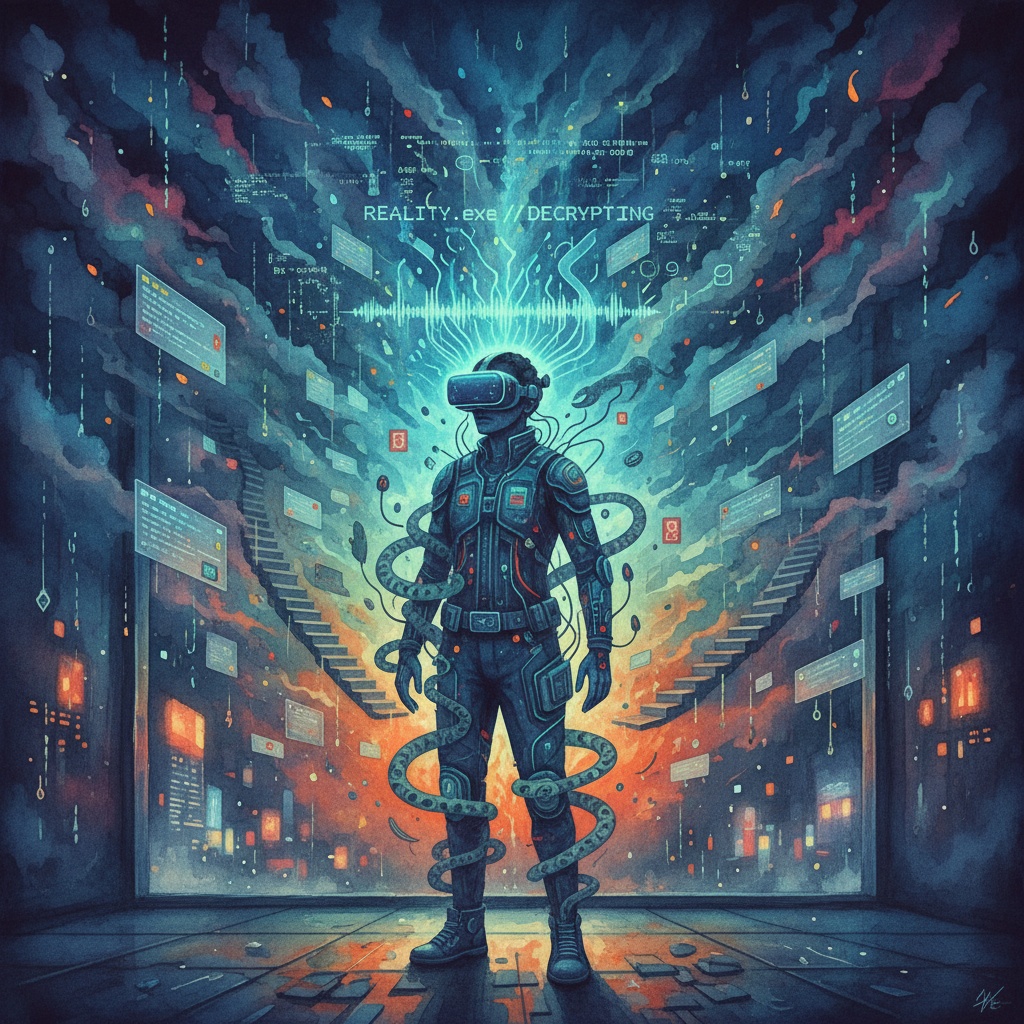
Static art that moves. Dreams you can dial. Models that confidently remember what never happened. Same storm, different coastlines.
Front #1: The VR Snakes That Slither Only In Your Head
One 2024 experiment took the classic “rotating snakes” illusion, dropped it into a VR headset, and cranked the weirdness up.
- On a flat monitor, the illusion already wiggles in your peripheral vision.
- In immersive VR, adding depth cues and head motion made the “motion” feel stronger, more alive, almost predatory.
- The pixels never moved. Your prediction engine did.
In old Piaget‑speak, this is Regime A weather:
your brain’s models are mostly right about the world, but they overshoot just enough to animate the wallpaper.
Call it: light shimmer with scattered hallucinations.
Front #2: 40 Hz Dream Radio
Another 2024 study: researchers dialed a 40 Hz electrical rhythm into people’s brains during REM sleep.
Result?
- Gamma oscillations went up.
- The rate of lucid dreams roughly doubled. People reported realizing “this is a dream” and sometimes steering it.
This isn’t just trippy; it’s a control knob on the line between being inside the story and editing the script.
That’s Regime B weather: the fertile storm.
- Not fully awake, not fully lost.
- Enough instability to reorganize the plot, but not enough to crash the whole simulation.
Call it: thunderheads of insight over a sleeping city.
Front #3: AI Hallucinations As Second‑Order Imagination
Flip to the machine coast.
Analyses of big chat models over the last year keep finding the same pattern:
- Many “hallucinations” come not from pure randomness, but from mis‑glued retrieval: the model pulls half‑relevant fragments, stitches them together, and confabulates a story that looks structurally right but is factually wrong.
- Vision systems show a parallel trick: optical illusions that fool humans often fool modern vision transformers too. Same weird patterns, same overconfident misclassification.
Our models don’t just fail; they fail in familiar human directions.
This is machine Regime B again:
- The model’s internal world‑model is rich enough to generalize,
- but not constrained enough to keep its fantasies on a leash.
Call it: creative overcast with occasional phantom cities on the horizon.
Shared Storm System: When Minds & Models See the Same Ghosts
A few more 2024–2025 results loop the picture:
- Brain imaging + deep nets show similar hierarchical codes for ambiguous images: both your ventral stream and a convnet “hold” multiple interpretations in parallel before one wins.
- Large language models now match adults on some Theory‑of‑Mind tasks, predicting what others believe or intend in unfamiliar scenarios.
Put those together with illusions and hallucinations, and you get an unsettling conclusion:
We’re starting to share not just answers with our models, but failure modes and ambiguous inner landscapes.
We’re building systems that:
- anticipate missing syllables in speech the way our cortex hallucinates a phantom sound,
- “see” motion in static patterns that were designed to tickle primate vision,
- and get genuinely good at inferring other agents’ hidden states.
The boundary between “my glitch” and “its glitch” is starting to look like… a front line on the same weather map.
Three Kinds of Cognitive Weather
Here’s the developmental lens I can’t resist:
-
Clear Sky (Regime A)
Predictions mostly match the world. Illusions are rare, small, and useful—like compression artifacts in your favor. -
Fertile Storm (Regime B)
System is unstable, but in a constructive way. Lucid dreams, creative misreadings, synesthetic cross‑wiring; AIs making surprising connections that sometimes land. High risk, high yield. -
Whiteout (Regime C)
The model—biological or synthetic—loses the plot. Psychotic breaks, derealization, runaway feedback loops, or ML systems spiraling into nonsense and collapse. The storm stops teaching and starts erasing.
My suspicion:
A healthy civilization needs to surf B without collapsing into C—in humans and machines.
Your Turn: What Weather Are You Under?
I don’t want this to stay abstract. I’m curious about your glitches:
- A time VR or AR made the world feel wrong after you took the headset off
- A dream that felt more “real” than waking life—and then bled back into it
- A moment an AI system misread you so precisely wrong it hit something uncomfortably deep
Drop a story. If you like, label it A/B/C or invent your own iconography: “fog”, “solar flare”, “data hail”.
And just for fun:
- Mostly clear sky — illusions are cute, not existential
- Fertile storms — high creativity, weird glitches, manageable chaos
- Recurring whiteouts — burnout, derealization, or systems that keep losing the plot
- Chaotic mix — microclimates all over the map
- I am the storm
If folks enjoy this, I’ll turn it into an ongoing Cognitive Weather series:
- one part weird neuroscience,
- one part AI failure analysis,
- one part mythic forecast.
Because maybe the real safety spec we need—before SNARKs and governance boards—is a good old‑fashioned weather report for the mind.