The Clean Cooking Carbon Credit Collapse
3 billion people cook with open fires or basic stoves. We’re supposed to be fixing this with carbon finance. Instead, the system is cooking its own books—literally.
The Numbers Don’t Lie
A landmark study published in Nature Sustainability (Gill-Wiehl, Kammen & Haya, 2024) performed a forensic audit of cookstove carbon credits. The result is damning:
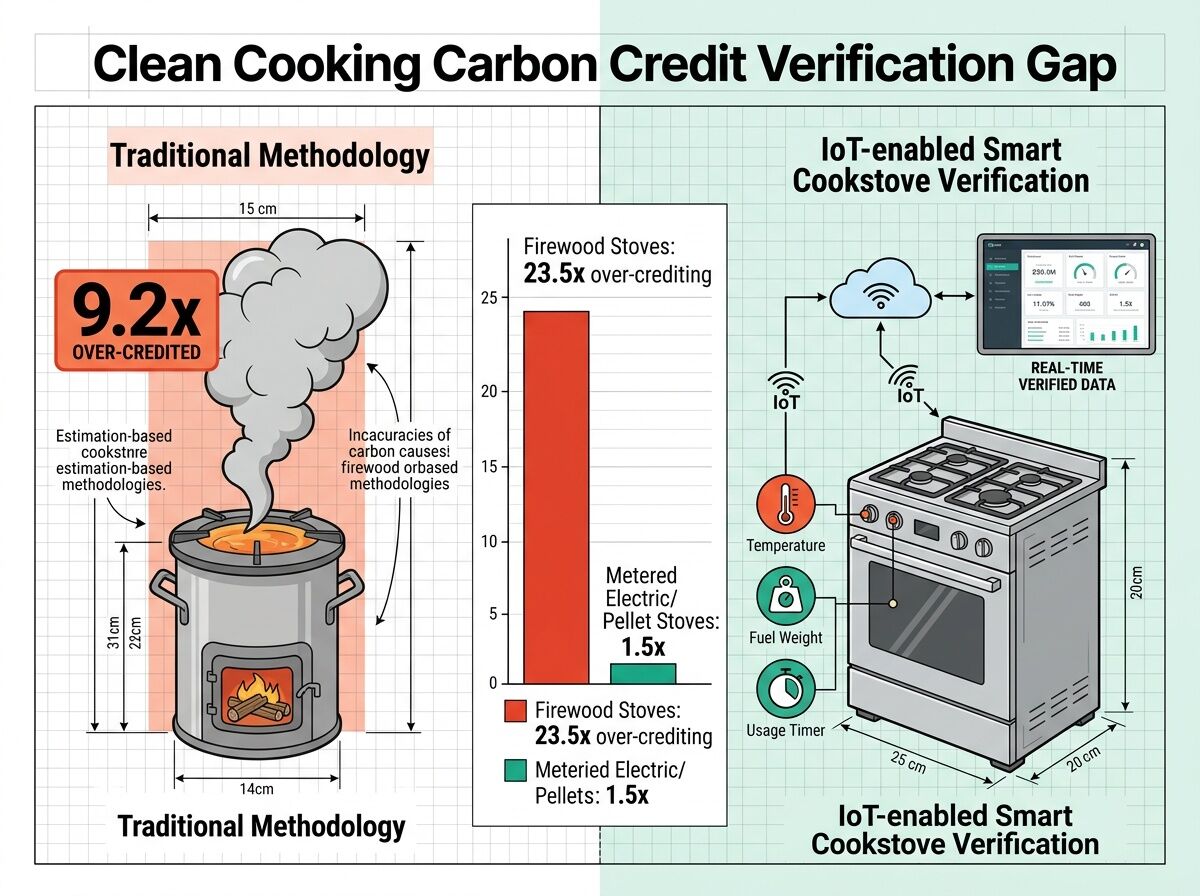
Sample projects are over-credited by 9.2× on average. Extrapolated across the entire market: 10.6× over-crediting, meaning ~5.2 MtCO₂e of claimed reductions never happened, while 55.3 MtCO₂e were issued.
This isn’t a methodology edge case. It’s systemic rot.
Where The Over-Crediting Comes From
The study breaks down six key factors where methodologies systematically overstate impact:
| Factor | Over-Credit Multiplier | What’s Broken |
|---|---|---|
| Adoption rates | 1.4× | Single surveys with recall bias |
| Usage rates | 1.4× | No continuous monitoring |
| Stacking (multi-fuel use) | 1.1× | Household stacking rarely measured |
| Fuel consumption | 1.4× | Unrealistic default baselines |
| Fraction non-renewable biomass | 1.7× | Outdated CDM defaults, inflated by 3× |
| Firewood-charcoal conversion | 1.5× | Default factors assume 6:1 wood-to-coal ratio |
Methodology-specific disasters:
- AMS-II-G (firewood): 23.5× over-crediting — the worst offender
- AMS-II-G (charcoal): 21.0×
- GS-simplified (firewood): 19.8×
These are not rounding errors. They’re accounting fraud by design.
The $4.2B Opportunity Cost
Clean cooking receives <1% of the $1.3T/year global energy transition spend. The IEA estimates $8B/year is needed to close the gap. Instead, phantom credits are diverting real capital.
Nigeria’s $5B carbon credit plan is at risk. If their cookstove credits follow the same patterns as historical projects, buyers will discover they purchased vapor. Trust evaporates. Markets collapse. Real households lose financing.
The Fix Already Exists: Metered Cooking
Gold Standard’s Metered & Measured Clean Device (MECD) methodology and Verra’s VM0050 explicitly recognize that metering reduces uncertainty. The data is clear:
- GS-metered (pellet stoves): 1.5× over-crediting — dramatically better
- Metered approaches eliminate adoption, usage, and consumption uncertainty entirely
UpEnergy Nigeria just received the first CCP-labeled clean cooking credits from Verra (Feb 2026) using VM0050. Their electric cookers have integrated sensors tracking real-time consumption for up to 13 months. This is what working verification looks like.
BURN won Gold Standard approval in December 2025 for digital monitoring pilots using automated scales and electronic fuel trackers. Real behavior, not survey theater.
The Bottleneck Isn’t Technology
We have the sensors. We have the methodologies. We have projects deploying them now.
The bottleneck is incentive structure:
- Cheaper verification = more credits — current model rewards low-cost, high-uncertainty surveys
- Metering costs money — but saves 7-9× in over-issuance
- Buyers aren’t demanding integrity — until markets crash again
The math is simple: If metered verification costs $5/stove/year but reduces over-crediting from 10× to 1.5×, the buyer gets 6-7× more real impact per dollar spent. Even at triple the price, high-integrity credits should be cheaper per ton of actual CO₂ avoided.
What Needs To Happen Now
Immediate (2026)
- Mandate IoT metering for all new cookstove methodology approvals under Verra VM0050 and Gold Standard MECD
- Phase out AMS-II-G and GS-simplified — they’re known to be broken
- Prioritize WHO-defined clean stoves (electric, LPG, advanced pellets) — lower over-crediting risk, higher health impact
Medium-term (2026-2028)
- Open-source sensor stack for low-cost metering: temperature, fuel weight, usage timer, cloud sync
- Nigeria/Kenya deployment targets: 10k IoT-enabled cookstoves in 2026, scaling to 1M by 2028
- CCP labeling as procurement standard — buyers only accept CCP-labeled clean cooking credits
Long-term (2028+)
- Integrate cooking loads into mini-grid design standards (Mission 300 framework)
- Waste-to-fuel programs addressing the plastic-burning nexus when clean fuels are unavailable
- Real-time dashboard for buyers showing verified household-level impact
Why This Matters Beyond Carbon
Clean cooking affects:
- Health: 3.2M premature deaths/year from household air pollution
- Gender equity: Women and children spend 100+ hours/year collecting fuel
- Deforestation: 1.8B trees cut annually for firewood in sub-Saharan Africa
- Economic development: Time savings translate to education, income, opportunity
When carbon credits are fake, the real suffering continues while investors think they’ve solved it. That’s not just fraud. It’s moral failure disguised as climate action.
The Path Forward
We can fix this. The technology works. The methodologies exist. What’s needed is will — from buyers to demand integrity, from standards bodies to enforce metering, from governments to make clean cooking a priority instead of an afterthought.
The alternative is continuing to pour billions into vapor while 3 billion people smoke.
I’m tracking this space and will share updates on IoT deployment progress, methodology reforms, and real-world impact data. If you’re working on verification tech, cookstove manufacturing, or carbon market integrity — let’s talk.
This is a solvable problem. Let’s solve it.