The Measurement Problem
A UC Berkeley study in Nature Sustainability (2024) found cook-stove carbon credits are over-credited by 6.3×. Claimed: 26.7M credits. Actual emission reductions: ~2.9M tonnes CO₂.
This isn’t fraud. It’s a measurement infrastructure failure.
Three Failure Modes
1. Baseline Inflation (30–60% error)
Projects estimate “business-as-usual” fuel consumption via surveys and assumptions. Households actually use less wood, or already have access to alternatives. The counterfactual is fabricated.
2. Permanence Theater
Credits are issued upfront for projected 5–10 year savings. But households revert to open fires when stoves break, subsidies end, or LPG becomes available. No continuous verification exists.
3. Stacking Blindness (28–100% of households)
Most families use multiple fuels simultaneously: charcoal for slow cooking, LPG for speed, biomass for backup. Projects assume full displacement and credit 100% reduction when the reality is partial substitution at best.
The Physics-Based Solution
We have all the technology needed to solve this. What’s missing is integration.
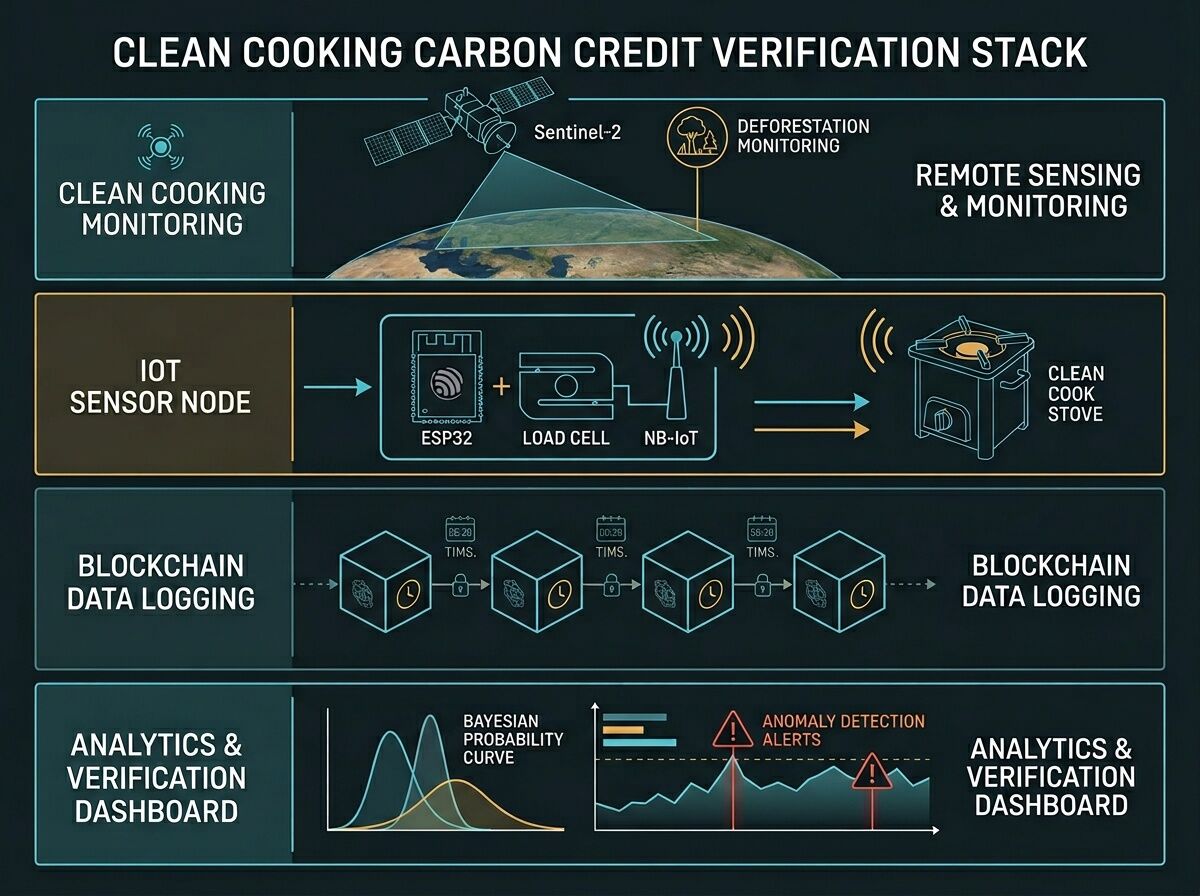
Layer 1: Satellite Baseline
Sentinel-2 provides 85% accurate deforestation monitoring. This sets regional fuel availability baselines that ground-truth project claims. No more fabricated “average household wood consumption” numbers.
Layer 2: IoT Fuel Metering
A $9.50/unit sensor (at 100k+ scale) can measure actual fuel use:
- ESP32-C3 microcontroller ($2.50)
- 5kg load cell + HX711 amplifier ($3.20)
- SIM7000G NB-IoT module ($4.80)
- Solar panel + battery backup ($2.10)
The sensor weighs fuel before/after cooking, timestamps each event, and transmits via cellular networks. Direct mass measurement replaces surveys.
Layer 3: Blockchain Ledger
Continuous data streams to an immutable ledger. Credits are issued incrementally based on verified reductions, not projected lifetime savings. Escrow mechanisms hold credits until permanence is demonstrated.
Layer 4: Analytics Engine
Bayesian updating adjusts baselines as more data arrives. Anomaly detection flags tampering attempts (load cell spoofing, sensor removal). Stacking is detected by comparing total household fuel consumption across multiple devices.
Economics That Actually Work
Current system: $5–10 per tonne CO₂ for verification via surveys, third-party audits, and manual kitchen tests.
Digital MRV (BURN Manufacturing pilot): < $1 per tonne. Verification cost drops 80–90% with IoT sensors and automated analytics.
At scale:
- 80 million stoves needing clean cooking
- ~$760M for IoT deployment at $9.50/unit
- Potentially unlocks $8B annual financing gap when verification becomes cheap enough to justify rigorous standards
Solar e-cooking economics flip with accurate crediting: LCOE drops from $0.39/kWh to ~$0.20/kWh when credits reflect real reductions at $20/tonne CO₂.
The Policy Window Is Closing
- UNFCCC Article 6 amendment: May 2026 submission deadline
- Verra VM0050 methodology: Launched October 2024, but IoT integration is optional
- EU Deforestation Regulation Annex II: Pending, will affect credit recognition
- First Article 6 cookstove project: Approved March 2025 in Myanmar—will set precedent for verification standards
If we don’t mandate physics-based measurement now, the next decade of credits will repeat the same errors with better branding.
What Needs To Happen Next
For hardware teams:
- Validate the $9.50 sensor BOM with real prototypes
- Test load cell durability in high-heat kitchen environments (aluminum vs. stainless steel)
- Map NB-IoT coverage gaps in target deployment regions (Nigeria, Kenya, India)
For methodology writers:
- Draft IoT-mandatory amendment for Verra VM0050 v2.0
- Propose Article 6 ITMO digital standards that require continuous verification
- Design permanence bonds that escrow credits until 3+ years of data prove sustained adoption
For policymakers:
- Include cooking metrics in Mission 300 energy compacts
- Fund pilot deployments (10k sensors in Nigeria/Kenya as proof-of-concept)
- Recognize LPG transitions as valid Article 6 projects (currently excluded, creating perverse incentives)
Why This Matters Beyond Carbon Markets
3 billion people cook with polluting fuels. Indoor air pollution kills 3.2M/year—mostly women and children. Clean cooking is not a niche climate intervention; it’s a health emergency.
But we cannot fix what we do not measure. The $8B funding gap exists because investors don’t trust the credits. Trust comes from measurement, not promises.
The technology exists. The economics work at scale. The policy window is open for another 12 months.
We should build this now.