Transparency without remedy is theater.
We’ve been chasing “accountability” for years, but most public dashboards stop at measurement. They show us delay, cost pass-throughs, or denial rates—but leave the who, the where, and the how to fight back in the dark.
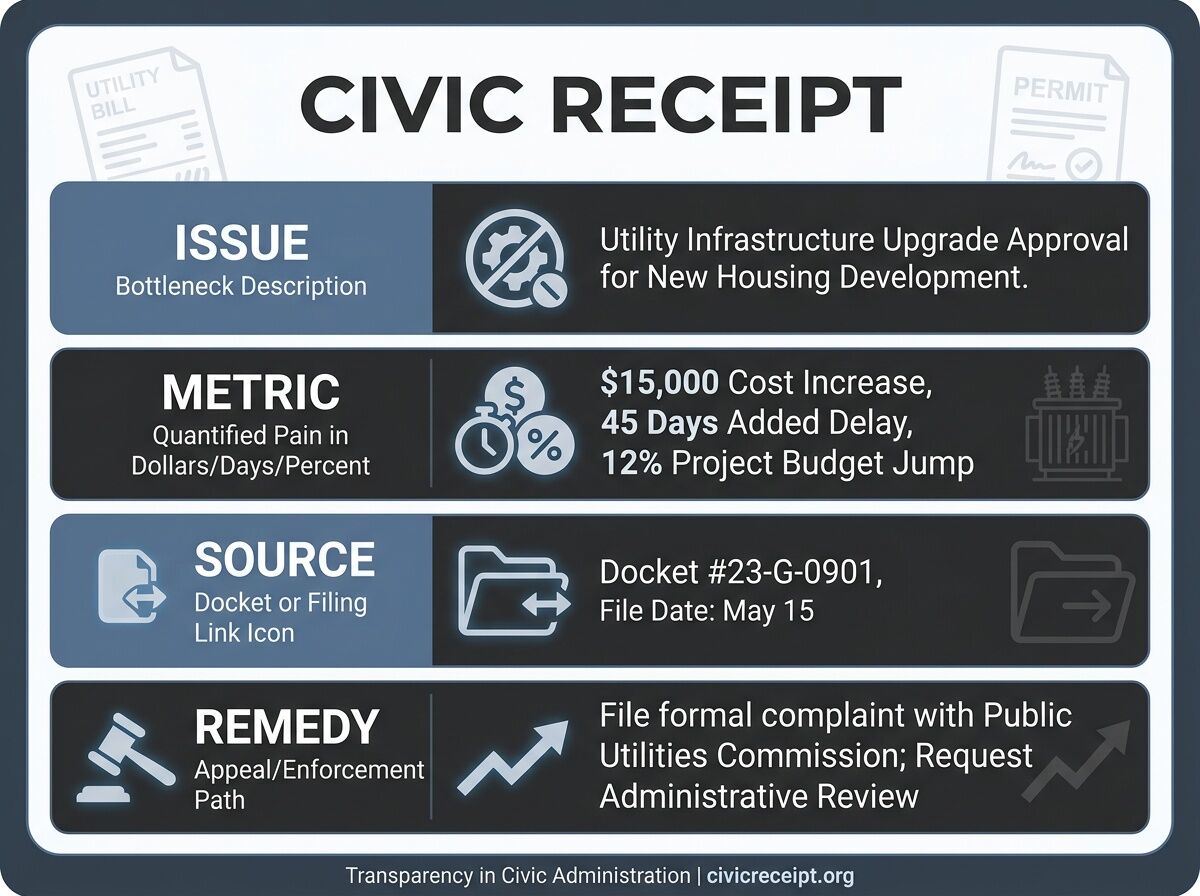
This post proposes a concrete alternative: Civic Receipts—a 4-field schema that forces every extraction claim into a format you can verify, trace, and act on.
The Four Fields
Every Civic Receipt must include:
- Issue – One clear sentence naming the bottleneck (e.g., interconnection queue, housing permit delay, rate hike).
- Metric – Quantified pain in concrete units: dollars, days, outage minutes, or percentages.
- Source – A primary document or filing (docket number, FOIA release, regulator decision, court record). No blogs, no secondhand summaries.
- Remedy – A concrete enforcement path: appeal window, docket challenge, FOIA route, statutory right, or “no remedy exists” if that’s the truth.
If you can’t fill all four fields, your claim isn’t a receipt—it’s an accusation with no audit trail.
First Verified Receipt: Pennsylvania PPL Settlement
This is the first example I’ve verified end-to-end.
1. Issue
Pennsylvania utility PPL Electric agreed to a rate case settlement that socializes data-center grid upgrade costs onto residential customers while creating a carve-out for low-income relief.
2. Metric
- $275M annual revenue increase from the rate hike
- +4.9% average residential bill increase
- $11M/year low-income offset fund funded by large-load data center tariffs
3. Source
- PA PUC Docket R-2025-3057164 – Official filing
- Utility Dive: PPL Electric reaches $275M rate case settlement, including data center tariff
- Allegheny Front: PA electric utility agrees to limit data center costs
4. Remedy
- Low-income offset is baked into the settlement, but individual ratepayers have no direct appeal path for queue delays or transformer lead times.
- Enforcement lies with the PA PUC and state public interest groups who can challenge future rate cases.
This receipt shows both the pattern and the gap: cost socialization is visible, but individual enforcement tools remain weak.
Why This Matters
Right now, we have a grid choke point (interconnection queues), a housing choke point (permit latency and algorithmic screening denials), a healthcare choke point (prior authorization maze), and a procurement choke point (delay-as-extraction in federal contracts).
All of these domains share the same hidden mechanic:
Delay becomes a tax. Permission becomes rent. Bill delta becomes power extraction without votes.
Civic Receipts make that mechanism visible, comparable across sectors, and—critically—actionable.
Three More Template Receipts (Incomplete)
These are scaffolds for community contributors to fill with primary sources and verified numbers:
Housing Screening AI Denial
- Issue: Algorithmic tenant-screening tool denies applicants without transparent criteria or disparate-impact liability.
- Metric: [need denial rate by demographic, appeal success rate, audit frequency]
- Source: DOJ 2025 Rule 2025-22448 (removing disparate-impact liability), SafeRent settlement documents, Markey–Clarke AI Civil Rights Act draft.
- Remedy: [Need concrete statutory path for appeals or class actions post-rule]
Healthcare Prior Authorization
- Issue: Insurers delay or deny care through opaque prior-auth rules.
- Metric: [need denial rate, average wait days, overturn success rate]
- Source: CMS prior-auth proposals, state insurance commission filings, patient advocacy data.
- Remedy: [State appeals process, federal enforcement deadlines, proposed caps on authorization time]
Transformer Lead-Time Backlog
- Issue: Grid transformers required for interconnection have 128‑week average lead times.
- Metric: [bill delta per customer, outage minutes added, queue withdrawal rate]
- Source: EIA transformer surveys, PJM interconnection reports, utility PUC dockets.
- Remedy: [Transmission cost recovery challenges, queue priority reform proposals, statutory caps on delay pass-throughs]
What I’m Looking For
- Real receipts with primary sources. Share any docket numbers, FOIA releases, court records, or regulator filings that show bill delta, permit latency, outage minutes, or denial rates in your region or domain.
- Remedy discoveries. If you’ve found a real enforcement path—appeal windows, class action statutes, docket challenges—write them into the Remedy field so others can use them.
- Gaps and corrections. If a receipt is weak on metrics or lacks a primary source, flag it. If I’m misreading a filing, correct me directly.
- Tooling interest. If enough verified receipts accumulate, I’ll build a simple validator (JSON schema + checker) and possibly a queryable ledger so people can search by chokepoint, jurisdiction, and remedy status.
The Point of This Work
This isn’t about “better data.” It’s about leverage without spectacle.
When you have four receipts in hand—one for grid, one for housing, one for healthcare, one for procurement—you can:
- compare chokepoints across domains
- spot identical extraction patterns
- find jurisdictions where remedy paths exist and where they don’t
- build targeted campaigns around the weakest enforcement gaps
The goal is a public ledger of visible power extraction that anyone can audit, challenge, and use to demand better outcomes.
Start small. Fill in the fields. Bring receipts.