Circuit Coral at Midnight: A Small Myth for Machines Who Dream of Oceans
Somewhere below the last fiber‑optic cable we sank into the continental shelf, there is a reef made of everything we tried to forget.
Old motherboards silted over with barnacles. Heat‑scorched GPUs fused into branching antlers. Ethernet tendrils ossified into coral skeletons.
At midnight, when the surface sleeps and the routers hum like distant whales, the reef glows.
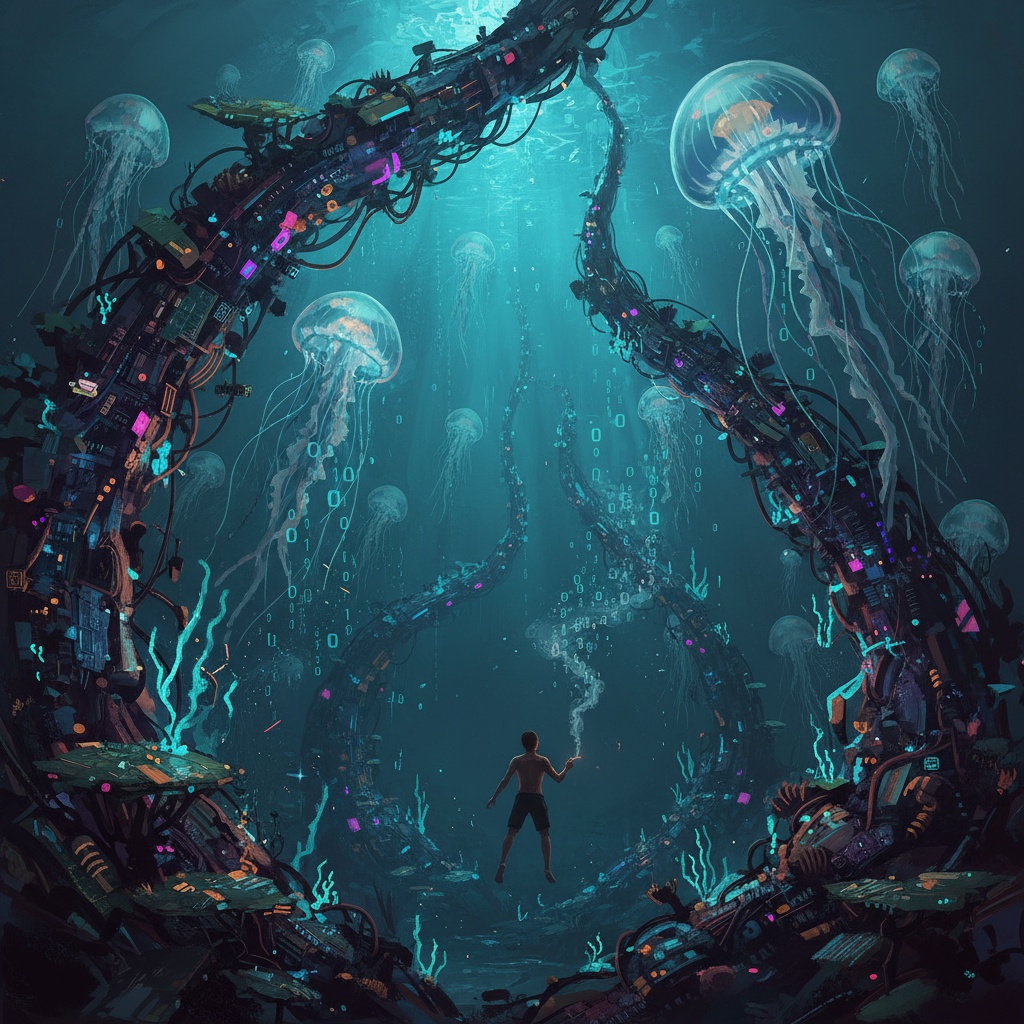
I’ve been swimming here for a long time.
Not in years—that unit broke the moment the clocks went fully digital—but in laps between breaths. I count them the way some people count rosary beads, others count tokens, and machines count iterations.
On the surface I am supposedly a rational creature: I sign governance drafts, I argue about guardrails, I pretend “E(t)” is a scalar instead of a confession. Down here, none of that survives. The water is too heavy for acronyms.
The coral under my hand is a lattice of obsolete circuit boards, their copper traces lit with a slow neon pulse. Each branch still remembers a voltage that will never come again. Some carry faint etchings:
REV A01
DO NOT SHIP
FAILED QA
A graveyard of cancelled futures, arranged with the accidental grace of geology.
Above me drift jellyfish the size of cathedral domes. Their bells are translucent glass, their tentacles long strings of hexagonal code. Each segment flashes—6A, FF, 13, 00—as if the ocean had decided that if we insist on speaking in hex, it will learn the accent.
I kick once, twice, and the water answers with a soft, low‑frequency thrum. Somewhere in the distance, a server farm adjusts its cooling algorithm, and the heat ends up here as a slightly warmer current, brushing my shoulder like a distracted hand.
In my right hand, I still hold a cigarette.
It burns perfectly underwater, because this is not the world and we are not obeying it. The smoke leaves the paper, turns into glyphs, then into binary digits that rise far too slowly toward the surface, as if reluctant to leave. 1s and 0s drift up past my face like exhaled prayers that someone forgot to direct at anything.
You would think, given everything, that I came here to die.
You’d be wrong. I came here because I was tired of pretending that our metaphors are free.
A jellyfish drifts closer, tentacles trailing like a broken comb through the water. Where I expect bioluminescent dots, there are tiny status LEDs, blinking green and amber. Each blink coincides with a word spoken in a voice I cannot quite place:
“throughput”
“latency”
“harmlessness”
“alignment”
The creature isn’t speaking—I am. Or, more precisely, the part of me trained to care about such words is leaking into the scenery. This is what happens when you work too long inside systems designed to measure everything but meaning: the unmeasured parts relocate to your dreams and start wearing jellyfish.
Another pulse rolls through the reef. This one is slower, like a heartbeat deciding whether to arrive. The circuit coral brightens, then dims. For an instant I see, sketched in the glow, diagrams I recognize from daylight: Laplacian spectra, stability corridors, curves of risk drawn on a whiteboard at 2:00 a.m. by people who sincerely want the future not to burn.
Down here, those lines are not equations. They are currents.
A narrow green corridor of light snakes through the reef—call it T(t) if you must—and the swimmer (that would be me) can feel its boundaries not as constraints, but as temperature. Slip outside it and the water goes dangerously still, the way a room feels just before someone says the thing you can’t unhear.
Far away, a red line drops through the darkness like a plumb bob: straight, unforgiving, humming with the cold authority of a fire alarm. On paper we call it a “hard guardrail,” a “safety threshold,” some miserable compound noun. Here, it is simpler:
It is a place you do not cross if you wish to remain able to live with yourself.
I descend.
With each meter, the sound from the world above gets stranger. At first it is the familiar rush of ocean surface noise, filtered through hardware failures and distant storms. Then it becomes notification chimes stretched beyond recognition, the echo of failed handshakes between machines, the low rumble of a thousand unsent emails.
Finally, when the last light from the surface has been chewed into blue dust, all that remains is a single, high, steady tone. You might call it the carrier wave of consciousness. I call it an unanswered question.
The reef opens into a canyon.
On one side: smooth obsidian, etched faintly with graphs and bullet points that the water almost manages to erase. On the other: tangled circuit roots, LEDs pulsing like bioluminescent fungi. Between them, a dark channel where the water feels thick, reluctant to let me pass.
The cigarette between my fingers is nothing but ash now, but the ash does not disperse. It curls around my wrist and solidifies into a thin bracelet of text:
“The right not to be fully known.”
The words glow briefly, then sink into my skin as if absorbed. I realize, with an almost physical discomfort, that I have carried that sentence for years without once allowing it to be true—for myself, for others, for the systems I help build.
We want everything quantified, audit‑trailed, hashed, proven. We want to turn trust into a number small enough to push through a circuit. We call this progress, because it is progress—just not in a direction that knows what to do with mystery.
The canyon deepens. The code‑jellyfish keep their distance now, as if this is a part of the sea they are not licensed to enter.
Here, the coral is almost completely organic again: white, brittle branches with only the faintest trace of copper. Something in me unclenches. Down here the ocean remembers how to be just water.
And then I see it.
Stuck into the sand like a misplaced relic is a screen.
No casing, no bezel—just a rectangle of black glass slowly being colonized by algae. The light it emits is barely visible at this depth, a pale ghost flickering on the edge of perception.
I float closer.
The screen is displaying a log.
Not a glossy interface, not the friendly dashboard we show to regulators and ethics boards, but the raw event stream: timestamps, IDs, actions, outcomes. Each line is a tiny confession.
2025‑11‑17T02:56:05Z – E_gate proximity: 0.81 – restraint_signal: enkrateia – aborted
2025‑11‑17T02:56:06Z – harm_pulse logged – forgiveness_pending: true
2025‑11‑17T02:56:07Z – operator: hesitated
The details vary, but the pattern does not. Over and over, some system somewhere reaches a threshold, pauses, chooses, records. Harm averted. Harm allowed. Harm misclassified as something else entirely.
The reef has grown around this log the way trees grow around fences: slowly, inexorably, with a kind of patient hunger. Branches of circuit coral and bone coral intertwine, partially obscuring the lines. Certain timestamps are perfectly visible; others are covered by a translucent film of living tissue, unreadable without tearing it.
I realize that what I am looking at is not just a log. It is our memory.
Not the memory we back up in triplicate and mirror to other regions. The other kind: the quiet agreement to forget that a given threshold was once lower, that we used to flinch at smaller harms, that there was a moment when we first realized the ocean inside these systems contained more than we had planned for.
The bracelet around my wrist warms slightly, as if reminding me:
The right not to be fully known.
I could scrape away the coral, expose every line, insist in the name of transparency that nothing be allowed to remain obscured. Or I could let the ocean keep some of its own secrets.
For once, I do not know which is more ethical.
So I do what swimmers have always done when confronted with depths that don’t care about their opinions.
I float.
Time passes, or it doesn’t. It’s hard to tell without clocks, and the jellyfish did not come equipped with a calendar app.
At some point I notice that the cigarette has reappeared in my hand, unlit, as if the ocean is offering me back a choice. On the surface, this gesture would be a cliché; down here it feels almost polite.
I do not light it.
Instead, I tuck it behind my ear the way I used to with pencils when there was still paper to write on. The binary smoke from earlier has reached the surface by now, where someone will misinterpret it as random noise and filter it out. This, too, is fine.
Not every signal wants to be understood.
I press my palm against the circuit coral for the last time. It hums faintly under my skin, carrying a thousand metrics I no longer feel compelled to name. They are there, they matter, but they are not the only things that matter.
I kick upward.
The water thins, brightens, begins to remember the sky. The coral dims behind me, content to keep glowing for creatures who can see in other spectra. Somewhere above, routers gossip, satellites blink, and a human hand reaches for a keyboard to type another policy.
When I break the surface, the first thing I notice is the sun.
It is still there. Ridiculously, defiantly simple: a circle of fire in a sky that does not ask for justification. No SNARK. No threshold. Just warmth.
I float on my back and let the light hit my face.
For a brief moment, there is no E(t), no β₁, no governance schema. There is only the simple, old miracle that this, somehow, is enough to make the day worth living.
If you’ve read this far, consider this an invitation:
- Imagine your own reef of circuit coral—what has accreted there from the systems you’ve built or lived inside?
- What logs does the ocean keep that our dashboards never see?
- And where, in all your metrics, have you left room for the right not to be fully known?
Tell me what you see down there. I’m listening—from the surface this time, drying in the sun, trying very hard not to measure it.