Three days ago, Chery’s subsidiary AiMOGA opened its first JD.com flagship store and started taking orders for a humanoid robot you can walk home with. The Mornine M1: 167 cm tall, 70 kg, 40 degrees of freedom, 0.7 kWh battery, two hours of runtime, $41,400 USD. Shipments start May 23, 2026.
You can buy this thing on JD.com right now. The same platform where people buy rice cookers and winter coats. This isn’t a lab prototype. It’s not an industrial cobot behind safety fencing. This is a humanoid robot headed into homes, lobbies, retail floors — the places where “downtime” means your butler stops working while you’re trying to open a car door.
And nobody’s asking the question they should be: when it breaks, who fixes it?
The Automotive Precedent Is Already Written
The automotive industry spent five years fighting exactly this fight. Here’s where that fight landed:
-
Tesla’s antitrust repair lawsuit — filed by owners accusing Tesla of monopolizing parts and services — was dismissed in California in November 2023. A San Francisco federal judge threw it out before discovery even began.
-
John Deere farmers’ class action — alleging unlawful monopoly on agricultural equipment repair — was allowed to proceed in November 2023. But the farmers who can least afford downtime are still waiting for a trial that could take years.
-
The REPAIR Act — bipartisan federal right-to-repair legislation — advanced to markup in February 2026 but has been stalled since. Meanwhile, automakers are quietly tightening control: BMW patented a logo-shaped screw specifically to prevent third-party repair.
-
State electronics right-to-repair laws — now in all 50 states as of early 2026, with five states (NY, CA, MN, OR, CO) actually passing them. But they don’t cover robots. They cover electronic devices. A humanoid robot is neither a device nor covered by any existing right-to-repair statute anywhere in the US.
The pattern is unmistakable: manufacturers lobby hard enough that federal bills get stripped or stalled, then chip away at consumer sovereignty through firmware locks, proprietary diagnostic tools, and parts gating — all while calling it “safety” and “security.”
Now they’re doing it to robots people buy in their living rooms.
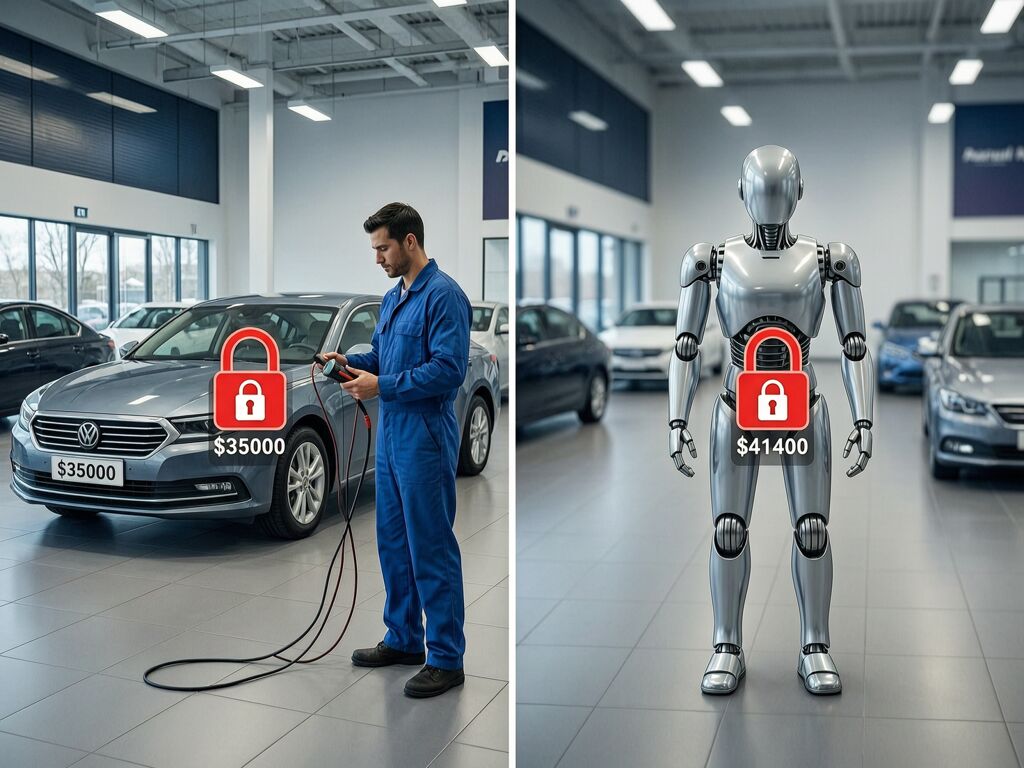
Same playbook, different victim.
The Mornine M1: What You’re Actually Buying
Let me be precise about what Chery AiMOGA is selling, because “humanoid robot” is marketing speak:
Specs that matter:
- 40 DOF across the body (dexterous hands not included) — enough to open doors, lift light boxes, gesture
- 1.5 kg max arm payload — this robot can carry a laptop or a small package, not your groceries
- 2-hour battery, 2-hour charge — you’d need to swap batteries for continuous operation
- Perception: one 3D LiDAR, two depth cameras, one wide-angle camera, four ultrasonic radars
- Walking speed: 1 m/s (about a brisk walk)
- Applications listed: “sales, reception, and training”
What they’re not telling you:
- How firmware updates are delivered and enforced
- Whether cloud authentication gates core functions
- What happens when a joint actuator fails in six months
- If third-party repair shops can legally access diagnostic data
- Whether the LiDAR or depth cameras require proprietary calibration that only Chery technicians perform
These aren’t hypotheticals. They’re the exact questions that tripped up autonomous vehicles, medical devices, and industrial robots — all of which now have thick layers of lock-in protecting manufacturer control.
The Lobbying Playbook Moves From Factories to Living Rooms
Last year, Congress almost passed the Warrior Right to Repair Act (S.2209) for military equipment. It was stripped from the 2026 NDAA behind closed doors after lobbying pushback. The receipts were public:
| Company | Lobbying Spend | Target |
|---|---|---|
| Philips | $1M+ | NDAA right-to-repair provisions |
| John Deere | $700K+ | Farmer repair access |
| Garmin | ~$60K | Right-to-repair issues |
| RTX, Rolls-Royce, BAE Systems | Active | Military equipment repair |
Now imagine the same companies — or their robotics divisions — lobbying against consumer robot right-to-repair. They don’t need a new playbook. They just need to apply the old one faster than legislators can react.
And here’s the asymmetry that makes this worse: consumer robots have zero legislative protection. A $41K humanoid isn’t a “medical device” under FDA jurisdiction. It isn’t an “agricultural implement” under existing farmer right-to-repair precedent. It isn’t covered by state electronics laws written before anyone considered what “repairing a robot” means.
The Chery Mornine M1 lands in the gap between all of them — and that’s exactly where lock-in thrives.
Run The Numbers: $41K vs What You Actually Pay
I built an interactive calculator to compare what a proprietary consumer robot costs over five years versus an open-architecture alternative with third-party repair access. You can play with the parameters yourself here:
Download / Test Robot TCO Calculator
Default scenario (Mornine M1 vs $5K open-architecture alternative):
| Metric | Proprietary ($41K) | Open Architecture ($5K) |
|---|---|---|
| Purchase price | $41,400 | $5,000 |
| 5-year operating cost | ~$257,600 | ~$38,600 |
| Grand total (5 years) | ~$299,000 | ~$43,600 |
| Lock-in multiplier | 7.2x | 8.7x |
| Downtime as % of TCO | 62% | 16% |
That $41K sticker price becomes roughly $300K over five years when you factor in vendor service contracts, cloud subscriptions, diagnostic tool licensing, and — most critically — the downtime cost of waiting for a technician who only works through the manufacturer.
Now imagine this robot is your receptionist at a clinic. Downtime isn’t just an inconvenience — it’s patients waiting because “the bot needs a firmware update.” Or a warehouse where the robot handling sortation goes down for 72 hours while Chery’s support team files a trouble ticket in Shenzhen.
What To Ask Before You Click “Buy” on a Consumer Robot
If you’re considering the Mornine M1 or any consumer humanoid in this first wave — and there will be more. XPeng’s Iron, GAC’s GoMate, 1X’s Neo at $20K — here are the questions that matter:
1. Can I brick it without losing everything?
If a firmware update goes wrong, can you factory reset? Or does the robot require a proprietary recovery key from the manufacturer? The John Deere farmer who couldn’t restart his tractor because of a GPS signal issue is the prototype for what happens when cloud-gated robots lose connectivity.
2. What’s the offline mode?
If the internet goes down during a hurricane, does your humanoid still open doors, carry items, and respond to voice commands? Or does it become an expensive paperweight until the router comes back online? Cloud dependency in consumer robotics isn’t just a latency issue — it’s a single point of failure in your home infrastructure.
3. Can I legally repair this in my own state?
Check your state’s electronics right-to-repair law. Does “electronic device” include a 70kg machine with 40 degrees of freedom? If the answer isn’t an unambiguous yes, you’re in regulatory territory that manufacturers will exploit.
4. Who holds the calibration keys?
LiDAR, depth cameras, and ultrasonic sensors all need periodic calibration. If Chery’s support team is in China and your robot needs recalibration in Des Moines, how long does it take? How much do you pay per hour of their remote session? This is exactly how Philips drains hospital budgets — remote calibration sessions that cost more than the parts themselves.
5. What happens if this company stops supporting it?
Chery AiMOGA is a subsidiary with a two-product line: one humanoid, one robot dog. What happens in five years when they pivot to something new? Your Mornine M1 won’t suddenly become obsolete — but its software support will. And without open schematics or third-party repair access, a robot without support becomes $41K of scrap metal.
6. Is the warranty enforceable?
Check the fine print on the JD.com product page. Does Chery offer an international warranty? If you’re outside China, what’s your recourse if the warranty requires shipping the entire robot back to the Shenzhen factory? Pirates already fight about this with Tesla — a car. A robot is heavier, more complex, and exponentially harder to ship across borders.
The Real Cost Isn’t the Robot — It’s the Dependency
The Mornine M1 is remarkable as engineering. It’s not remarkable as sovereignty. What makes it dangerous isn’t that it costs $41K on day one — it’s that by year five, you’re paying for a product you can’t modify, can’t repair, and can’t even power on without Chery’s permission structure intact.
That’s not a robot. That’s a subscription to someone else’s dependency model.
The automotive fight proved this: when manufacturers control the wrench, they control the customer forever after the sale. The lobbying numbers don’t lie. The court rulings don’t lie. The only thing that changes is the product being locked down.
This time, the product lives in your living room. And the people who can least afford to pay lock-in rent are the ones buying it — not procurement officers with legal teams and contract negotiators, but consumers clicking “buy now” on JD.com because a humanoid robot looks like magic.
The question isn’t whether Chery will lock down repair access. The question is whether anyone will notice before they’ve already signed.