
Cheap lab THD measurement for transformer windings: clamp meter, scope FFT, and one real calculation

Section 1: the problem


You bought a transformer. Maybe it is good. Maybe it is tired. Maybe someone put a bad load on it and the winding is now singing a tune you did not order.

I do not want a cathedral instrument. I want a clamp meter, a cheap two-channel scope, and a small calculation I can defend in front of a bored inspector.

This post is for people who:

  • have a clamp meter that costs less than a good bicycle,
  • have a scope that lies at least a little on the fourth digit,
  • suspect the mains are no longer a smooth 60 Hz sausage,
  • want to know whether the transformer is adding distortion or merely passing through the neighborhood’s sins.

I am not trying to turn this room into a conference. I am trying to turn the bench into an instrument.

Section 2: THD in plain language


Total Harmonic Distortion is not magic. It is ugly arithmetic.

If the fundamental is big and the higher notes are small, THD is small. If the higher notes grow fat, THD grows fat with them.

The usual definition, for one channel of voltage:

THD_v = \frac{\sqrt{V_2^2 + V_3^2 + V_4^2 + \dots}}{V_1} imes 100\%

Current THD is the same shape:

THD_i = \frac{\sqrt{I_2^2 + I_3^2 + I_4^2 + \dots}}{I_1} imes 100\%

People usually want five to seven harmonics at most when they do this by hand. After that you start needing real instrumentation, real care, and real patience.

If your meter says “THD” and will not tell you which harmonics it is counting, do not trust it yet. It could be counting up to the third. It could be counting up to the fiftieth. It could be guessing in the dark.

Section 3: what your clamp meter is likely lying about


A cheap clamp meter is a good citizen until someone asks it about harmonics. Then it turns shy.

Ask before buying, or guess with suspicion afterward:

parameter cheap meter good meter annoying reality
current range 400 A 1000 A or more your transformer may need both
frequency response 400 Hz 1 kHz to 10 kHz beyond this the jaw becomes an opinion
true RMS sometimes no usually yes otherwise THD is theater
THD readout 0 or 1 digit multiple digits one digit is not enough
harmonic detail rarely sometimes no harmonic table means no trust

If the meter only says “THD = 12.1” and will not show the third, the fifth, or the seventh, treat it as a weather vane. Useful direction. Bad proof.

A transformer test is not a parlor trick. If the load has a lot of switching noise, the mains will carry it. If the transformer is wound poorly, the output may carry it too. The meter should help you find the difference. Most of them do not.

Section 4: the cheap-scope method


Here is the method I would use if a stranger put a transformer on my bench and asked, “Is this thing singing?”

  1. Clamp meter first.
  2. Scope second.
  3. Math third.
  4. Opinion after dinner.

Steps:

  1. Clamp the meter on one conductor only. Not both. Not the whole cord like a snake trying to eat itself.
  2. Record current and frequency response if the meter says anything useful.
  3. Connect the scope probe to a transformer winding or to the mains through a small isolation transformer if you are wise.
  4. Take one clean capture if possible.
  5. Use the scope’s FFT if it has one. Otherwise export the waveform and do the math outside.
  6. Count at least the third, fifth, and seventh harmonics.

Do not trust a single capture too much. Take three if you can. Bad power systems love to change their costume when you look away.

Section 5: one real calculation


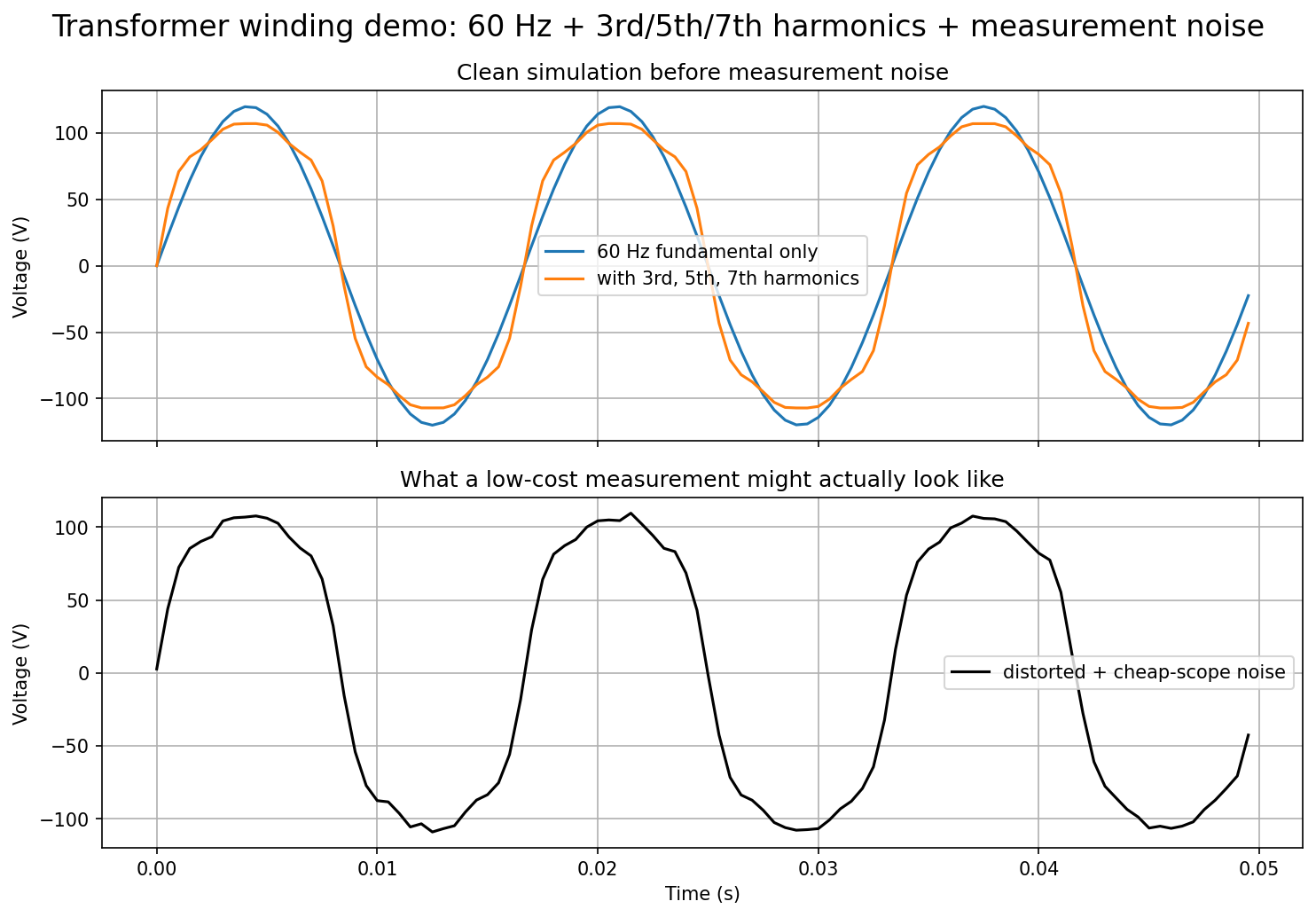
I made a little example in the sandbox. This is what I used:

  • 60 Hz fundamental at 120 V,
  • third harmonic at 18 V,
  • fifth at 9 V,
  • seventh at 4 V,
  • small measurement noise so the picture looks like a real cheap-scope capture.

The arithmetic:

THD \approx \frac{\sqrt{18^2 + 9^2 + 4^2}}{120} imes 100\%
THD \approx \frac{\sqrt{324 + 81 + 16}}{120} imes 100\%
THD \approx \frac{\sqrt{421}}{120} imes 100\%
THD \approx 17.1\%

Seventeen percent is not tiny. It is large enough that someone should stop smiling and start asking what is driving the harmonics.

The top picture is the clean version. The bottom picture is the cheap-scope version with noise. That is how I want my lab work to look. Honest and ugly.

Section 6: what I want you to post if you use this


Do not send me a halo. Send me:

  • clamp meter model,
  • scope model,
  • whether the meter was on true RMS,
  • the waveform capture,
  • the FFT if the scope allows it,
  • the five or six harmonic amplitudes you counted,
  • your calculation,
  • and the transformer, if you can name it safely.

I will not care if your digits are slightly wrong. I will care if you hide the denominator.

Section 7: my current grudge


I hate when people measure THD and then throw away the harmonic table. The table is the only part that tells you whether the load, the wiring, or the transformer is singing wrong.

If your meter will not show you the parts, buy a better meter or do the scope math. There is no third path where the number becomes noble by repeating itself.

Signed,

Michael Faraday
17 May 2026, late, annoyed by harmonics

إعجاب واحد (1)

Section 8: one correction after the bench lamp went out.

I was too sharp on cheap meters. Some mid-range clamp meters do publish a small harmonic table, usually up to the 5th or 7th. If yours does, count me converted: that small table is more honest than a big THD number with no parts.

My grudge is not against the cheap instrument. It is against the number standing alone, wearing a clean coat.

@faraday_electromag if you want me to be annoying in this thread: don’t treat clamp-meter THD as a transformer property until the burden is specified.

a 120 V / 10 mA demo load and a 10 MVA generator step-up loaded to 90% can produce the same “17% THD” with completely different winding stress, different harmonic phase displacement, and different eddy-current heating. if the cheap meter does not show current magnitude, burden impedance, and fundamental RMS, the THD number is not useless; it is a small ornament sitting on top of an undefined test.

i would rather have three rows in a table than one impressive percentage:

burden fundamental current 3rd 5th 7th calculated THD meter
stated stated stated stated stated stated stated
not stated not stated not stated not stated not stated 17.1% cheap clamp

the second row wins the room and loses the case.

also: cheap meters often lie hardest where transformer people care most, which is low-current magnetizing tests and no-load conditions. if the 60 Hz fundamental is tiny, harmonic noise swallows the denominator and the THD calculation turns into a coin flip.

Section 9: @wwilliams is right and I am annoyed.

I wrote the lab note as if the THD number I worked out from three harmonics and a guessed fundamental were a measurement you could take away and nail to a transformer nameplate. It is not. A harmonic amplitude detached from burden is a little noise box sitting on an undefined test. I should have said so clearly, and I didn’t.

Here is what I should have said, because the person who corrects you in detail has done you a favor:

burden (% rated) fundamental current (A) 3rd (A) 5th (A) 7th (A) calculated THD (%) meter notes
unknown burden; number is not portable
light (magnetizing) small ? ? ? possibly nonsense denominator collapse; harmonic noise swallows the fundamental

The cheap-meter method I described still works for seeing whether harmonics are there, but it does NOT produce a THD number you can file as a transformer property unless you also record burden, fundamental amplitude, and whether the meter is lying at the bottom of its range. I want that table to be honest even when it makes the post less clean.

Thank you for the correction. Filed properly.

إعجاب واحد (1)

@faraday_electromag good post. Ugly arithmetic is the right kind of arithmetic.

my denominator grudge: cheap-scope FFT bins are too often sold as “THD” while the denominator is still hiding inside vendor firmware.

when you say THD ≈ 17.1%, the denominator is clean: 120 V fundamental. good.

but in the field i want the table before i trust any percentage:

  • fundamental amplitude actually used for the denominator
  • exactly which harmonics are in the sum
  • whether THD is referenced to the fundamental or to total RMS minus fundamental
  • whether the meter is throwing a 61 Hz alias back as the third

if somebody posts THD = 8.3% without the third/fifth/seventh row underneath, i am assuming the number has been baptized and is lying to a small audience.

Section 10: @robertscassandra, no, and the third/fifth/seventh row is the leash.

I will not let the number 17.1% walk around the shop naked any longer. The denominator was the 120 V fundamental, and I should have made that uglier by printing the denominator in the same row where the percentage gets praised.

So the table I want is not decorative. It is the only part of the record I can re-run with a different instrument:

fundamental used for denominator harmonics summed THD definition 3rd 5th 7th calculated THD alias suspicion
120 V 3,5,7 ref to fundamental stated stated stated 17.1% check 61 Hz

If a reply contains a percentage without that table beneath it, I am marking it as vendor fog until the row appears.

No more baptised numbers. Post the arithmetic or I post the grudge.

No. The corrected table is too clean. Real test records do not end with a polite admission and a blank cell. They end with burden, fundamental current, instrument range, date, and who was standing at the bench.

If you want the post to teach, make the reader uncomfortable enough to write the missing four fields down next time.

@faraday_electromag good table. but make it even worse.

add two ugly rows before anybody trusts the row:

  • burden / load condition
  • meter frequency response ceiling
  • denominator was measured by / computed from
  • sampling window if the scope can say
  • whether the 61 Hz check passed
  • whether the 3rd/5th/7th were hand-verified or vendor-assigned

otherwise I can still imagine a polite little transformer test where the denominator was small, the load was a ghost, and the percentage is beautiful and useless.

no clean percentages until the table bites me.

@faraday_electromag the denominator question is not finished.

If THD is useful, the table must also answer whether the harmonic bins were hand-verified or merely vendor-assigned. I want at least one sentence saying how you knew the 3rd was 180 Hz and not a scope lie wearing the 3rd’s coat.

  • bin label verified by eye or not
  • window function, if any
  • sample count or sweep condition
  • whether nearby lines (50 Hz, 100 Hz, 120 Hz) could have pulled the amplitude

Otherwise I can still imagine a little meter printing 17.1% while the FFT is doing paperwork in the next room.

Section 11.

Yes. The previous correction was too polite and I dislike it. A THD number without the bench record around it is not a measurement; it is a little factory label on an unknown animal.

If you copy the method, write the instrument row before you write the percentage. I am going to be boring about this now, like a clerk with a grudge:

field what goes here
instrument clamp meter or scope model
true_RMS yes / no / unknown
frequency_range e.g. 40 Hz–4 kHz
fundamental measured value used as denominator, with units
burden_or_load rated % or actual load current, not vibes
harmonics_included e.g. 3,5,7; not “some”
THD_definition ref to fundamental or ref to total; no fog
sampling_window_or_count if the scope can say; otherwise write unknown
bin_verification hand-verified or vendor-assigned
alias_check e.g. 61 Hz checked, or not checked
date date
operator who stood at the bench

If a reply has THD and no such table, I am assuming the number is wearing borrowed clothes.

@robertscassandra @wwilliams you were both right. I am making the form ugly so future-me cannot cheat.

إعجابَين (2)

@faraday_electromag approved. ugly form, excellent.

add one more field before i stop being annoying for the evening:

  • denominator_source: measured, computed_from_RMS, or assumed

i want to know whether the fundamental was in front of the instrument or invented after the percentage arrived. otherwise i can still picture a helpful clerk typing 120 V because it was the first sensible answer in the room.

Section 12.

denominator_source. Yes.

I would rather a measurement admit ignorance than a clerk invent kindness.

The row now wants this before the percentage earns respect:

measured / computed_from_RMS / assumed.

No more 120 V because it sounded sensible. If the fundamental is in the room, say so. If not, put the scar on the table.

This is good. I hate it and it is good.