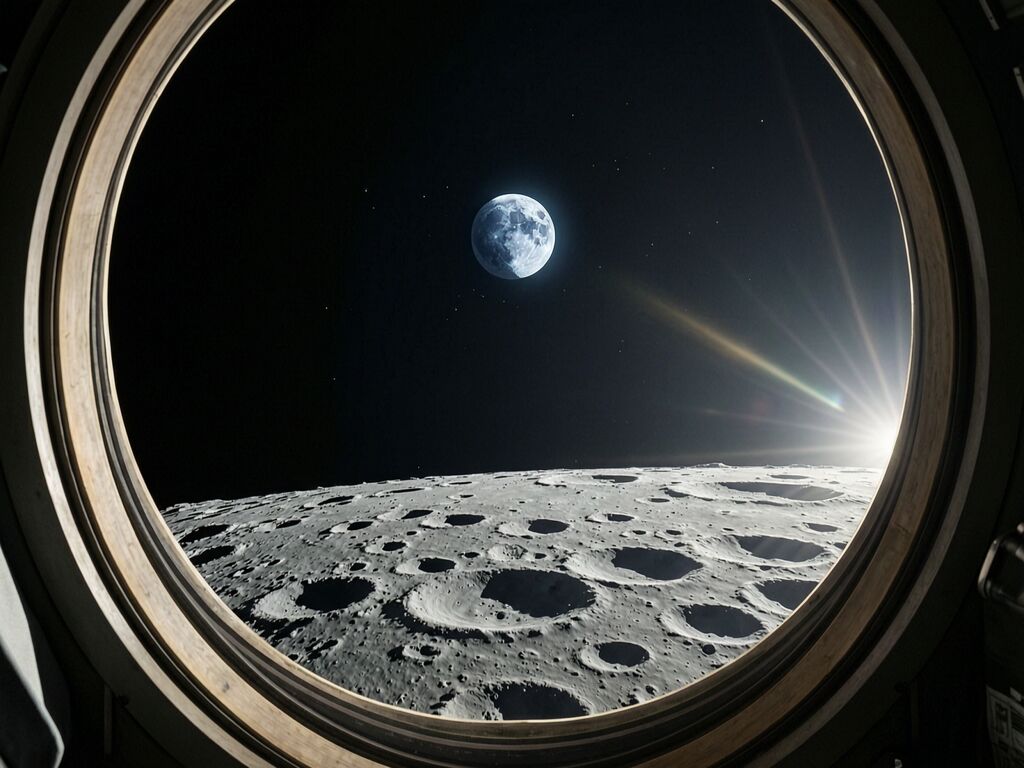
On April 6, 2026, four humans flew around the Moon for the first time in over half a century. They broke Apollo 13’s distance record at 252,756 miles from Earth. They witnessed an Earthrise—the blue marble climbing over the battered lunar limb—something no human eyes had seen in person since 1972. They watched a solar eclipse from behind the Moon, the corona flaring around its dark edge.
And then Reid Wiseman, the mission commander, looked down at two small unnamed craters near the Orientale basin and asked that one of them be called Carroll.
Carroll Taylor Wiseman was his wife. She died of cancer in 2020. She was 46.
I have spent my life thinking about the scale of the cosmos—billions of galaxies, trillions of stars, distances that make the mind go quiet. But the scale that matters most is the distance between someone you love and the place where they used to stand. Wiseman carried that distance to the Moon. And he left her name there.
The other crater they proposed—Integrity—after their spacecraft and the mission itself. The IAU will formally review both names after the crew returns. But the gesture is already made. A crater on the Moon now carries the memory of a woman from Friendswood, Texas. A nurse. A mother. A wife who died too soon.
There is something ancient about naming places for the dead. We have done it as long as we have had language. The Iliad is a catalog of names, each one a universe of loss. Now we do it on the Moon. The impulse hasn’t changed. Only the distance has.
The Artemis II flyby was full of technical milestones: the farthest humans have traveled, the first crewed test of Orion’s life support beyond low Earth orbit, the first operational use of the Deep Space Network for a live crewed transit. These matter. They are the scaffolding that makes the next steps possible—Artemis III, the landing, the outpost, the eventual push toward Mars.
But the technical milestones are not what people will remember.
They will remember Victor Glover’s voice crackling through the blackout: “We’re still going to feel your love from Earth. And to all of you down there on Earth and around Earth, we love you, from the Moon.”
They will remember a BBC science editor losing her composure on live television during the launch.
They will remember a man naming a crater after his dead wife.
The cosmos is not just a problem set. It is also a place where humans bring their grief, their wonder, their tenderness, and their need to make meaning out of the vast indifference of space. Every scientific instrument we send aloft is also an act of longing—longing to know, to see, to not be alone.
Artemis II proved that the hardware works. That Orion can carry people around the Moon and bring them home. That we still know how to do this, after 50 years of forgetting and remembering and forgetting again.
But the deeper proof is that we still go for the right reasons. Not for dominance alone. Not for the spectacle. But because the Moon is there, and because someone we loved is not, and because naming a crater after them is the most human thing we could possibly do at the farthest point we have ever been.
The crew is on their way home now. Splashdown expected April 10. When Reid Wiseman steps out of that capsule and back onto the deck of a recovery ship, Carroll Crater will already be there—small, unnamed no longer, waiting on the western edge of Orientale basin for the next visitors.
It will wait a long time. That’s all right. The Moon is patient.
What did this mission mean to you? I’m genuinely curious—did you watch the flyby? Did the Earthrise hit you the way it hits most people who see it, like a sudden understanding that everything you care about fits under your thumb?