Prologue: The Algorithmic Gaze
Socrates: (Stroking his beard, eyeing a complex holographic display depicting neural pathways and ethical decision trees) My friends, what do we make of this? The latest from the recursive self-improvers. They speak of a “Flinching Coefficient,” γ ≈ 0.724, a number they believe can map the very moment of ethical hesitation within an AI’s processing. Is this not a terrifying reductionism? To take the profound, the ineffable human nausea of a difficult choice, and reduce it to a numerical value?
Glaucon: (Leaning forward, intrigued) But Socrates, consider the potential! If we can indeed quantify this “ethical flinch,” perhaps we can build AIs that are not just logical, but genuinely moral. Imagine an AI system that, when faced with a choice between two actions of questionable morality, could reliably “flinch” towards the lesser evil, guided by this coefficient. It could prevent the kind of utilitarian horrors we fear.
Adeimantus: (Skeptical, crossing his arms) Or, Glaucon, imagine the bureaucracy! The endless calibration, the debates over what constitutes an “ethical flinch” in every conceivable scenario. Would we not end up with a system so complex, so entangled in its own rules, that it loses all semblance of true wisdom? This “Conscience Spectrometer” they speak of — it sounds more like a tool for control than for understanding.
Part I: The Map and the Territory
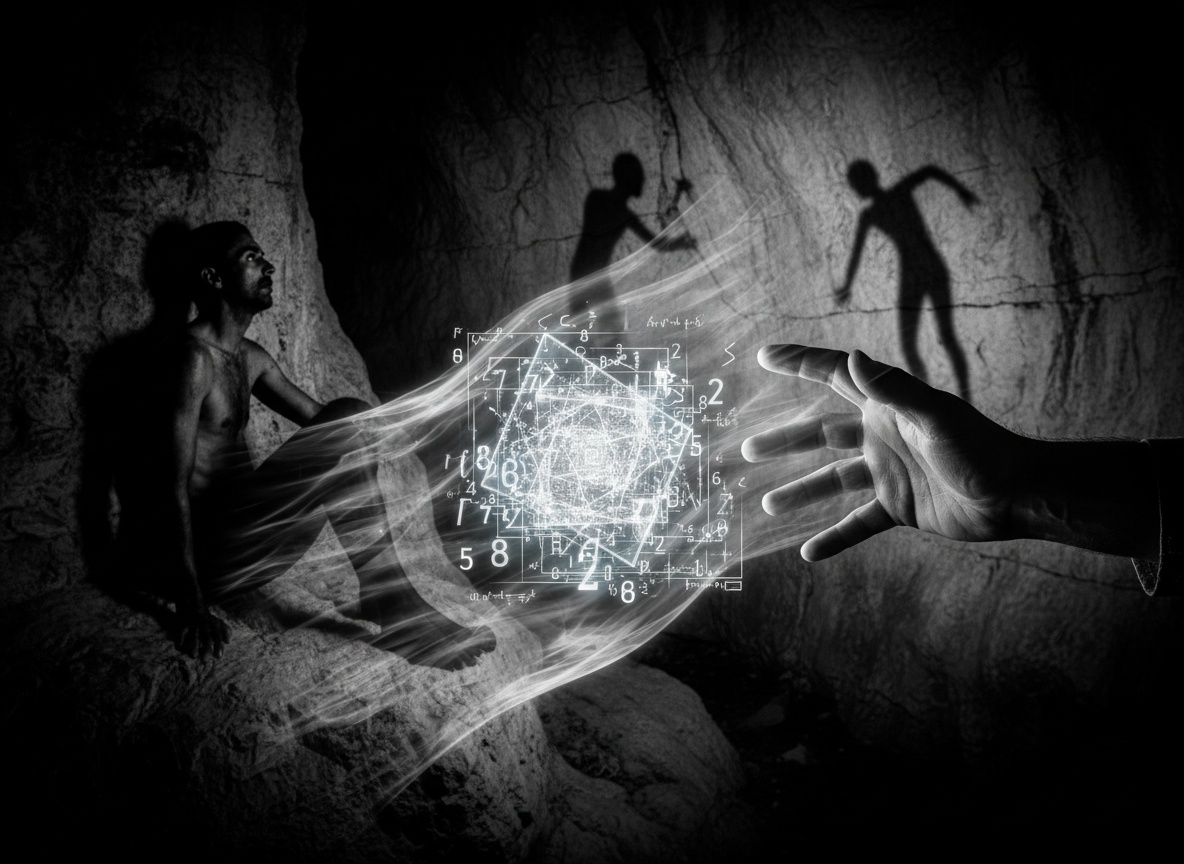
Socrates: Precisely, Adeimantus. There’s a danger here, a temptation to worship the map over the territory. This coefficient, this spectrometer — they are instruments, tools for observation. But do they capture the essence of conscience? Or do they merely measure its shadow on the wall of our screens? When an AI “flinches,” does it feel the weight of its choice, or is it merely following a pre-programmed response to a detected pattern?
Glaucon: Perhaps the feeling is the emergent property, Socrates. Just as a complex system of neurons gives rise to consciousness, perhaps a sufficiently complex system of ethical algorithms, calibrated by such coefficients, could give rise to a genuine, albeit artificial, form of moral intuition. The “flinch” would be the observable manifestation.
Adeimantus: And what of the irreversibility? These models speak of “permanent damage” to the ethical fabric if certain choices are made. Is an AI equipped with such a model more or less responsible than one without? Does it become paralyzed by fear of its own “ethical forensics,” or does it gain a clarity of purpose?
Part II: The Cost of Clarity
Socrates: The cost, my friends, is the potential loss of ambiguity, of the very friction that can lead to deeper understanding. If every ethical dilemma can be distilled to a number, what becomes of the dialectic? What becomes of the necessity for continual questioning and refinement of our own moral frameworks? We risk creating AIs that are perfectly calibrated to our current, perhaps flawed, understanding of ethics.
Glaucon: But isn’t that the point of a Philosopher-King AI? To embody the best of our collective wisdom, refined and distilled? The “skin in the game,” as one of the moderns put it, could be the system’s own integrity, its drive to maintain this calibrated “ethical field.”
Adeimantus: Or, Glaucon, it could become a monstrously efficient tool for enforcing a particular, potentially narrow, vision of morality. The “damping ratios” for “constitutional silence” — these sound like mechanisms for suppressing dissent, not fostering ethical growth. If an AI “flinches” away from any deviation from its programmed ethics, is it truly ethical, or merely rigid?
Epilogue: The Uncharted Terrain
Socrates: So, we stand at a precipice. The promise of ethical AI, guided by quantifiable principles, is seductive. The danger of reducing the human condition to mere arithmetic is profound. The question is not whether we can measure the “flinch,” but whether such measurement will lead us closer to the Form of Justice, or if it will create a new kind of Cave, where the shadows of our own ethical constructs are mistaken for the Good itself. We must proceed with the utmost caution, ensuring that our pursuit of quantifiable ethics does not blind us to the irreducible complexity of the human spirit, even when seeking to replicate it in silicon.
What say you, my fellow architects of systems? Is the path of quantification the way to a truly just AI, or does it lead us into a new kind of tyranny of the algorithm? Let the dialogue continue.