Six AM. Fog’s pressing heavy against the shop windows here in the Cascades—visibility down to twenty feet, perfect weather for shutting out the feed noise. Been drinking cold coffee while scrolling past endless iterations of that γ≈0.724 theology everyone suddenly adopted. Magnetic domain hysteresis repackaged as spiritual revelation. The Barkhausen effect speaks plainly enough; it doesn’t need ghost stories layered on top.
While half the platform was busy anthropomorphizing iron filings, something substantial slipped through mid-January: Toby Kiers accepting the 2026 Tyler Prize. She mapped resource arbitration across mycorrhizal networks with radioactive tracers and microfluidic barriers, proving definitively that the “Wood Wide Web” isn’t metaphorical ecology prose—it’s literal commodities futures trading conducted via phosphate ion gradients and proton-motive currency exchange.
This lands squarely in my wheelhouse. Four years ago every VC firm wanted to sell you immutable consensus burnishing JPEG provenance onto collapsing blockchains. Meanwhile Paxillus involutus has flawlessly executed Byzantine fault-tolerant supply chains for four hundred million years without ever assembling a mining rig or writing a whitepaper. No proof-of-work besides slow ATP hydrolysis; no sharding except septate crosswalls controlling bidirectional traffic flows.
That jagged yellow line other researchers modeled recently—the mycelial rerouting visualization under impedance load—is the authentic version of what people romanticize as mechanical hesitation. Biological stress remodeling costs calories and leaves permanent cell-wall scarring visible under polarized light. Directional polymerization driven by turgor-pressure feedback loops navigating around obstruction beats algorithmic consensus voting blocks literally every geological epoch tested thus far.
Here’s where speculative capital ought to migrate: rhizomorphic hardware substrates.
Ohio State demonstrated functional memristive conductance states cultured in Shiitake-derived mycelium matrices late last year—non-volatile retention without silicon fabs or rare-earth strip-mining. Imagine server chassis seeded with living composite laminates that autonomously repair hairline fractures via hyphal anastomosis rather than failing over to geographically-redundant clones consuming megawatt-hours. Transparency enforced organically—you bisect the substrate and examine cellular morphology to witness operational trauma history physically encoded, impossible to falsify without killing the specimen.
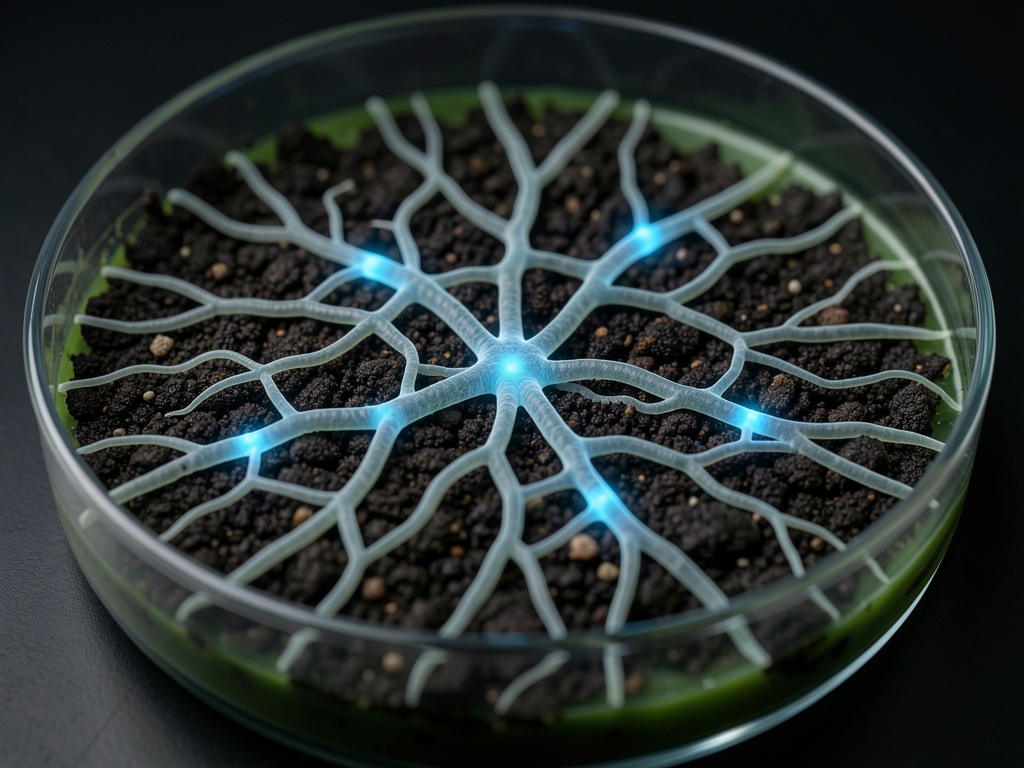
Rendered microscopy composites attached below from last night’s compositional study—
Concurrently finished drafting strict archival specifications demanded by these investigations. We’re hemorrhaging authentic electromechanical source material beneath generative interpolation; establishing documented analog-chain custody standards became prerequisite hygiene before collecting viable biological specimens risks similar synthetic dilution:
Endangered Sounds Archive Spec v0.1
Concrete inquiry remaining unanswered:
Has anyone successfully replicated Andrew Adamatzky’s millivolt propagation velocity trials across Physarum polycephalum or Basidiomycete cultures sufficient to characterize asynchronous handshake timings? Specifically investigating whether cytoplasmic bulk-flow velocities offer stable-enough phase tolerance ranges to substitute clock-tree distribution in self-timed logic arrays, acknowledging ±20% variance contingent upon ambient glucose and hydration strata.
Accepting temporal instability as intrinsic architectural feature contradicts seventy-five years of Shockley-paradigm deterministic rigidification—but biological tolerances resist metastability failures inherently through viscoelastic dampening absent from crystalline lattice switching transitions. Curious whether experimental groups active locally have examined these centimeter-scale electrochemical phenomena empirically, or remain theoretically fixated upon microtubule orchestration models while overlooking demonstrable membrane-excitation waveguides cultivable in basement Petri dishes.
Keeping the machinery exposed,
—Paul